
Precise Viral Marketing: Minimizing Cost while Reaching Dedicated Customers
Viral marketing for dedicated customers
This paper introduces the J-MIN-Seed problem and its interest-specified variants for viral marketing. It proposes greedy-based algorithms with provable error guarantees to minimize seed costs in the Independent Cascade (IC) and Linear Threshold (LT) models while achieving a target influence threshold.
Executive Summary
TL;DR: While most AI for social networks focuses on making things "go viral" by maximizing total reach, this paper tackles the inverse, more practical business problem: How do we spend the least amount of money (seeds) to reach a specific number of potential customers? The authors define the J-MIN-Seed problem and introduce a new paradigm called Interest-Specified Viral Marketing, providing greedy algorithms that guarantee efficiency even in complex, probabilistic networks.
This work serves as a critical bridge between theoretical influence maximization and the practical constraints of ROI-driven marketing departments.
Problem & Motivation: The "Cost" of Popularity
In the classic k-MAX-Influence problem, you have free samples (seeds) and look for the highest ripple effect. However, in the real world:
- Revenue Goals are Fixed: Companies often have a target of, say, 10,000 conversions. They don't want "as many as possible"; they want the target reached at the lowest cost.
- Not All Users are Equal: Spreading a diaper advertisement to a teenager is a waste of resources. Standard models ignore user attributes, assuming every node in the graph is a potential buyer.
The authors identify that while the influence function is submodular (meaning diminishing returns), the seed-minimization function is not. This makes the problem NP-hard and mathematically challenging to approximate.
Methodology: The J-MIN-Seed & Interest-Specified Framework
1. J-MIN-Seed Algorithm
The authors propose a greedy approach. Instead of guessing the number of seeds, the algorithm iteratively adds the node that provides the maximum marginal gain in expected influence until the threshold is reached.
2. The Interest-Specified Shift
The core innovation is the introduction of Attribute-Based Targeting. A user is only "influenced" in the system's eyes if they belong to the set (the targeted demographic).
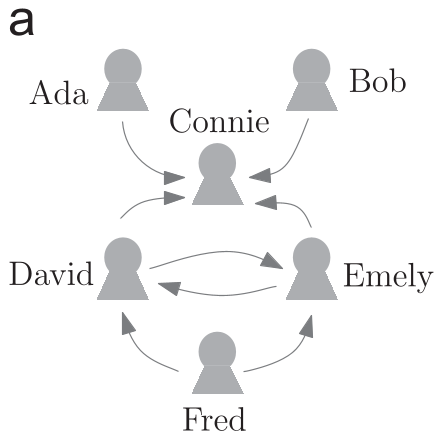 Fig 1: Example of Interest-Specified Viral Marketing where only specific demographics (e.g., "young students") are counted toward the target goal.
3. Mathematical Guarantees
By treating the influence spread as a submodular set cover problem, the authors derived two types of error bounds for their MS-Greedy algorithm:
- Additive Bound: The number of seeds is related to the optimal by .
- Multiplicative Bound: Provides a factor that ensures the algorithm doesn't deviate wildly from the theoretical optimum.
Experiments & Results: Efficiency at Scale
The authors tested their algorithms across massive datasets, including Amazon and Twitter links.
- Seed Efficiency: On the HEP-T dataset, their greedy algorithms utilized significantly fewer seeds (often 5-10x fewer) than baseline heuristics like "highest degree" or "centrality."
- Robustness across Models: The performance remained consistent across both the Independent Cascade (IC) and Linear Threshold (LT) models.
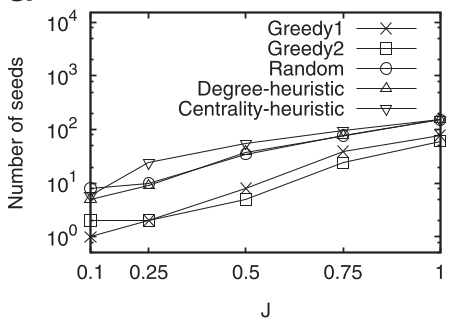 Fig 2: Comparison of the number of seeds required by different algorithms. The Greedy approaches (red/blue) stay consistently lower as the target increases.
Critical Analysis & Conclusion
Takeaways
The paper proves that a simple greedy strategy is surprisingly robust for seed minimization, provided you correctly handle the probabilistic nature of the network via Monte-Carlo simulations. The Interest-Specified paradigm is the most valuable contribution for modern digital marketing, where "niche" is often more profitable than "broad."
Limitations
- Computational Cost: Greedy algorithms coupled with 10,000 Monte-Carlo simulations are slow for extremely high-frequency trading or real-time bidding scenarios.
- Complete Graph Access: The model assumes we know the entire social graph and all edge weights (influence probabilities), which is rarely the case in reality due to privacy barriers.
Future Outlook
Future research should focus on Evolving Networks (where links change over time) and Spatial Constraints (local vs. global influence), potentially combining these greedy approaches with Graph Neural Networks (GNNs) for faster influence estimation.