
PMDG: Why Maximizing Influence Isn't the Same as Maximizing Profit
Viral Marketing for Digital Goods in Social Networks
The paper formalizes the Profit Maximization for Digital Goods (PMDG) problem in social networks, shifting the focus from mere influence spread to net profit. It identifies the problem as an unconstrained non-monotone submodular maximization task and applies an O(N+M) randomized algorithm achieving a 1/2-approximation guarantee, alongside a novel Profit Discount heuristic.
TL;DR
Researchers from Nanjing University have bridged the gap between social influence and actual revenue. By modeling the viral marketing of digital goods as an unconstrained non-monotone submodular maximization problem, they demonstrate that "more influence" doesn't always mean "more money." They provide a linear-time algorithm with a 1/2-approximation guarantee and a hyper-efficient "Profit Discount" heuristic that scales to large social networks.
Problem & Motivation: The "Free Sample" Paradox
In classical Influence Maximization (IM), the goal is simple: pick people to maximize the buzz. But in the real world of digital goods (apps, e-books, music), the marginal cost of production is zero, but the opportunity cost is not. If you give a "seed" user a free copy, you lose the revenue you would have made if they had bought it.
The authors argue that the optimal number of seeds shouldn't be a fixed . Instead, it should be the point where the marginal profit from viral spread exactly equals the marginal loss of giving away the product. This makes the objective function non-monotone: adding more seeds eventually leads to a decrease in total profit.
Methodology: Taming Non-Monotonicity
The paper defines the profit function as: Where is the set of all activated users and is the seed set.
1. Theoretical Grounding (The Double Greedy)
The problem is NP-Hard. To solve it, the authors adopt a Deterministic and a Randomized algorithm from theoretical computer science. These algorithms maintain two sets ( and ) and process nodes in a single pass. By comparing the marginal gains of adding a node to vs. removing it from , they achieve a robust 1/2-approximation in time.
2. The Profit Discount Heuristic
For practical applications, they propose a heuristic that "discounts" the value of a seed if its neighbors are likely to be influenced by other seeds anyway. This prevents "influence overlap" and ensures that every free sample given away is working efficiently to reach new, uninfluenced clusters.
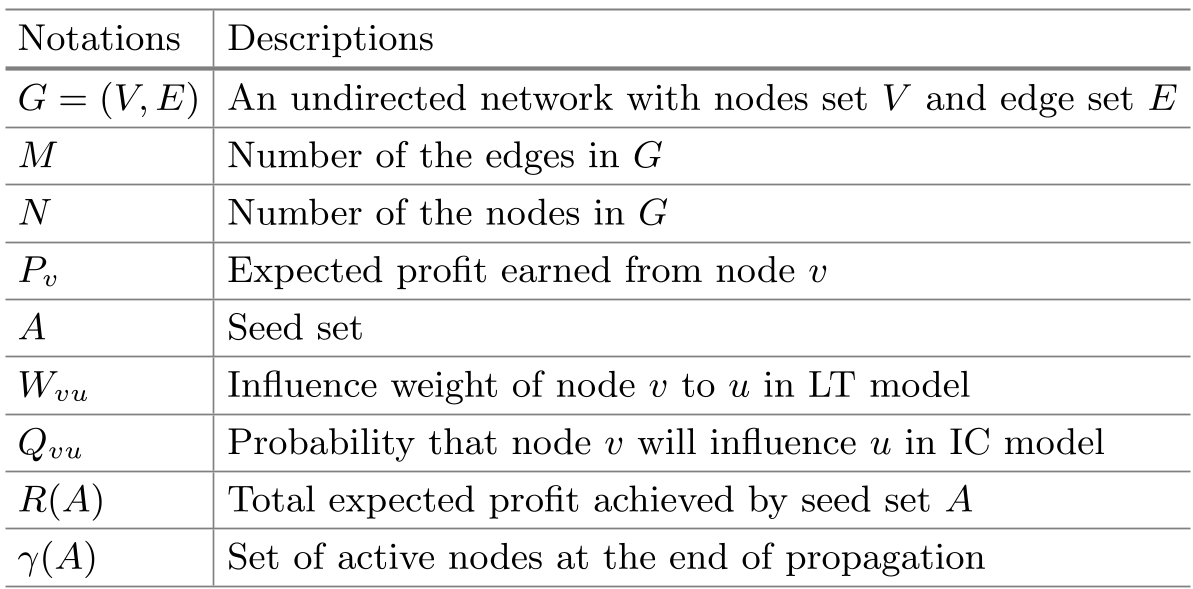 Table 1: Key notations defining the viral marketing mechanism under LT and IC models.
Experiments & Results
The authors tested their methods on Arxiv collaboration networks. The results confirm a critical insight: as connectivity increases, the optimal number of seeds decreases. In a highly connected "small world," a few strategic seeds can trigger a massive cascade, making extra free samples a waste of money.
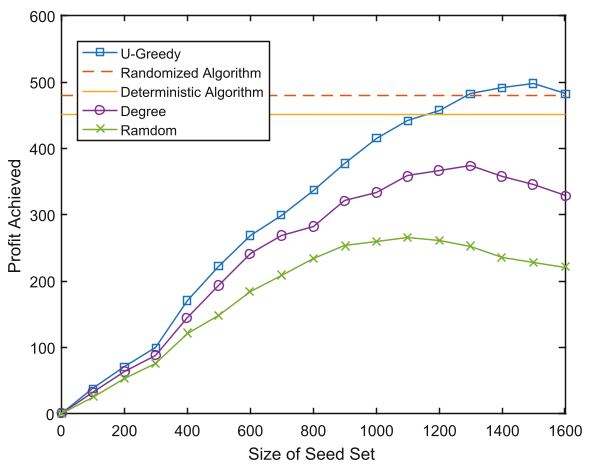 Performance of different algorithms: The Profit Discount and Randomized methods track closely with the costly U-Greedy while maintaining much higher speed.
Efficiency Benchmark
The speed advantage is staggering. While the standard Greedy approach (U-Greedy) takes nearly 40 seconds on moderate datasets due to heavy Monte-Carlo simulations, the Profit Discount heuristic finishes in 0.1 seconds.
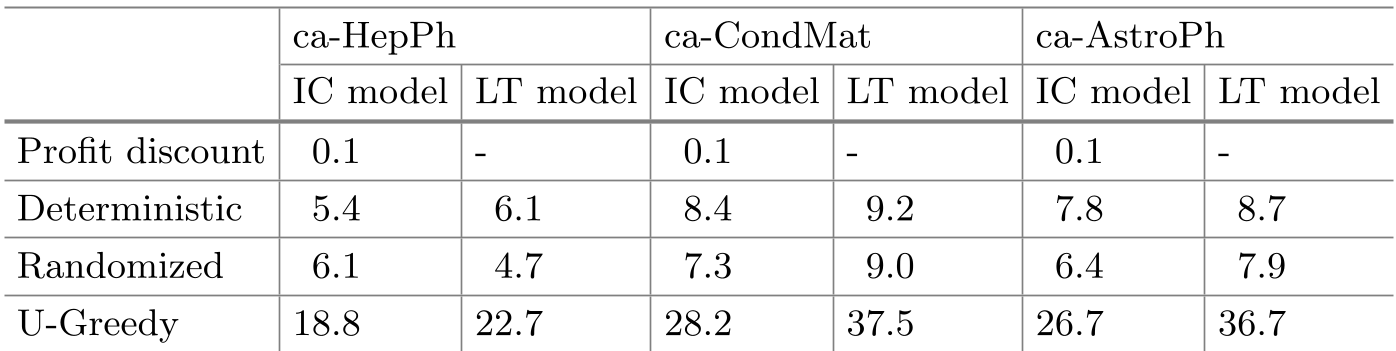 Table 3: Comparison of wall-clock time showing the superiority of the heuristic and linear-time approximation methods.
Critical Analysis & Conclusion
Takeaway
The paper effectively shifts the viral marketing paradigm from "maximum reach" to "optimal ROI." For platforms like Steam or the App Store, this suggests that the strategy of "Temporary Free" sales should be targeted at specific network clusters rather than the whole population.
Limitations
- Static Network: The model assumes the social graph is static, whereas real social connections flux over time.
- Uniform Valuation: While profit is modeled with a distribution, the model doesn't fully account for "strategic" users who might wait for a free sample if they know a campaign is running.
Future Outlook
The authors point toward Algorithmic Game Theory as the next frontier—understanding how self-interested users might manipulate the market to get free digital goods, and how marketers can design "truthful" mechanisms to counter this.