
Competitive Viral Marketing: Balancing Maximum Reach with Information Secrecy
A new viral marketing strategy with the competition in the large-scale online social networks
This paper introduces the Influence Maximization while Limited unwanted target users (d-IML) problem, aimed at maximizing information spread in social networks within d-hops while keeping "unwanted" users below a leakage threshold. The authors utilize the Locally Bounded Diffusion (LBD) model and propose a Meta-Heuristic (MH) algorithm that outperforms traditional greedy and max-degree approaches.
TL;DR
In the modern social media landscape, viral marketing isn't just about reaching everyone—it's about reaching the right people while avoiding "unwanted" targets like competitors. This paper defines the d-IML problem (Influence Maximization while Limited unwanted), proves its NP-completeness, and introduces a Meta-Heuristic (MH) algorithm that balances reach and leakage better than standard greedy methods.
Problem & Motivation: The "Spy" in the Social Network
Most Influence Maximization (IM) research stems from the seminal work of Kempe et al. (2003), which treats every new "active" user as a win. However, the authors of this paper identify a critical real-world gap: Competitive Friction.
Imagine Company A launching a secret marketing campaign. They want to influence as many potential customers as possible, but they want to keep the strategy hidden from Company B’s employees for as long as possible. If Company B’s users are activated (receive the information), they might launch counter-campaigns. Existing IM models fail here because they lack a "privacy" or "unwanted" constraint.
Methodology: The Locally Bounded Diffusion (LBD) Approach
The authors utilize the Locally Bounded Diffusion (LBD) model, where a node becomes active if its number of active neighbors exceeds a specific threshold defined by an influence factor .
The d-IML Formulation
The goal is to select a seed set of size to maximize total active users within hops, subject to: for all unwanted users .
Basically, the information leakage to each unwanted user must stay below a defined threshold .
The Meta-Heuristic (MH) Algorithm
While the authors provide an Integer Linear Programming (ILP) formulation for optimal solutions, it is computationally too expensive for large networks. Instead, they propose a novel heuristic function :
This function is brilliant in its simplicity: it prioritizes nodes with high marginal gain () but heavily penalizes them if they contribute to the normalized leakage level () of unwanted users.
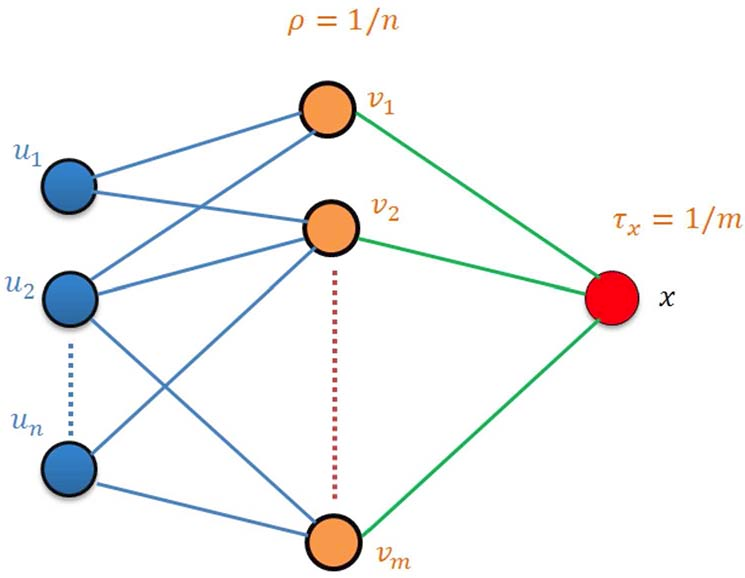 Fig 1: The reduction from Maximum Coverage to 1-IML, proving the problem's complexity.
Experiments & Results
The researchers tested their methods on two primary datasets: arXiv-Collaboration (scientific co-authorship) and Gnutella (P2P file sharing).
Solution Quality vs. ILP
Because the d-IML problem is not purely submodular due to the leakage constraints, the standard Greedy Algorithm (GA) often gets stuck. The Meta-Heuristic (MH) consistently outperformed both GA and the high-degree heuristic.
- Performance: As the budget grows, the gap between MH and other methods widens, showing MH's superior selection logic in tight-constraint scenarios.
- Optimality: Compared to the ILP (solved via CPLEX), MH achieved roughly 64% to 80% efficiency of the theoretical optimum, which is impressive given its polynomial-time execution.
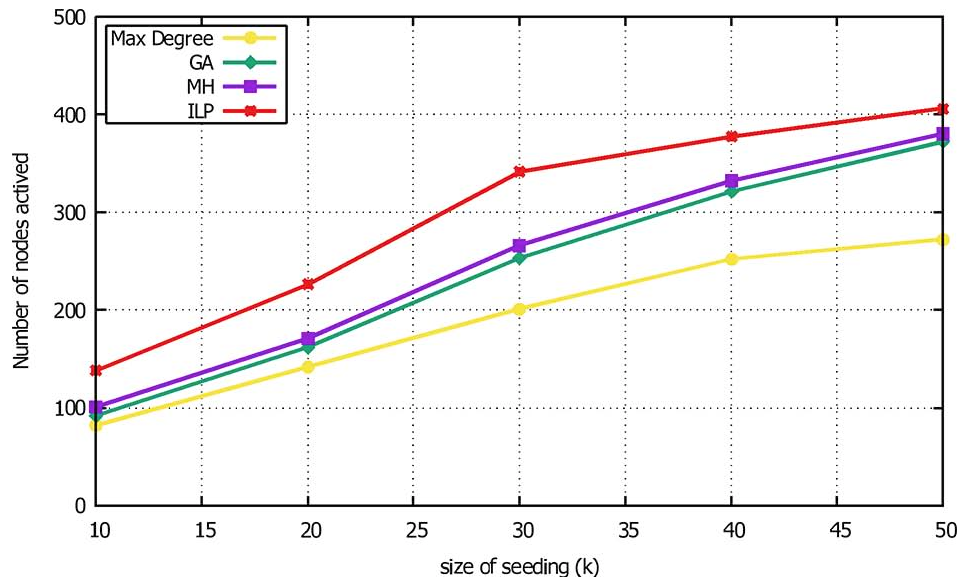 Example of influence spread growth vs. seed set size k.
The Role of Influence Factor (ρ)
The experiments showed that as (the threshold for activation) increases, the diffusion "hardens." Activation counts dropped from ~1000 to below 400 as moved from 0.2 to 0.6. This highlights that in a competitive environment, the intrinsic "resistance" of the network to new information is a dominant factor.
Critical Analysis & Conclusion
Takeaway
The d-IML problem is a necessary evolution of the Influence Maximization task. By acknowledging that some users are "toxic" to our goals, the authors provide a framework more suited for corporate strategy, political campaigning, and secure information dissemination.
Limitations
- Static Constraints: The leakage threshold is static. In reality, unwanted users might actively change their thresholds or behavior if they detect a campaign.
- Dataset Scale: While arXiv and Gnutella are standard, they are small compared to modern Facebook or X (Twitter) graphs. The scalability of the MH evaluation (calculating marginal gain for every node) remains a bottleneck for billion-scale edges.
Future Outlook
The next step for this research would be Dynamic d-IML, where unwanted users act as "blockers" in real-time, or applying this to Multi-agent Reinforcement Learning (MARL), where two organizations compete to influence the same network simultaneously.