
VIRO: Escaping the Local Maxima Trap in Mobile Social Networks with Ricci Flow
VIRO: A virtual routing method for eliminating dead end in Opportunistic Mobile Social Network
This paper introduces VIRO, a virtual routing method designed to eliminate the "dead end" problem in Opportunistic Mobile Social Networks (MSNs). By employing Discrete Ricci Flow and conformal mapping, it transforms local utility-based topologies into virtual geometric maps to ensure continuous data forwarding, achieving up to a 42% increase in delivery ratio.
TL;DR
In the world of Opportunistic Mobile Social Networks (MSNs), data packets often reach a "dead end"—a node that has the highest social utility in its immediate vicinity but isn't the destination. This paper introduces VIRO, a virtual routing strategy that uses Discrete Ricci Flow and Conformal Mapping to reshape the virtual geometry of the network. By mathematically eliminating "holes" and local maxima, VIRO boosts delivery success rates by up to 42% with minimal overhead.
The Problem: The "Greedy" Dead End
Most MSN routing protocols (like PROPHET or BubbleRap) operate on a simple "Greedy" principle: If you meet someone who has a higher chance of meeting the destination than you do, give them the packet.
While intuitive, this leads to a classic optimization failure: Local Maxima. A packet might reach a highly socially active node (a "local celebrity") who happens to have no better contacts for a specific destination. The packet stays stuck there until it expires. Existing data suggests up to 20% of messages in popular traces like MIT Reality fall victim to this phenomenon.
Methodology: From Social Utilities to Virtual Geometry
The authors' core insight is that if we can't find a path in the social utility space, we should transform that space into a geometric one where "dead ends" are mathematically impossible.
1. Geometric Conversion and Triangulation
First, VIRO converts abstract utility values into "virtual distances." It constructs a local map where the carrying node is at the origin (0,0) and the destination is on the X-axis. Using Delaunay Triangulation, it builds a planar mesh of the local topology.
2. The Magic of Discrete Ricci Flow
The most sophisticated part of VIRO is the application of Discrete Ricci Flow. In differential geometry, Ricci Flow is used to deform a metric to achieve a constant curvature.
- The Goal: Transform the mesh so that every internal vertex has a curvature of zero (flattening it) and boundary vertices form a circular shape.
- The Result: Ricci Flow ensures that every triangle in the resulting map is acute.
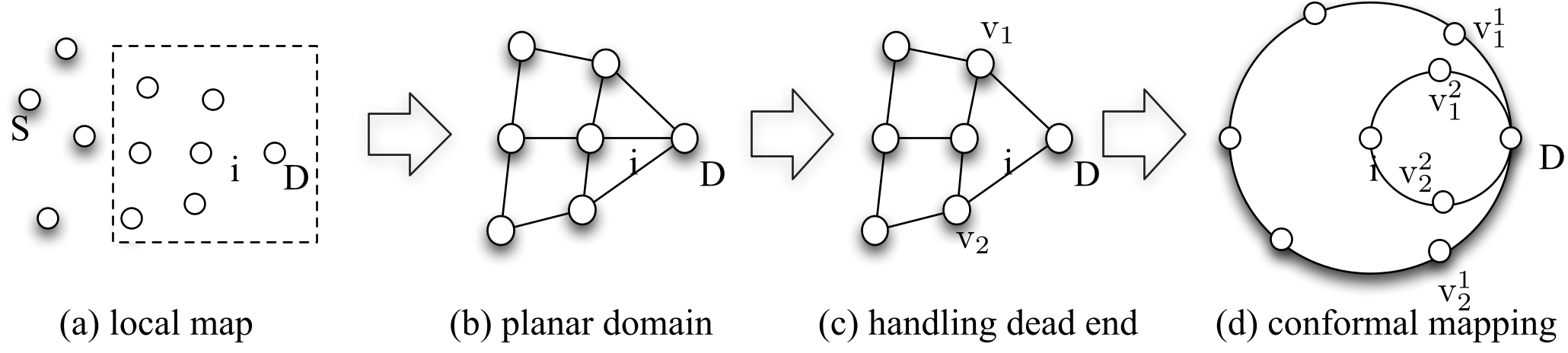 Figure: The transition from opportunistic contacts to a conformal virtual map.
3. Guaranteed Forwarding
By mapping the network to a unit disk where triangles are acute, the authors leverage a known geometric theorem: In an acute triangulation or a circular boundary, a node can always find a neighbor closer to the destination than itself. This effectively "smooths out" the local maxima.
Experimental Results: Breaking the Ceiling
The authors tested VIRO against established baselines using three major datasets: MIT Reality, DieselNet, and Cabspotting.
Delivery Ratio Breakthrough
When plugged into the PROPHET protocol, VIRO increased the delivery ratio from approximately 40% to over 80% on the MIT Reality trace—a staggering 42% improvement.
| Metric | PROPHET (Standard) | PROPHET + VIRO |
|---|---|---|
| Delivery Ratio | ~40% | ~82% |
| Avg. Delay | Lower | Slightly Higher |
| Avg. Cost (Hops) | ~2.4 | ~2.6 |
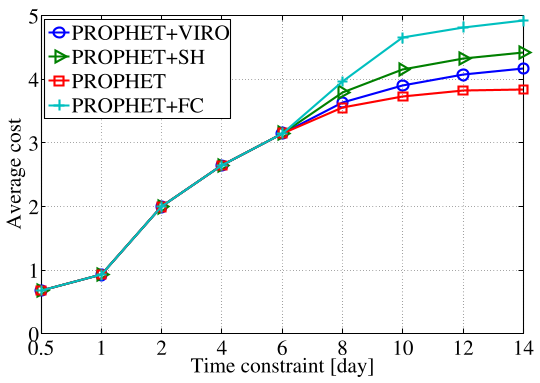 Figure: Comparison showing the massive leap in delivery ratio over time using VIRO.
The Trade-off: Delay and Cost
Crucially, this gain doesn't come at the cost of network flooding. The Average Cost (number of relays) only increased by about 0.2 hops, and the Average Delay remained significantly lower than alternative methods like First Contact (FC) or Second Highest (SH) utility forwarding.
Critical Insight & Conclusion
VIRO is a brilliant example of Cross-disciplinary Engineering. It takes a concept from high-end Riemannian geometry (Ricci Flow) and applies it to a practical networking problem (MSN routing).
Key Takeaways:
- Local is Enough: VIRO doesn't need global network knowledge; it operates on local neighbor discovery.
- Robustness: It effectively handles "holes" in the connectivity graph by treating them as boundaries in a conformal map.
- Future Impact: While tested on MSNs, this geometric approach toward "routing holes" is highly applicable to modern robotic swarms and decentralized IoT networks where "dead ends" are a persistent physical reality.
The limitation remains the computational overhead of calculating Ricci Flow on mobile devices, though the authors argue that for small local maps, this is well within the capabilities of modern smartphones.