
Bridging Simulation and Control: The Virtual Accelerator Environment for DCLS
Development of Virtual Accelerator Environment for Beam Diagnostics
The paper presents a Virtual Accelerator (VA) environment for the Dalian Coherent Light Source (DCLS), developed using ELEGANT and the SDDS toolkit. It enables the seamless integration of physics simulations with EPICS-based control systems to verify beam diagnostics and orbit control algorithms before physical commissioning.
TL;DR
Researchers at the Shanghai Institute of Applied Physics have developed a Virtual Accelerator (VA) environment for the Dalian Coherent Light Source (DCLS). By wrapping the ELEGANT simulation engine in an EPICS-compatible shell, they have created a "digital twin" that allows operators to test beam diagnostic tools and orbit correction algorithms in a sandbox that mimics the real machine's behavior.
Background & Motivation: The Commissioning Bottleneck
Commissioning a Free Electron Laser (FEL) is a high-stakes task. Parameters such as beam energy, energy spread, and transverse emittance must be tuned with extreme precision. Traditionally, high-level applications (HLAs) were developed against theoretical models but often struggled when faced with the realities of control system latency and hardware interfaces.
The authors recognized that the SDDS (Self Describing Data Sets) toolkit and ELEGANT code, while powerful for design, needed a "live" interface to interact with the EPICS (Experimental Physics and Industrial Control System) framework used in the actual control room.
Methodology: The Architecture of a Digital Twin
The core of the VA is its ability to masquerade as hardware. The system architecture is divided into three functional layers:
- Simulation Engine: ELEGANT handles the heavy lifting of beam dynamics, including 3D particle tracking.
- Communication Bridge: An I/O interface performs bi-directional conversion between SDDS files and MATLAB structures.
- Control Integration: Using EPICS portable Channel Access (CA), the simulation variables are published as Process Variables (PVs), making the VA indistinguishable from the real linac to the High-Level Applications.
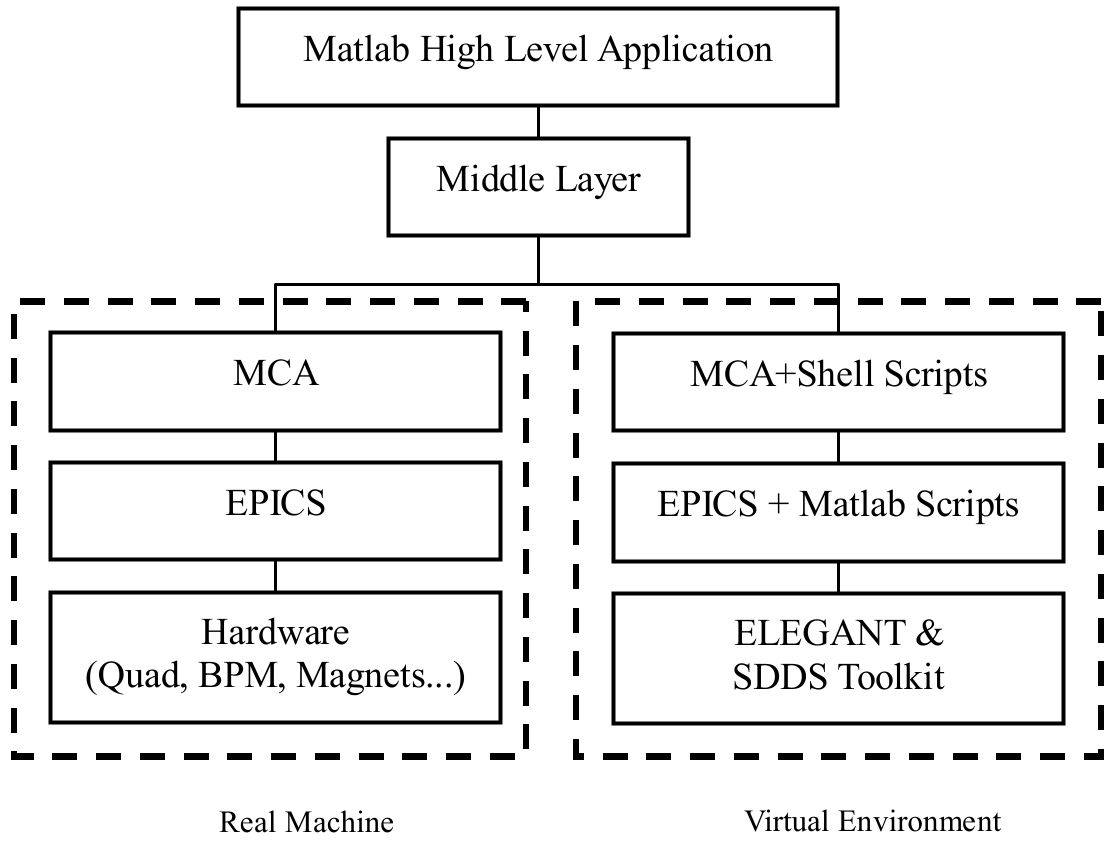 Fig 1: The structure of the virtual accelerator environment compared to the physical machine.
Measuring the Invisible: Emittance and Energy
One notable feature is the Quadrupole Scan tool. By varying the strength () of a quadrupole and observing the resulting beam size () on a virtual profile monitor, the system fits a second-order polynomial to derive the transverse emittance.
This allows the HLA to practice fitting algorithms on simulated "images" that include realistic pixel calibrations (10um/pixel) and background noise.
Experimental Validation: Orbit Correction
The VA's utility was most evident in Beam Orbit Correction. Using the Singular Value Decomposition (SVD) algorithm, the authors generated a Response Matrix—a map of how every dipole corrector affects every Beam Position Monitor (BPM).
In the virtual testbed, the environment simulated alignment errors (100μm offsets). The correction tool was then applied, achieving a near 10-fold improvement in orbit stability.
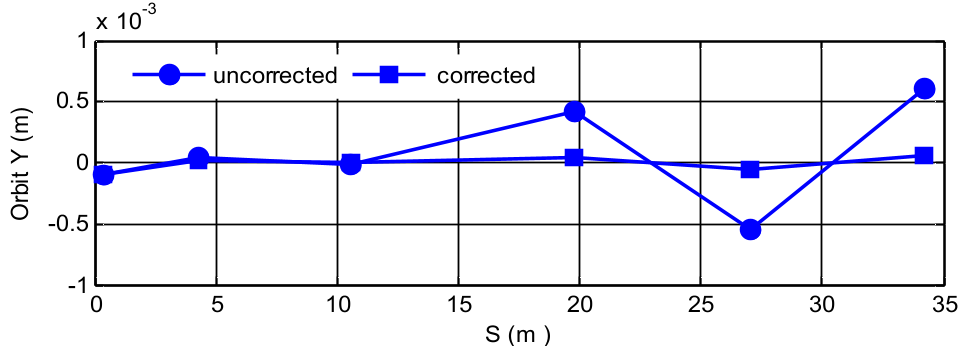 Fig 2: Beam position improvement after applying SVD-based correction in the VA.
Critical Insight: Why This Matters
The hallmark of this work is not just the simulation, but the transparency of the interface. Typically, physicists work in SDDS/ELEGANT while engineers work in EPICS. By unifying these via MATLAB-based HLAs, the DCLS team has created a environment where:
- RF Phase Tuning can be optimized by finding the point of minimum energy spread without consuming beam time.
- Response Matrices can be calculated theoretically and verified experimentally, providing a fallback for machine operation.
Conclusion & Outlook
The Virtual Accelerator environment is a critical "force multiplier" for accelerator physics. While the current model excels at linear optics and standard diagnostics, future extensions could incorporate space charge effects or collective instabilities to further refine the virtual twin. For the DCLS, this VA isn't just a simulator—it's the primary training ground for its control software.