
Can Learning Be Virtually Boosted? Why Facebook is More Than Just a Distraction
Can learning be virtually boosted? An investigation of online social networking impacts
This study investigates the impact of online social networking (OSN) engagement, specifically Facebook, on university students' social learning outcomes. Utilizing Social Learning Theory, the authors demonstrate that OSN engagement significantly enhances self-esteem, university life satisfaction, and performance proficiency.
TL;DR
Is social media destroying student productivity, or is it a secret weapon for academic success? This seminal study argues the latter. Researchers found that active engagement on platforms like Facebook significantly boosts self-esteem, university satisfaction, and performance proficiency. By acting as a catalyst for social acceptance and cultural adaptation, online networking prepares students for the rigors of university life better than traditional isolated study might.
The "Net Generation" Dilemma
For years, educators viewed social media as the enemy of the classroom—a "distraction" from serious scholarship. However, this study shifts the perspective by framing the university as a social system. The problem isn't the technology; it's the failure to recognize that learning is inherently social. Prior work focused on how social networks help business professionals get jobs, but skipped the crucial "socialization" phase where students turn from outsiders into high-performing academic insiders.
Methodology: The Socialization Bridge
The authors utilized Bandura’s Social Learning Theory to build a bridge between digital scrolling and academic succeeding. They posit that OSN engagement (specifically Facebook intensity) doesn't just "give" you grades; it facilitates two critical processes:
- Social Acceptance: Gaining a sense of belonging among peers.
- Acculturation: Understanding and internalizing the university’s values, norms, and culture.
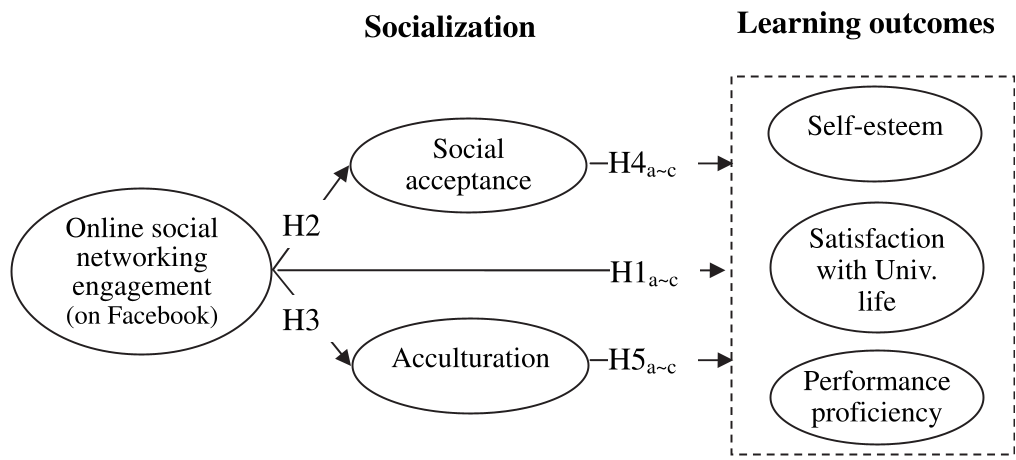 Figure 1: The structural model showing how OSN engagement filters through socialization to reach learning outcomes.
The study used a dual approach: focus groups to gain "thick" qualitative data, followed by a PLS-SEM (Partial Least Squares Structural Equation Modeling) analysis of 187 students to verify the statistical paths.
Key Insights and Results
The data suggests a multidimensional win for students who engage actively online:
- Self-Esteem & Proficiency: Social acceptance by peers is a massive driver for cognitive growth. When students feel "accepted," their confidence in their academic skills (Performance Proficiency) skyrockets (t=3.670).
- Satisfaction with University Life: Acculturation—knowing the "vibe" and rules of the school—is the primary driver for happiness and retention (t=5.020).
- Direct Impact: Even without the mediators, Facebook usage correlates directly with better psychological well-being.
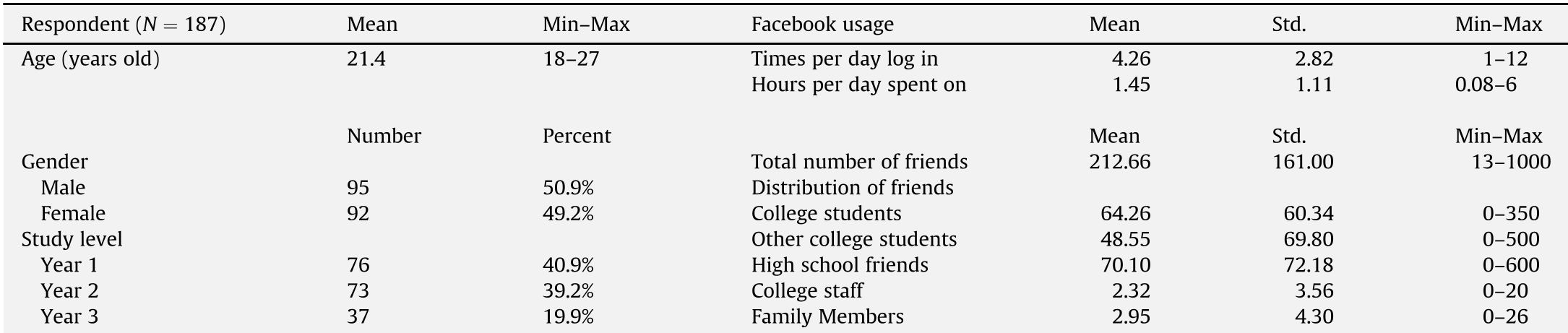 Table 1: Participant demographics and Facebook usage intensity.
The researchers noted that students often use Facebook to "trace" the lives of peers and professors, lowering the "fear of embarrassment" common in face-to-face interactions. This low-stakes environment allows for the formation of "bridging" and "bonding" social capital simultaneously.
Critical Analysis: A Double-Edged Sword?
While the results are overwhelmingly positive, the authors do not suggest students should spend all their time online. During focus groups, students admitted to distraction risks. The "whole-person development" mentioned in the paper requires a balance.
From a Senior Tech Editor's perspective, this work was visionary for 2010. It correctly predicted that the "virtual" and "physical" campus would merge. However, a modern critique would argue that the "privacy paradox" and the rise of algorithmic echo chambers (which didn't exist in the early Facebook era) might complicate these socialization processes today.
Conclusion: From Scrollers to Scholars
The takeaway for educational institutions is clear: Don't ban the network; leverage it.
- Design for Socialization: Universities should use OSN for orientation and building "student-to-professional" identities.
- Acknowledge the Peer Power: Peer-led online communities are as important as the library for a student’s "social genesis."
By viewing Facebook not as a "toy" but as a pedagogical tool, we can move from passive consumption to a "virtually boosted" learning environment.
Keywords: Social Learning Theory, Facebook, Socialization, e-Learning, Higher Education Strategy.