
Beyond Interfaces: How Virtual Humans are Revolutionizing Assisted Health Care
Virtual humans for assisted health care
This paper introduces a distributed Virtual Human (VH) architecture designed for assisted health care and clinician training. By integrating speech recognition, natural language understanding, and procedural animation, the authors developed "Virtual Patients" (e.g., the Conduct Disorder simulator 'Justin') and interactive assistants to support aging populations and medical education.
TL;DR
Researchers at USC’s Institute for Creative Technologies have pioneered a distributed architecture for Virtual Humans (VHs)—AI agents that look, speak, and emote like people. By moving beyond static buttons and menus, these agents provide a naturalistic interface for elderly care and a scalable simulation platform for medical students to practice complex psychiatric diagnoses.
Academic Positioning: This work bridges the gap between Intelligent Tutoring Systems and Socially Assistive Robotics, positioning VH technology as a key solution for the "Standardized Patient" bottleneck in medical education.
The "Digital Divide" in Aging and Medicine
As populations age, the demand for monitoring and companionship outpaces human resources. However, the elderly often find current software cumbersome. Simultaneously, medical education faces a scalability crisis: training a student to handle a conduct-disorder patient or a negotiation scenario requires expensive human actors.
The authors' core insight is that human-like interaction (incorporating non-verbal cues like gaze and posture) isn't just "flavor"—it is the functional mechanism that lowers cognitive load for users and increases the pedagogical value of simulations.
Methodology: The Anatomy of a Virtual Human
The system is not a monolithic program but a distributed modular framework. This "plug-and-play" approach allows the agent to be as simple as a chatbot or as complex as a cognitive actor with its own "Beliefs, Desires, and Intentions" (BDI).
The Core Pipeline:
- Input: Speech recognition and vision sensors capture the user's state.
- Cognition: An Intelligent Agent reasons through an ontology to decide on a response.
- Expression: The Non-Verbal Behavior (NVB) generator selects gestures and gazes synchronized with synthesized speech.
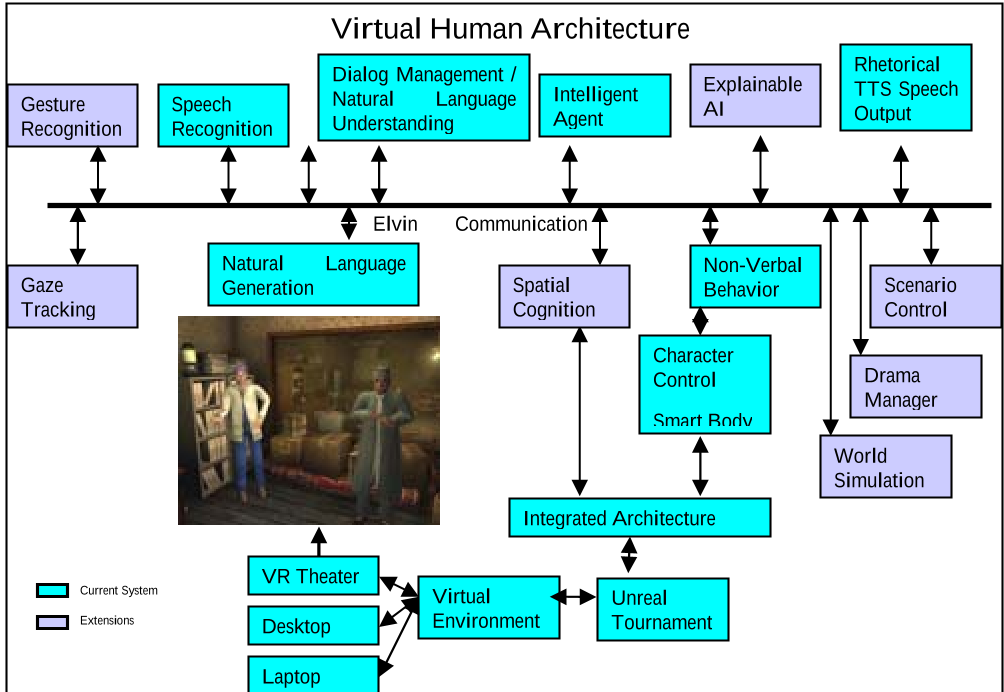 Figure 1: The modular architecture allows for the seamless replacement of speech or graphic engines without re-writing the core logic.
From Negotiation to Diagnosis
The paper showcases two primary applications:
- The Negotiation Scenario: Used for military and cultural training, where users must navigate multi-party conflicts between a village elder and a clinic doctor.
- The Virtual Patient "Justin": A simulated teenager with conduct disorder. This allows novice clinicians to practice differential diagnosis—deciding if a patient’s behavior fits specific DSM-IV criteria—without the pressure of a real clinical encounter.
 Figure 2: "Justin" in a simulated clinical setting, providing a consistent and repeatable training stimulus for students.
Experimental Results & Performance
Subject testing with students and professional clinicians revealed:
- High Realism: Users interacted with "Justin" naturally, asking sufficient history-taking questions to reach accurate diagnostic conclusions.
- Engagement: The system successfully portrayed a "conduct disorder" persona that was perceived as consistent and engaging.
- Developer Efficiency: The distributed nature allowed researchers to iterate on different medical conditions without re-engineering the entire speech-to-gesture pipeline.
Critical Insight & Future Outlook
While this work provides a robust blueprint, it acknowledges a significant hurdle: the content bottleneck. Creating a new "Virtual Patient" still requires massive manual effort in dialog engineering and behavioral rule-setting.
The Takeaway: The future of assisted health care lies in Multi-Modal Integration. By embedding VHs into smart home environments where sensors track medication adherence or falls, the VH becomes more than a talking head—it becomes a proactive, embodied health advocate. As we look toward the 2020s and beyond, integrating Generative AI into these modular frameworks will likely solve the content bottleneck, making these "Virtual Humans" as common as smartphones in the homes of the elderly.
Limitations: The study notes the high complexity of large system integrations and the urgent need for a unified standard for sensor-to-VH communication.