
Personalizing the VR Cure: How Group-Specific Modeling and Virtual Exposure Mitigate Public Speaking Anxiety
Virtual reality interfaces and population-specific models to mitigate public speaking anxiety
This paper presents a multimodal approach to quantify Public Speaking Anxiety (PSA) using bio-behavioral indices from wearable sensors and Virtual Reality (VR) interfaces. It introduces group-specific machine learning models that incorporate individual traits and contextual factors, demonstrating that systematic VR exposure significantly reduces both self-reported and physiological anxiety markers.
TL;DR
Public Speaking Anxiety (PSA) is more than just "butterflies in the stomach"—it's a complex physiological and psychological response. This research from Texas A&M University leverages wearable sensors (EDA, ECG, Audio) and Virtual Reality to not only quantify anxiety with a high degree of personalization (improving prediction correlation from 0.10 to 0.55) but also to alleviate it through systematic virtual exposure.
The Personalization Gap in Affective Computing
Most current AI models for emotion or stress detection suffer from a "one-size-fits-all" problem. They attempt to map physiological signals (like a racing heart) directly to an anxiety score. However, a high heart rate in a seasoned professor might mean "excitement," whereas in a student, it signifies "panic."
The authors identified that contextual factors (age, gender, native language) and individual traits (personality, general trait anxiety) act as critical moderators. Previous SOTA designs often ignored these "nuisance variables," leading to models that fail when applied to diverse groups like non-native speakers or different age demographics.
Methodology: The Power of Group-Specific Fine-Tuning
The study's pipeline is divided into two distinct objectives: quantifying PSA using multimodal data and treating PSA via VR.
1. Multimodal Feature Extraction
The researchers collected data using:
- Wrist-worn sensors (Empatica E4): Capturing skin conductance (EDA), Blood Volume Pulse (BVP), and temperature.
- Chest-worn ECG: Measuring Heart Rate Variability (HRV) indices like RMSSD.
- Acoustic Analysis: Extracting Jitter, Shimmer, and pitch from speech.
2. Group-Specific Architecture
Instead of a single regressor, the team used a hierarchical approach:
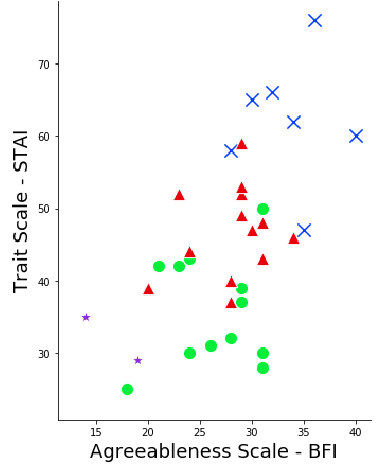
- Clustering: Participants were clustered via K-Means (K=4) based on their psychological and demographic profiles.
- Neural Network Fine-Tuning: A baseline Feed-forward Neural Network (FNN) was trained on the entire dataset. Then, the specific weights of the hidden and output layers were fine-tuned for each cluster.
 Caption: The group-specific FNN architecture allows the model to adapt to the unique physiological "signatures" of different populations.
Experiments & Results: VR as a Clinical Tool
The impact of the VR intervention was tested through a PRE-TEST-POST design. Participants presented to a real audience, then underwent 8 VR sessions, then returned to a real audience.
Key Performance Wins:
- Prediction Sensitivity: By adding demographic and personality data, the Spearman correlation for PSA prediction jumped significantly. The combination of context and trait factors yielded the highest performance (r=0.55).
- Physiological Desensitization: After VR training, participants showed a significant reduction in Skin Conductance Response (SCR) frequency and Heart Rate when facing a real audience.
- Subjective Relief: Self-reported state anxiety (CAI State) dropped from a mean of 46.25 to 39.74.
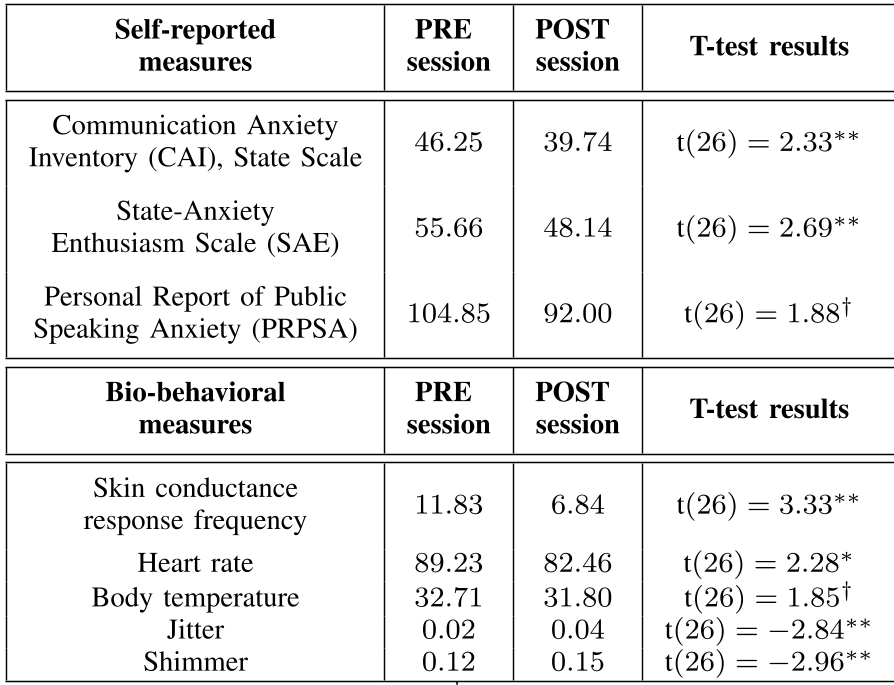 Caption: Comparison of self-reported and physiological measures before and after VR sessions.
Critical Insight: Why Does This Work?
The effectiveness of this approach lies in the "Moderating Factors." For instance, the study found that undergraduate students depicted higher EDA frequency (stress) and trait anxiety compared to graduate students. By clustering these groups, the AI learns that a certain level of EDA frequency for an undergrad is "normal" within their cohort, while it might indicate extreme distress in another group.
Moreover, the VR environment provides immersion without risk. Unlike practicing in front of a mirror, VR mimics the "social threat" of an audience, triggering the sympathetic nervous system. Repeated exposure leads to "habituation," effectively retuning the brain's response to the threat.
Conclusion & Future Outlook
This work lays the groundwork for in-the-moment biofeedback. Imagine a VR headset that monitors your heart rate and provides real-time "cognitive restructuring" tips (e.g., "Take a deep breath, your heart rate is rising") while you practice.
Limitations: The study notes that the "habituation" might partially stem from doing 10 speeches in two weeks, regardless of the VR. Future studies will need to compare VR against traditional "real audience" practice to isolate the exact value-add of the virtual interface.
Final Takeaway: For AI to truly assist in mental health, it must stop treating humans as a uniform data source and start recognizing the demographic and psychological context that defines our biological responses.