
The Digital Public Sphere: How Social Networks Weaponize E-Government Against Corruption
Virtual Social Networks as Public Sphere: Relating E-government Maturity, ICT Laws, and Corruption
This paper investigates how Virtual Social Networks (VSNs) act as a digital "Public Sphere" to influence the efficacy of e-government in combating corruption. Using archival data from 136 countries, it establishes a mediation-moderation model where E-government maturity reduces corruption indirectly through the development of ICT laws, a process significantly amplified by the diffusion of VSNs.
TL;DR
Is e-government enough to stop corruption? Not quite. This study reveals that e-government only effectively reduces corruption when supported by strong ICT laws. Crucially, the "missing link" that forces these laws to work is Virtual Social Network (VSN) diffusion, which acts as a modern-day Habermasian Public Sphere, providing the public pressure necessary for institutional reform.
Context: The E-Government Paradox
For decades, scholars have debated whether digitizing government services actually reduces "misuse of entrusted power for private gain." While some see it as a transparency tool, others argue it simply moves bribery into the digital realm. The researchers at IIM Kozhikode argue that this inconsistency exists because we’ve ignored the legal infrastructure and the social pressure that makes technology effective.
The "Public Sphere" Insight
The core innovation of this paper is the application of political science—specifically Jürgen Habermas’s Public Sphere—to the Information Systems domain. For a digital space to function as a public sphere and curb corruption, it must meet three criteria:
- Disregard for Status: Everyone’s voice carries weight regardless of rank.
- Common Concern: Discussion focuses on societal issues (like corruption).
- Inclusivity: Accessibility to all citizens.
The authors argue that VSNs (Facebook, Twitter, etc.) fulfill these requirements, turning passive internet users into active monitors of state behavior.
Methodology: A 136-Country Analysis
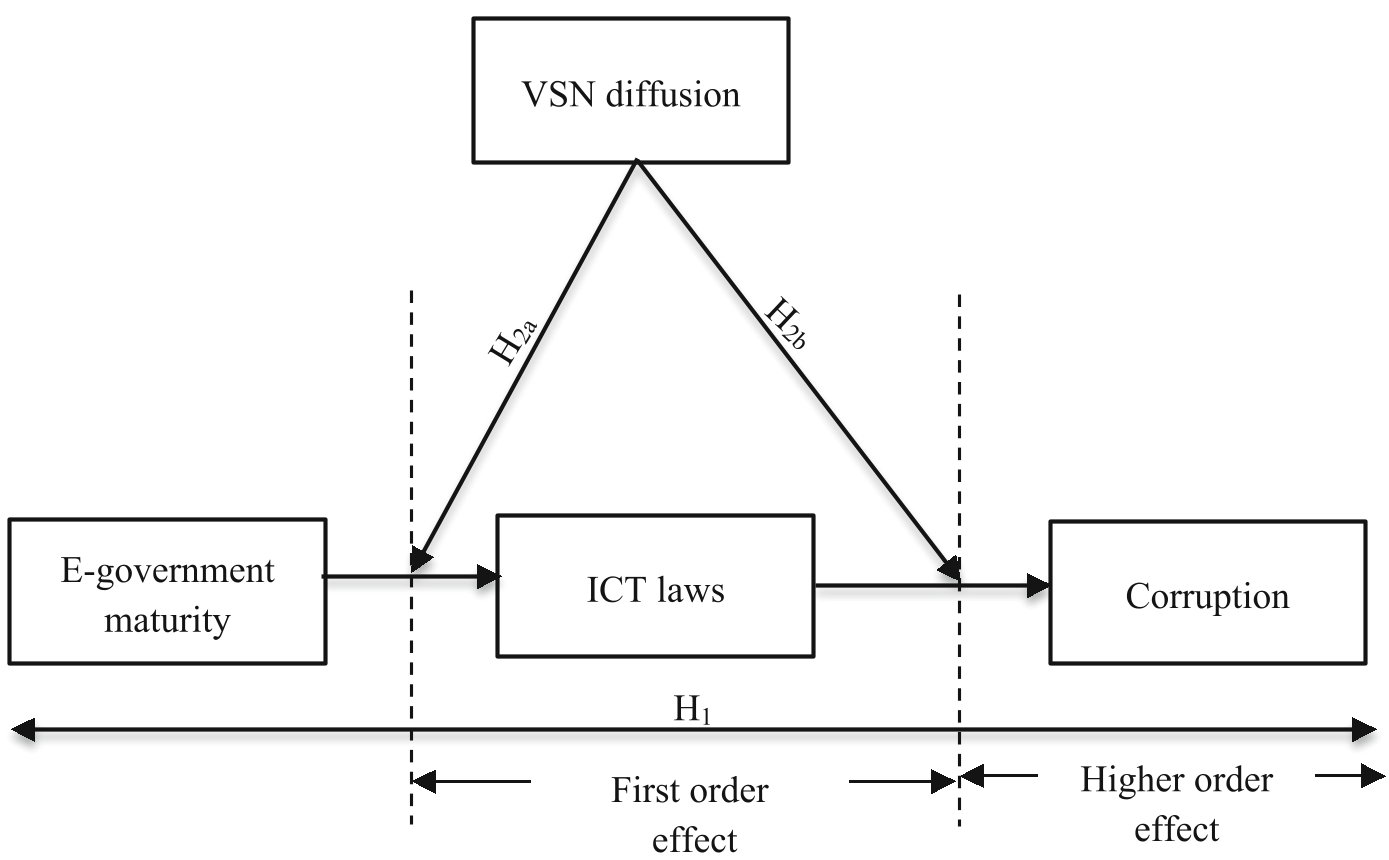
The study utilizes a massive dataset combining reports from the UN, World Bank, and Transparency International. They proposed a Moderated Mediation Model:
- Independent Variable: E-government Maturity (Online Service Index).
- Mediator: ICT Laws (Legislative frameworks for e-commerce, digital signatures).
- Moderator: VSN Diffusion (Usage rates of social platforms).
- Dependent Variable: Corruption Perception Index.
Key Findings: The Catalyst Effect
The results provide a clear roadmap for how digital tools solve institutional rot:
1. The Legal Bridge
E-government doesn't reduce corruption by magic; it forces the creation of ICT Laws. These laws provide the "Rules of Engagement" for digital interactions, building the citizen trust necessary to move away from informal (corrupt) systems.
2. VSNs as an Accelerator
The data shows that in countries with high social media usage, the link between e-government and legal development is significantly stronger. Why? Because citizens use these platforms to demand accountability.
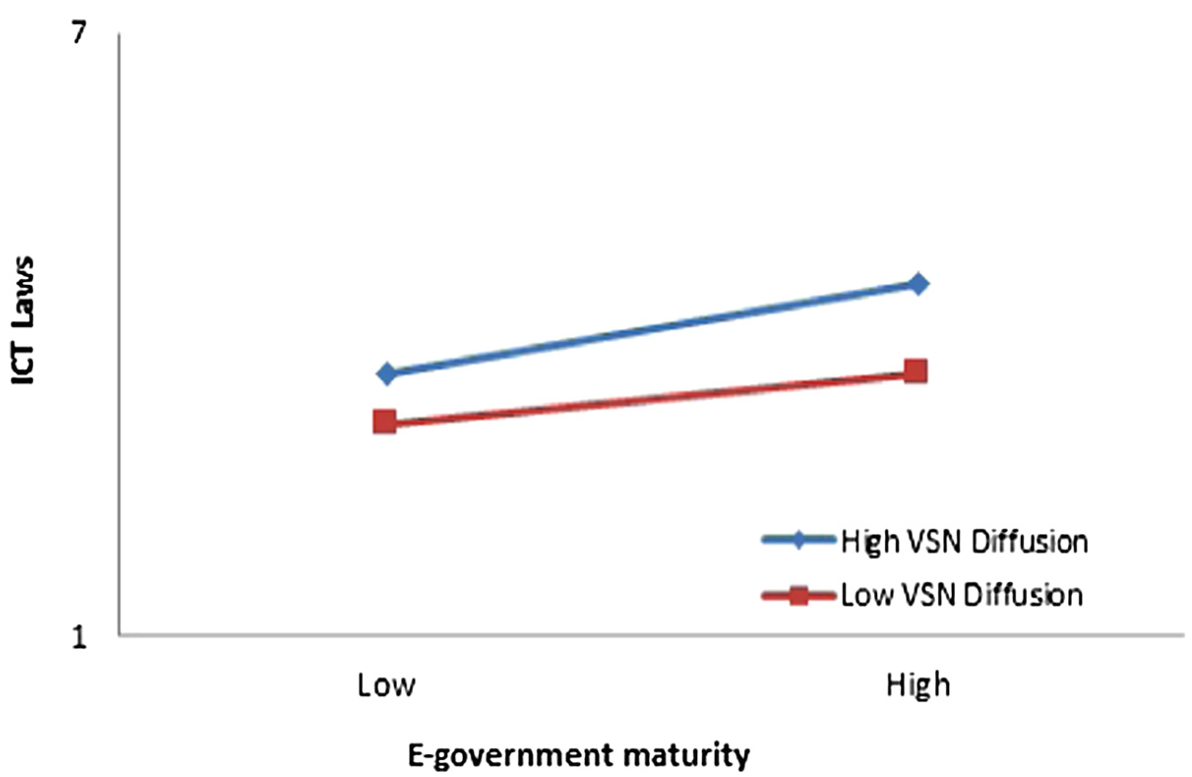 The slope is steepest for high VSN diffusion, showing that social networks make government digitizing efforts "stick" legally.
3. Closing the Enforcement Gap
Even with laws on the books, corruption can persist. However, the study found that high VSN diffusion makes ICT laws more effective at actually reducing corruption. Social networks act as a watchdog, ensuring that laws are implemented and not just "window dressing."
Critical Analysis & Takeaways
This research shifts the focus from technology as a tool to technology as an ecosystem.
- The Power of Trust: The study highlights that ICT laws are the primary drivers of trust. Without a legal framework for digital signatures and privacy, e-government initiatives likely fail to impact corruption.
- Policy Implications: Policymakers shouldn't just build portals; they must encourage a vibrant digital civil society. Restricting social networks might actually undermine the anti-corruption benefits of e-government.
- Limitations: The study relies on archival perception data. Future work should look at objective "hard" corruption cases and longitudinal panel data to track these shifts over decades.
Final Word
By reestablishing the "Public Sphere" in the context of VSNs, Arayankalam and Krishnan prove that the fight against corruption is as much about social connectivity as it is about software. If you want to clean up government, you need to ensure the citizens have a digital megaphone.