
Virtual Spectrum Hole: Mining Hidden Capacity through User Behavior Awareness
Virtual Spectrum Hole: Exploiting User Behavior-Aware Time-Frequency Resource Conversion
This paper introduces Time-Frequency Resource Conversion (TFRC), a context-aware resource allocation strategy that exploits user behavior—specifically the "focus of attention" across multitasking applications. By strategically withdrawing spectrum from background applications to create "Virtual Spectrum Holes," the method significantly increases LTE-type cell capacity (up to 90%) while maintaining Quality of Experience (QoE).
TL;DR
As mobile data traffic explodes, simply building more base stations is no longer enough. This paper proposes a paradigm shift: Time-Frequency Resource Conversion (TFRC). By identifying which app a user is actually looking at (Foreground) and "stealing" spectrum from apps running in the background, the system creates Virtual Spectrum Holes. This approach boosts cell capacity by 90% without the user ever noticing a drop in quality.
Background & Motivation: The Multitasking Paradox
Modern smartphones are multitasking powerhouses. You might be watching a YouTube video while downloading a file and syncing photos. In traditional LTE/5G resource management, the network treats these streams with similar priority based on their traffic class.
However, the Human-in-the-loop factor is often ignored. If you are focused on the video, you won't mind if the background photo sync slows down temporarily. The authors argue that current "context-unaware" resource allocation leads to spectrum starvation. Their insight is simple: Radio resources should follow the user's eyes.
Methodology: Building the Virtual Spectrum Hole
The core of the paper is the TFRC Strategy, which operates on two levels:
1. The Optimization Logic
The system doesn't just cut off background data. It uses a mathematical framework to balance the Spectrum Contribution (how much bandwidth we gain) against the QoE Degradation (the risk of the background app "freezing" when the user switches back to it).
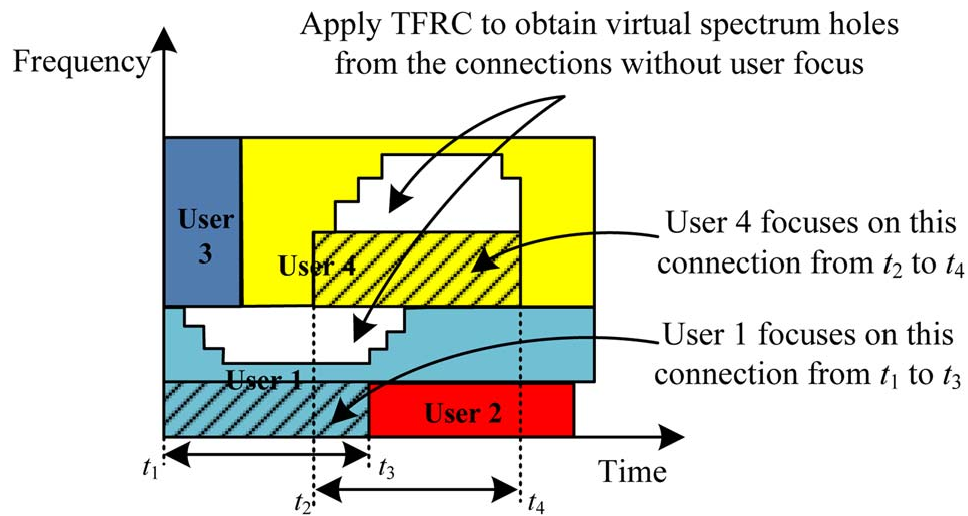 Fig 1: Illustration of how TFRC shifts resource usage across time to create reusable "holes" in the spectrum.
2. Double-Threshold Guard Channel Policy
To prevent "Recovering Calls" (when a user brings a background app to the foreground) from being dropped, the authors propose a tiered priority system:
- New Calls: Lowest priority.
- Handoff Calls: Medium priority (reserved channels ).
- Recovering Calls: Highest priority (dedicated guard channels ).
This ensures that the "aggressive" reuse of spectrum doesn't ruin the experience for existing users.
Experimental Results: Massively Increased Multi-tenancy
The researchers used a Multiple-Stair Markov Model to simulate real-world traffic dynamics. The results are striking.
Performance Gains
As shown in the performance charts, the TFRC-enabled system keeps new call blocking probabilities significantly lower than traditional systems.
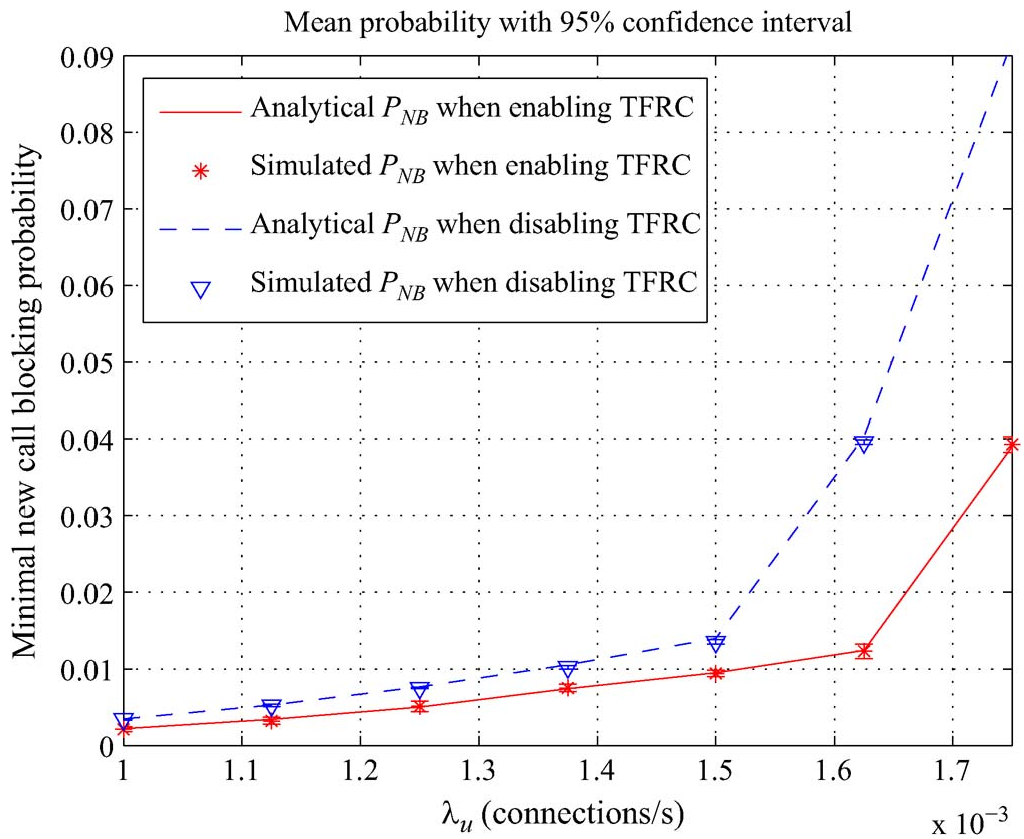 Fig 2: Call blocking and dropping probabilities under varying traffic loads. Note the low recovery dropping probability.
- Capacity Surge: In scenarios with high user traffic, the system successfully supported 90% more users per cell.
- Invisible Degradation: The probability of a user failing to recover their background connection was kept under 0.1%, effectively making the resource "theft" invisible to the end-user.
Critical Insight & Future Outlook
This work moves beyond traditional Cognitive Radio (which looks for "empty" spectrum) into Behavioral Cognitive Radio, where the network creates empty spectrum by understanding human intent.
Takeaways for the Industry:
- UE-Network Synergy: Success depends on the UE feeding back "Context Information" (CI) regarding the foreground app. OS-level integration (Android/iOS) is crucial.
- Scalability: While the per-user optimization is effective, future work must address the signaling overhead of collecting CI from thousands of devices in a 5G/6G Macro-cell.
In conclusion, the "Virtual Spectrum Hole" represents a sophisticated way to manage overloaded networks by treating human attention as the ultimate finite resource to be optimized.