
The Digital Dialect: Scaling Sociolinguistics to the Virtual Community
The Virtual Speech Community: Social Network and Language Variation on IRC
This paper presents a pioneering sociolinguistic study of language variation on Internet Relay Chat (IRC) through a social network analysis of the channel #india. By employing factor analysis on a 24-hour log file, the author identifies a "Virtual Speech Community" where linguistic choices—such as Hindi use, "IRC spellings" (u/r/z), and profanity—are rigorously structured by participants' social positions and tie strengths.
TL;DR
In this seminal work, John C. Paolillo challenges the traditional sociolinguistic view that language variation is a simple byproduct of "strong" vs. "weak" social ties. By analyzing 24 hours of IRC chat logs from #india, he discovers that online communities develop their own internal hierarchies where "standard" IRC shorthands actually mark the social periphery, while the elite "core" uses native language (Hindi) to signal status and power.
Background: The Laboratory of the Logfile
For decades, sociolinguists had to rely on human observation and post-hoc interviews to map social networks. Paolillo argues that the Internet provides a "frictionless" laboratory. Because every interaction on IRC is recorded in a textual log, we can calculate the exact frequency of contact between any two individuals. This allows for a level of granular analysis—what the author calls "Structural Equivalence"—that was previously impossible in face-to-face studies.
Methodology: Mapping the Social Topology
The study analyzed a 794K log file from the EFNet channel #india. To understand the social structure, the author didn't just look at who was talking, but who they were talking to.
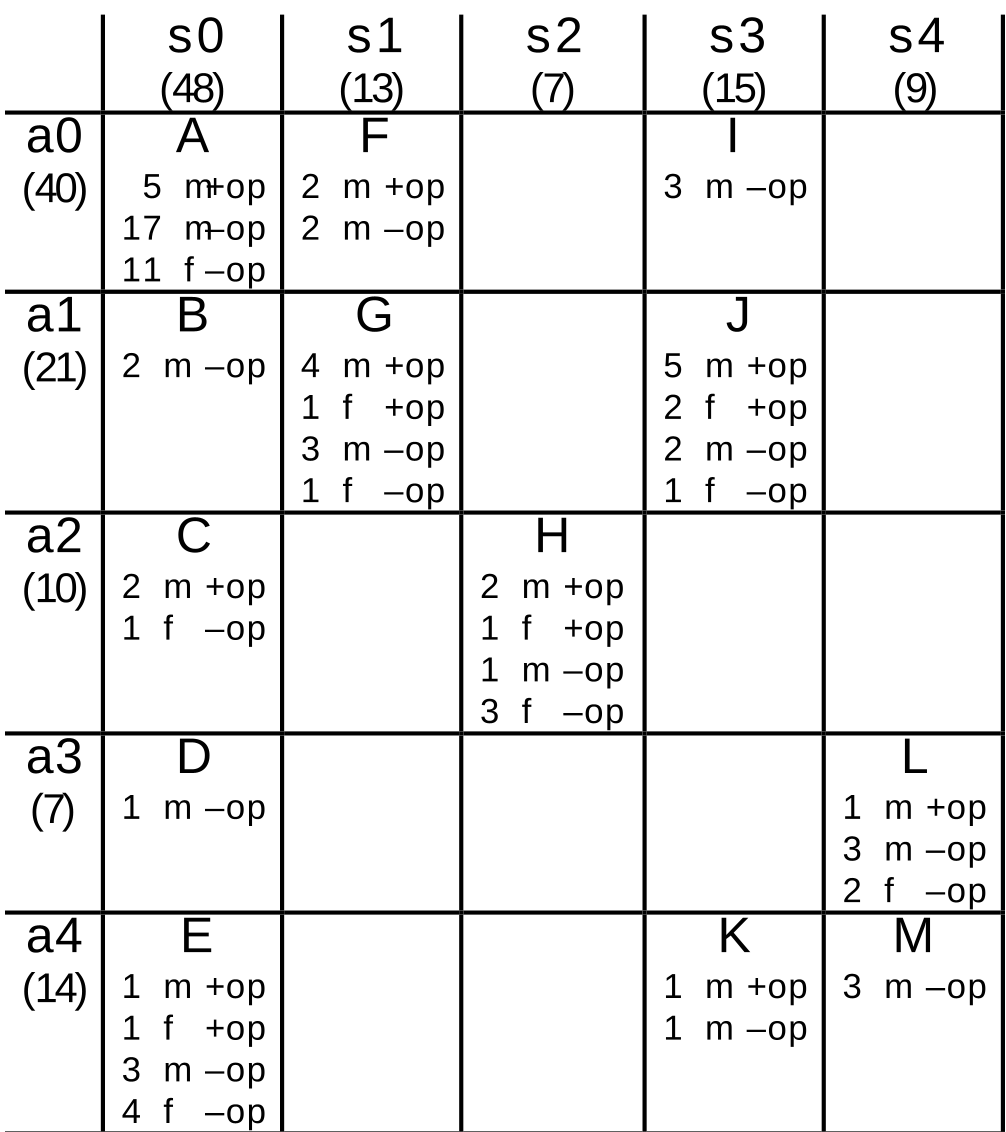
- Factor Analysis: By creating a matrix of 350 speakers and 288 addressees, the author used factor analysis to group participants into 13 "Types" (A through M).
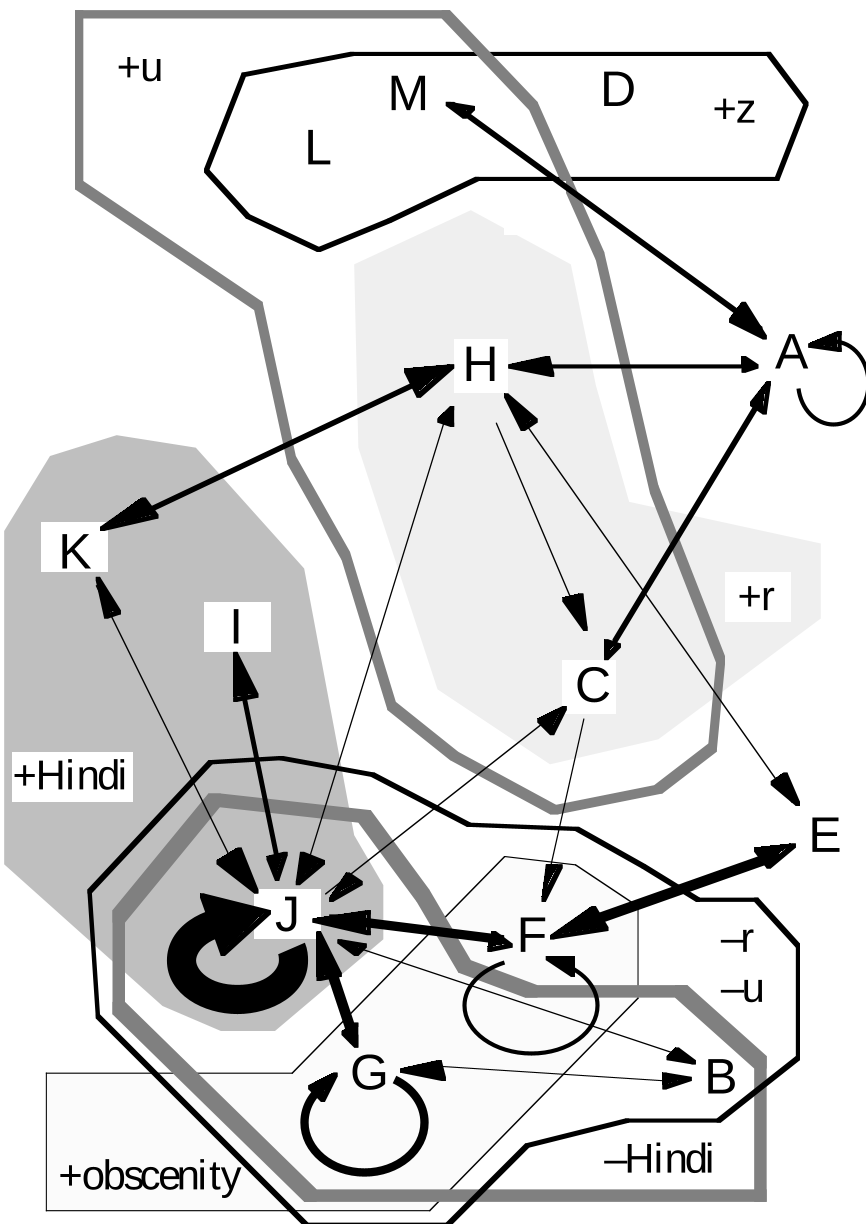
- Positional Analysis: He identified the "Core" (Group J), characterized by "operators" (users with administrative power to 'kick' others) who are the focus of most interaction.
- Linguistic Tagging: Every sentence was coded for five variables: Hindi usage, "r" instead of "are", "u" instead of "you", "z" instead of "s", and profanity.
The Hierarchy of Virtual Speech
The most striking finding is the inverted relationship between IRC-specific language and social status.
In traditional theory, we expect the most "non-standard" forms to be at the core. On IRC #india:
- The Core (Group J): These are the "elites." They predominantly use Hindi to mark their ethnic identity and avoid "IRC-speak" like "u" or "r".
- The Non-Core Central (Groups F & G): These users interact heavily with the core but use more obscenity. The paper suggests this is a performance of power—operators can curse without being "kicked," whereas newbies cannot.
- The Periphery (Groups L, M, D): These users use the most "u", "r", and "z". On IRC, these are not "slang"—they are the IRC Standard. Using them signals that the person is a regular user of the technology, but perhaps not a "core" member of the specific
#indiacommunity.
Deep Insights: Why Does This Matter?
1. The Relativity of "Standard"
The paper proves that "prestige" is local. In the global context of English, writing "r u there" is non-standard. But in the context of IRC, it is the expected norm for an experienced user. However, in the specific context of an ethnic channel like #india, the true prestige resides in Hindi. This multi-layered "Standardization" is a key takeaway for modern LLM developers and computational linguists: context defines the norm.
2. Power Dynamics and Linguistic Freedom
The use of profanity is linked to administrative status. This mirrors offline dynamics where those in positions of high "Social Capital" can deviate from social norms with fewer repercussions. On IRC, "Ops" use their immunity to define the linguistic "vibes" of the channel.
Conclusion and Future Outlook
Paolillo’s work was among the first to show that virtual communities are not just chaotic chat-rooms but highly structured social organisms. While the technology has moved from IRC to Discord and Slack, the fundamental insight remains: Linguistic variation is a map of social power.
Future Research Directions:
- Diachronic Studies: How do these network cores shift over years rather than 24-hour windows?
- Cross-Platform Variation: Does a core-member on Twitter use same linguistic markers as a core-member on a private Discord?
This paper remains a cornerstone for anyone looking to understand how humanity translates the nuances of offline social hierarchy into the text-based digital void.