
Virtual Team Networks: Decoding the "Social Capital" Recipe for Team Success
Virtual Team Networks: How Group Social Capital Affects Team Success in a Massively Multiplayer Online Game
This study investigates how "group social capital"—defined through closure within teams and brokerage between them—affects the effectiveness of virtual teams (guilds) in the Massively Multiplayer Online Game (MMOG) Dragon Nest. Analyzing server logs of over 10,000 players, the authors find that team success is maximized at moderate levels of internal density across social, task, and exchange networks, while diverse external connections primarily benefit achievement-oriented guilds.
TL;DR
Is a tightly-knit team always a better team? According to a massive study of 10,000+ players in the MMOG Dragon Nest, the answer is a definitive "not exactly." By analyzing millions of interactions, researchers found that the most successful virtual teams (guilds) aren't those where everyone is best friends, but those that maintain a moderate level of internal bonding while building diverse bridges to the outside world.
The "Group Social Capital" Paradox
In the world of Virtual Teams (VTs), two forces are constantly at play:
- Closure (The Inner Bond): High density leads to trust, reciprocity, and a sense of "we're in this together."
- Brokerage (The Outer Bridge): Connecting with people outside the group brings in new ideas, resources, and "insider info" that would otherwise be missed.
The problem is that you can have too much of a good thing. A group that is too "closed" becomes an echo chamber, losing touch with external innovations. Conversely, a group with no internal bonds lacks the trust required to execute complex tasks.
Methodology: Mapping the Digital DNA
The authors didn't just look at one network; they dissected the virtual world into three distinct layers:
- Social Network: Who is on whose "friends list"?
- Task Network: Who fights monsters (dungeons) together?
- Exchange Network: Who trades items and gold?
By tracking these, they could see how different types of "social capital" translated into Guild Points—the ultimate measure of success in Dragon Nest.

Key Findings: The "Golden Mean" of Networking
1. The Inverted U-Shape of Success
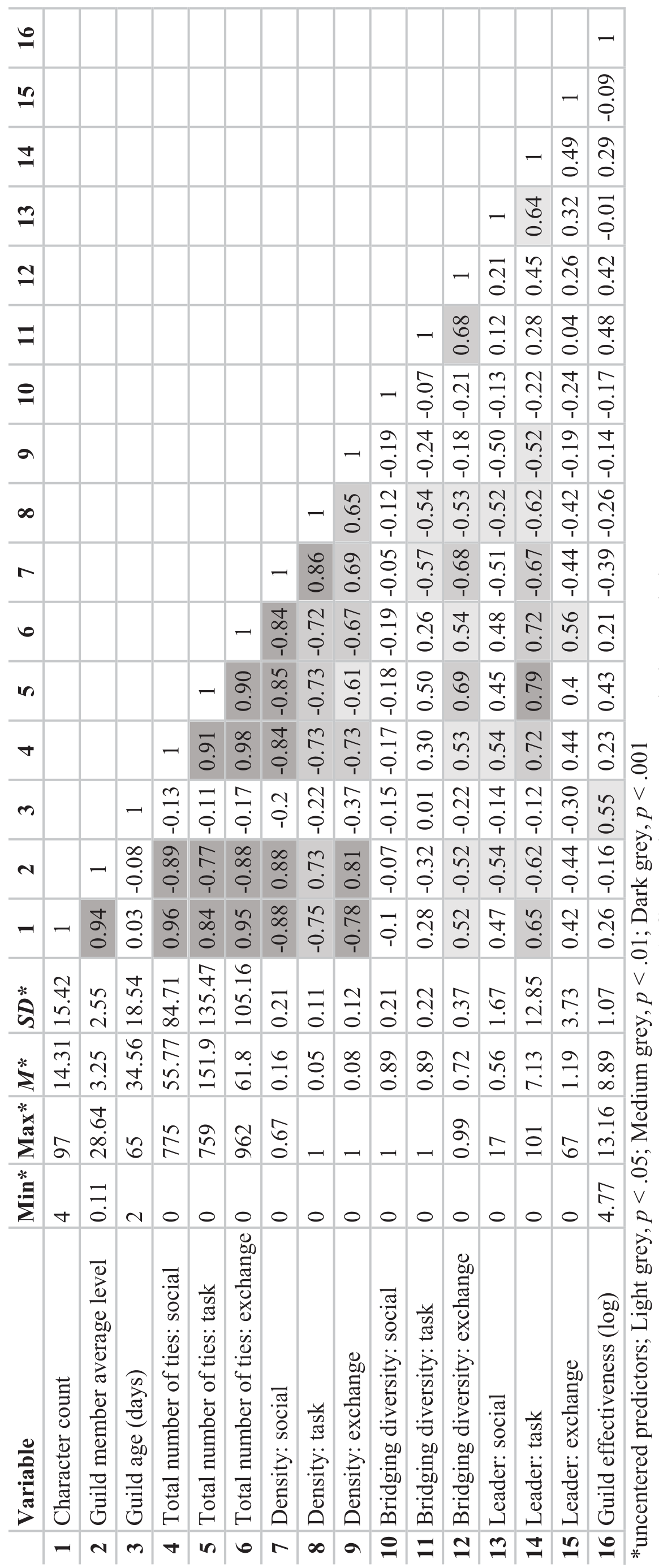
The study confirmed that Intragroup Closure (density) follows a curvilinear path. If a guild is too fragmented, they fail. If they are too "incestuous" in their social ties, they plateau. The "sweet spot" usually lies around a moderate density.
2. Achievement Requires Diversity
In the task and exchange networks, guilds that had high brokerage—members who frequently collaborated or traded with players outside their guild—consistently out-performed those that were isolated. Interestingly, this didn't matter for the "social" network; having friends in other guilds doesn't necessarily make your own guild better at killing dragons.
3. Leadership Matters (In the Right Context)
The study found that when guild leaders teamed up with other guild leaders in high-level tasks, their entire home guild benefited. It suggests that "leadership social capital" is a real force: leaders who are well-connected in task-oriented circles bring back organizational wisdom to their teams.
Deep Insight: Success isn't just about "Working Harder"
The data suggests that team effectiveness is a structural property. You could have the most skilled players in the world, but if your guild's network architecture is flawed—either too insular or too chaotic—you will be outperformed by a guild with a smarter social layout.
Why this matters for the "Real World":
- For Managers: Don't just focus on "team building" (closure). Encourage your employees to maintain "weak ties" with other departments (brokerage).
- For Designers: Software (like Slack or Teams) should perhaps suggest collaborations with "strangers" or other departments to help teams break out of their structural holes.
Conclusion & Limitations
While the study is a landmark in using big data to prove social capital theories, it's worth noting that MMOGs are unique. Players aren't "hired"; they join for fun. However, the core truth remains: the most effective organizations are those that balance internal trust with external awareness.
Future research must look at whether these trends hold true across different cultures (this study focused on China) and whether "structurally ideal" leaders always outperform "formally assigned" ones.
Final Takeaway: To lead a winning team, spend 50% of your time strengthening your core and 50% of your time building bridges. Success is found in the balance.