
What Do Virtual “Tells” Tell? Reconstructing Cybersociety Through the Lens of Digital Archaeology
What do virtual "Tells" tell? Placing cybersociety research into a hierarchy of social explanation
This paper proposes a theoretical framework for "Virtual Tells," applying archaeological analogies to study the material remains of computer-mediated communication (CMC). It introduces a hierarchy of social explanation for cybersociety, distinguishing between social theory and the physical constraints of communication technologies.
TL;DR
Just as archaeologists study physical mounds (Tells) of debris to understand vanished societies, we can study the "digital debris" of online interactions—post lengths, message frequencies, and threading structures—to understand the health and limits of virtual communities. This paper shifts the focus from why people talk online to how the physical limits of technology and human cognition define the boundaries of what is possible.
Background Positioning
This work is a seminal theoretical pivot in Computer-Mediated Communication (CMC). It moves away from the psychological "intent-based" studies of the 1990s and repositions the field within a scientific hierarchy. It bridges the gap between archaeology, anthropology, and information systems.
Problem & Motivation: The Trap of Technological Determinism
Most early internet research fell into two traps:
- Technological Determinism: The belief that "if we build a high-speed forum, a democratic community will automatically follow."
- Over-reliance on Social Theory: Analyzing every interaction through the lens of human meaning, while ignoring the "bricks and mortar" of the interface.
The authors argue that human cognition has a finite capacity. No matter how much we want to interact, if a chat room moves too fast (high message density) or a thread is too complex, the community will collapse due to "communication stress."
Methodology: The Hierarchy of Social Explanation
The heart of the paper adapt's Roland Fletcher’s archaeological model of settlement growth. Fletcher noticed that ancient cities couldn't grow past certain sizes without new communication technologies (like writing on clay tablets).
The Virtual Settlement Model
The authors define a Virtual Settlement as the material prerequisite for a virtual community. To analyze it, they propose a hierarchy:
- Social Theory: Individual behavior and intent (The "What").
- Spatial/Temporal Patterning: Distribution of artifacts like listserv postings or spams (The "Where/When").
- Technological Parameters: The "I-Limits" (Interaction limits individuals can cope with) and "C-Limits" (Constraints of the tool) (The "How Much").
- Cyber-ecology: The supply of new users and resources (The "Is it sustainable?").
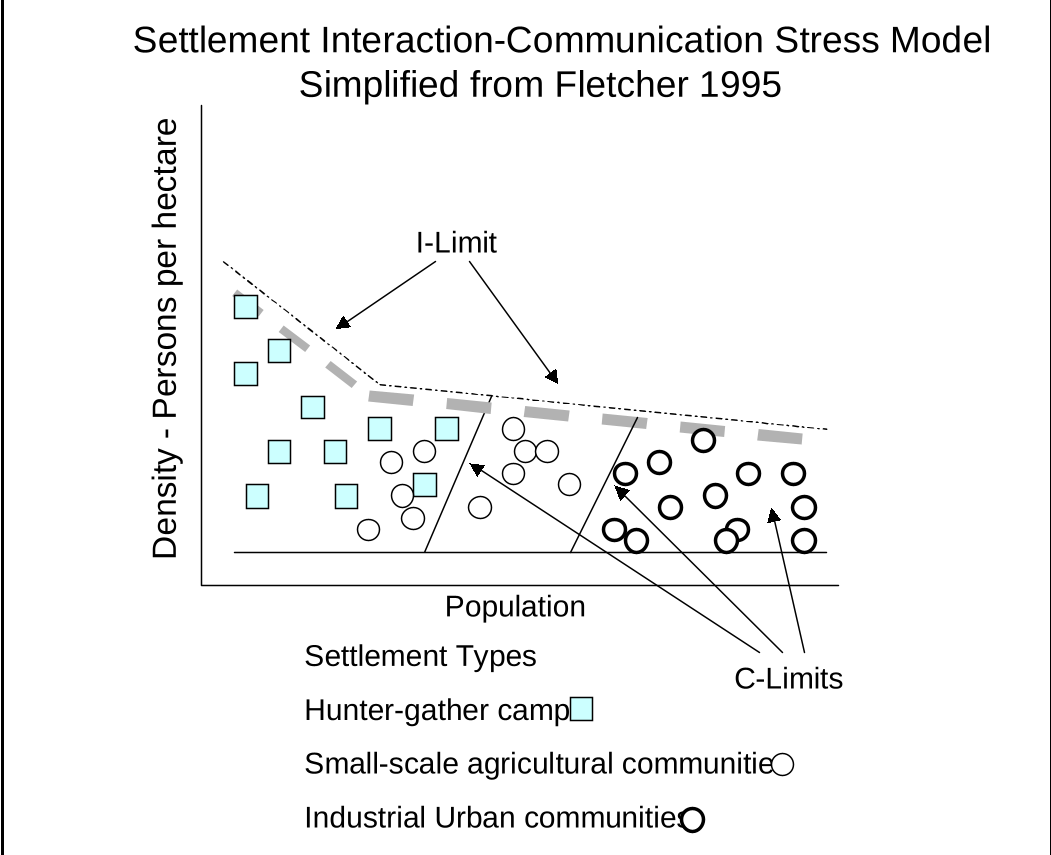 Diagram 1: Fletcher's original model showing how technology (I-Limits and C-Limits) bounds the density and population of human settlements.
Experiments & Results: The Stress of the Digital Crowd
The paper introduces the concept of Communication-Processing Load. As a virtual public grows, the effort required to stay coherent increases.
- The I-Limit: Represents the maximum density individuals can handle before "Information Overload" kicks in.
- The C-Limit: Represents the technological ceiling (e.g., email vs. IRC).
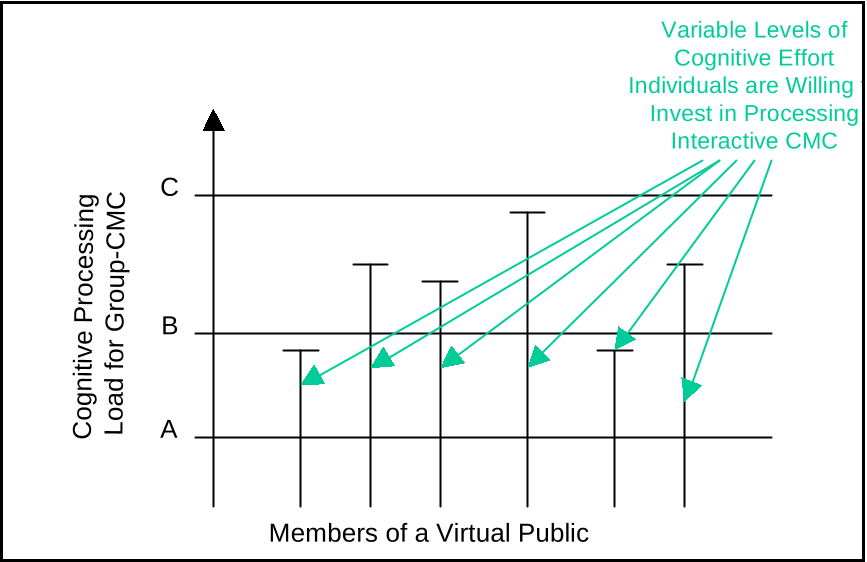 Diagram 2: This conceptual model illustrates how group processing limits are reached. When communication load exceeds the "Individual Investment" threshold, the group discourse fails.
The researchers suggest that by mapping these boundaries, we can empirically predict when a group like a Usenet newsgroup or an e-commerce community needs to "split" or "spawn" to survive.
Critical Analysis & Conclusion
Takeaway
The value of this research lies in its Indeterminacy Principle: Higher levels (technology) constrain lower levels (social interaction), but they do not dictate them. This gives designers a roadmap: you can't force a community to be "vibrant," but you can prevent it from "crowding" out its participants by managing message density.
Limitations
As a theoretical framework from the early 2000s, the paper focuses on text-based artifacts (IRC, Email, Usenet). Its application to modern algorithmically-curated feeds (TikTok, X/Twitter) is complex, as algorithms now act as "automated archaeologists" that filter debris in real-time.
Future Outlook
This "Cyber-archaeology" approach is more relevant than ever in the age of Big Data. It provides the mathematical and logical grounding needed to build "Virtual Metropolises" that don't crumble under the weight of their own information density.