
Exploring the Virtual Toy Box: How Kids Actually Use Virtual Worlds
Exploring the virtual toy box: virtual worlds and young children
This research paper, "Exploring the Virtual Toy Box," investigates how children aged 6-11 interact with popular virtual worlds like Club Penguin and Poptropica. Through ethnographic observation, it reveals that young users primarily treat these spaces as digital "toy boxes" for individual exploration and gaming rather than social platforms.
TL;DR
While virtual worlds are often marketed as "social media for kids," research shows that younger children (ages 6-11) treat them more like a chaotic, digital toy box. They largely ignore social features and complex quests in favor of simple exploration and creative play. This study highlights a critical gap between professional game design and the cognitive realities of early childhood.
Background: The Surging Pre-Social Media Era
In the early 2010s, platforms like Club Penguin, Webkinz, and Poptropica became a rite of passage. Unlike adult-oriented spaces like Second Life, these "walled gardens" were designed to be educational and social. However, Jeremy Sarachan's research suggests that we might be misclassifying how children actually perceive these spaces. Instead of "hanging out" or "geeking out," most kids are simply "messing around."
The Core Mismatch: Developer Intent vs. Child Ability
The most striking insight from the study is the failure of these platforms to accommodate the lower end of their target age range (6-8 years old).
- Reading Barriers: Many quests require a reading level far beyond a 6-year-old’s ability, leading to frustration.
- The Social Gap: While developers emphasize the "multiplayer" aspect, younger children are still in the developmental phase of "parallel play"—playing near others but not with them.
- UI Overload: Cluttered interfaces with too many icons can overwhelm children who have limited mouse skills or visual processing speed.
Methodology: Tracking the Motivation
The researcher observed 16 children and compared their self-reported motivations against actual observed behavior. They categorized activities into four pillars: Socializing, Gaming, Creating, and Exploring.
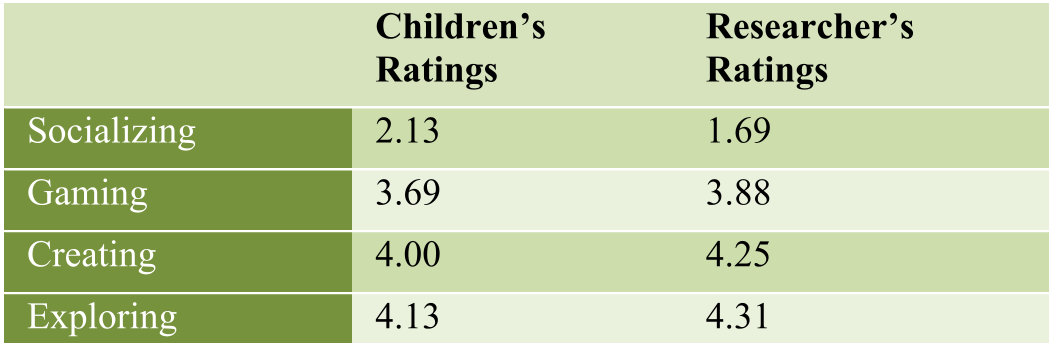
Key Findings from Figure 1:
- Exploration is King: With an observed rating of 4.31, kids are most engaged when they are simply discovering new rooms or clicking on animated objects.
- Socializing is a Myth: Both kids and the researcher rated social interaction as the least important factor (approx. 1.7 to 2.1).
- Creative Expression: The ability to customize an avatar or a room ("Creating") is a powerful hook that keeps children returning.
Digital "Messing Around"
The study references the Ito framework, noting that children participate in "messing around"—random exploration without a predefined goal.
"Youngsters may not understand the quests in Poptropica but still find it fun to move an avatar—with its flips and animated movements."
This "inefficient" play is actually a form of Digital Literacy Training. Even if a child never completes a quest, the act of navigating a 3-D space and interacting with menus prepares them for more sophisticated technological environments in the future.
Critical Analysis & Conclusion
The Takeaway: Virtual worlds for children shouldn't be designed as "Mini-Second Life." They should be designed as interactive playgrounds.
Limitations: This study was conducted in 2012, prior to the massive shift toward mobile/tablet gaming. Current children (Gen Alpha) are more "touch-native," which likely changes their relationship with UI navigation compared to the "mouse skills" discussed in this paper.
Future Outlook: Modern platforms like Roblox have succeeded by leaning into the "Creating" and "Exploring" pillars identified here. The future of kids' digital spaces lies in lowering the barrier to entry (less text, more icons) and embracing the "Toy Box" philosophy where there is no "wrong" way to play.
Reference: Sarachan, J. (2012). Exploring the virtual toy box: virtual worlds and young children. iConference '12.