
VirtualCrowd: Architecture and Strategy Simulation for Microtask Crowdsourcing
VirtualCrowd: A Simulation Platform for Microtask Crowdsourcing Campaigns
VirtualCrowd is a simulation platform designed for microtask crowdsourcing campaigns, utilizing a discrete-event system to model complex interactions between tasks and workers. It enables researchers to evaluate crowdsourcing strategies—such as worker selection and task assignment—achieving up to a 32% precision increase in urban mapping simulations.
TL;DR
VirtualCrowd is a comprehensive simulation platform built to solve the unpredictability of crowdsourcing campaigns. By leveraging a discrete-event simulation (DES) system, it allows researchers to test task assignment strategies (like random vs. quality-aware) in a controlled environment. In real-world urban mapping scenarios, the platform demonstrated that optimized strategies could boost mapping precision by up to 32%.
The "Uncertainty Path" in Crowdsourcing
Crowdsourcing is a powerful tool, yet it is notoriously difficult to manage. Most researchers face a "black box" problem: when you launch a campaign on platforms like Amazon Mechanical Turk or Figure Eight, you cannot control worker arrivals, their varying skill levels, or dropout rates. This makes it impossible to perform A/B testing on management strategies under identical conditions.
The authors of VirtualCrowd identified that the lack of a reproducible, simulated environment prevents the development of more efficient task-scheduling algorithms.
Methodology: The Discrete-Event Engine
VirtualCrowd's core innovation lies in its ability to model the temporal and behavioral dynamics of human workers through a structured pipeline.
1. System Architecture
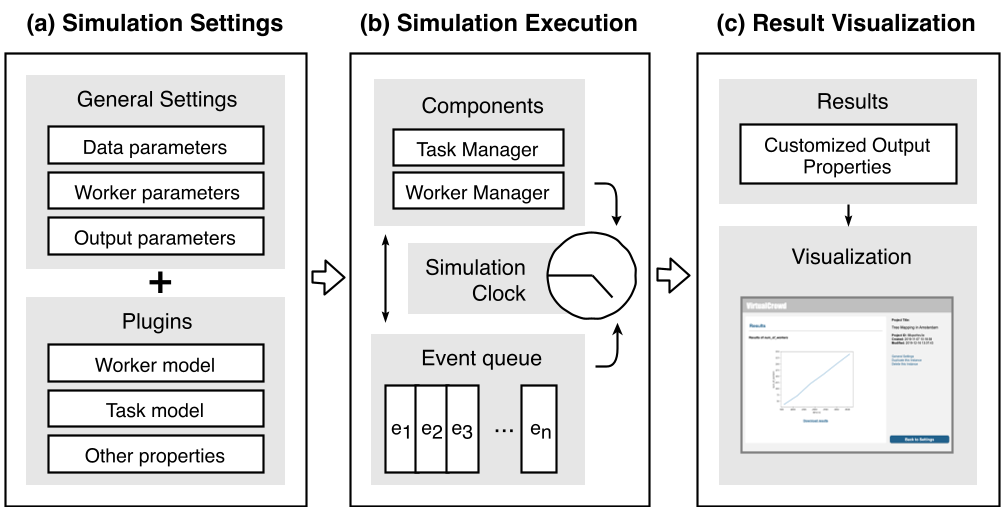
The system is split into three functional layers:
- Simulation Settings: A Web-UI where users define data parameters (price per judgment, data rows) and worker profiles.
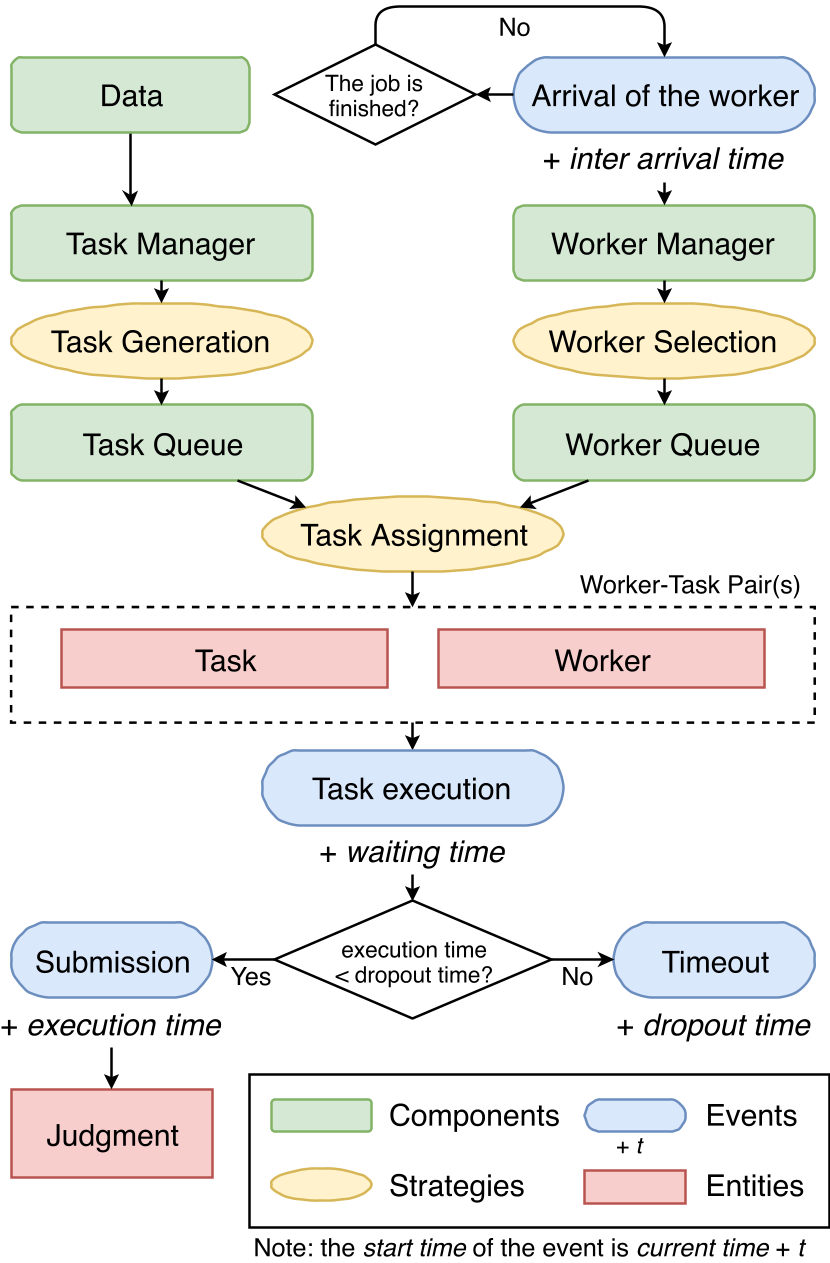
- Simulation Execution: The engine that manages the event queue (Arrival, Execution, Submission, Timeout).
- Analysis & Visualization: Real-time processing of quality metrics (Precision, Recall, Error) via Matplotlib integration.
2. The Plug-in Edge
Unlike previous simulators (e.g., CrowdSim), VirtualCrowd uses Python 3 plug-ins. This allows developers to inject complex logic, such as:
- Worker Selection: Deciding if a worker's past performance meets a threshold.
- Task Assignment: Using Skill-and-Stress-aware algorithms to pair workers with tasks.
- Mobility Models: Simulating how workers move through a physical space in crowdsensing tasks.
Case Study: Urban Tree Mapping
The researchers demonstrated VirtualCrowd by simulating a "Crowd-Mapping" task in Manhattan and Amsterdam. Workers were tasked with identifying trees from street-level imagery.
Performance Gains
By comparing Random Assignment with a Quality-aware Strategy, the simulation provided clear empirical evidence of the latter's superiority.
| City | Strategy | Precision | Recall |
|---|---|---|---|
| Manhattan | Random | 44% | 87% |
| Manhattan | Quality-aware | 67% | 87% |
| Amsterdam | Random | 55% | 83% |
| Amsterdam | Quality-aware | 87% | 83% |
The results show a massive 23-32% increase in precision without sacrificing recall. This quantification is vital for justifying the implementation of more complex assignment algorithms in commercial products.
Critical Insight: Why This Matters
The value of VirtualCrowd is not just in the simulation itself, but in the Inductive Bias it provides for system design. By simulating "dropout time" and "inter-arrival time" as Poisson distributions, it brings queue theory into the realm of human computation.
Limitations: Currently, the platform requires users to be proficient in Python 3 to utilize plug-ins, which might limit its accessibility for non-technical social science researchers. However, its modularity sets a new SOTA for crowdsourcing research tools.
Conclusion
VirtualCrowd bridges the gap between theoretical crowdsourcing models and real-world deployment. It provides the "digital twin" necessary to stress-test crowdsourcing campaigns before a single dollar is spent on actual worker payments.