
Virtualizing the Past: How Facebook Resurrects Lost Relationships and Redefines Social Ties
Virtualizing the Past: Re-connecting on Facebook and Emerging Social Relationships
This paper explores the phenomenon of "virtualizing the past" through a pilot qualitative study of Italian Facebook users. It identifies how Social Network Sites (SNSs) serve as "social archives" that facilitate reconnecting with past strong ties and cultivating new, previously undefined social relationships.
TL;DR
Why do we "friend" people from ten years ago only to never speak to them again? Or worse, why do some of these digital ghosts suddenly become meaningful parts of our present? This paper by Caterina Desiato explores the "Social Archive" of Facebook, revealing that SNSs aren't just for keeping up with current friends—they are tools for virtualizing the past. By analyzing Italian users during Facebook's 2008 boom, the study uncovers how digital "front and back stages" allow us to cultivate "stellar friendships" that traditional society has no name for.
The Problem: The "Lost" Ties of Our Biography
Before the age of the "Social Supernet," a relationship that faded usually stayed dead. Sociologists like Granovetter categorized our lives into Strong Ties (family/close friends) and Weak Ties (acquaintances), but they missed a crucial middle ground: the powerful, intimate affinities—what Nietzsche called "stellar friendships"—that don't fit into boxes like "romantic partner" or "coworker."
The problem? Historically, these ties broke because they lacked a medium. If you weren't dating or working together, there was no "casual" way to stay in touch. Re-contacting someone via phone or a long email felt too high-stakes. This paper argues that Facebook solved this "entry cost" problem, allowing us to bridge our past and present selves.
Methodology: Mining the Italian "Tipping Point"
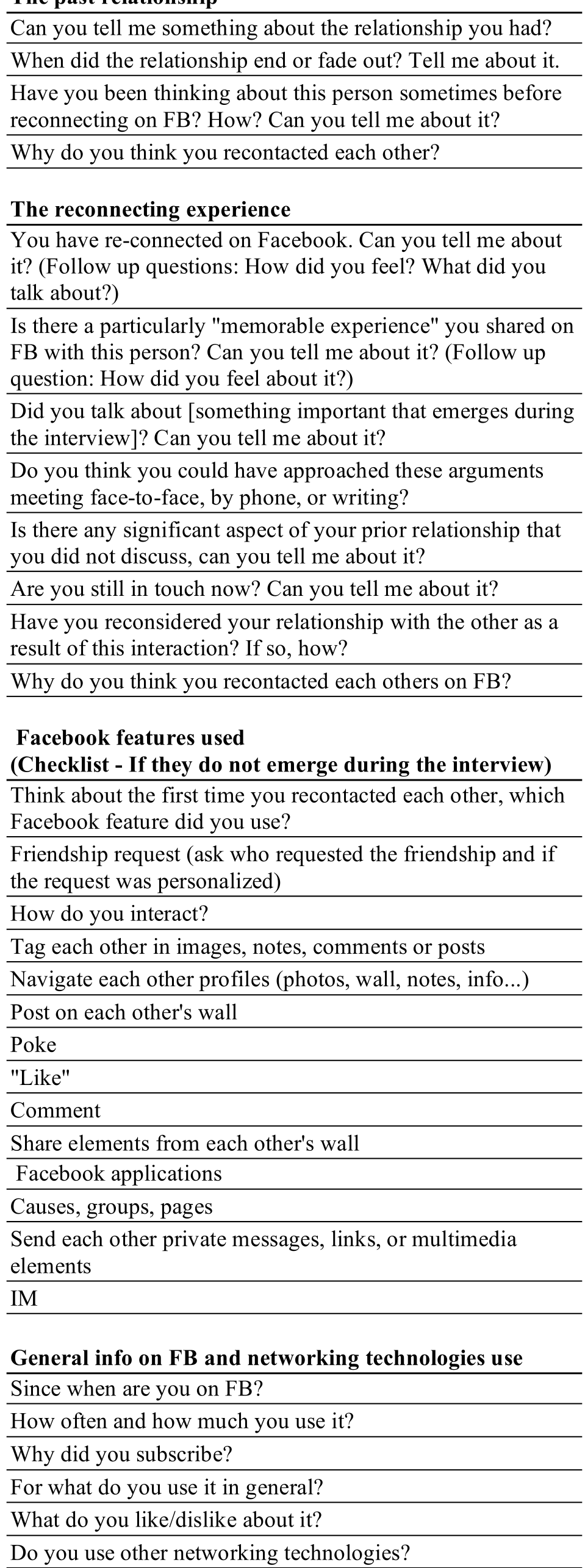
The author used an inductive approach, conducting in-depth interviews with Italian users who reconnected with "strong ties" from their past during the 2008 Facebook surge in Italy. This specific timeframe was treated as a "social laboratory" because the technology was still novel enough for users to be conscious of their behaviors.

The Core Insight: Facebook's Modular Architecture
The most striking finding is the "Modular Architecture of Front and Backstage." Drawing on Goffman’s dramaturgical theory, the paper explains how Facebook creates a layered social environment:
- The Frontstage (Public Wall/Status): Allows for "observation of performance." You can "check in" on a past tie without the pressure of a direct conversation.
- The Backstage (IM/Private Messages): Allows for the actual re-bonding.
- The "Casual" Trigger: Public posts often serve as "excuses" for private interactions. A simple "Like" or a comment on a photo acts as Social Grooming—a low-risk signal of presence.
Case Study: "It Allowed Me to Live It"
Consider the story of "Elisa" and "Federico." They had a deep affinity but avoided each other because Federico was married. Years later, Facebook allowed them to reconnect. Because the medium is asynchronous and primarily text-based, they could "manage" the relationship without it being a threat to Federico’s marriage. Facebook provided a "non-conflicting environment" where their undefined tie could finally exist.
Experiments & Results: Continuity in Heterogeneity
The results suggest that Facebook acts as a Spread Chronology. Users reported that looking at their friend list was like looking at a mirror of their entire life path.
| Feature | Social Impact on Reconnection |
|---|---|
| Social Archive | Prevents the loss of valuable social memories. |
| Phatic Comm. (Pokes/Likes) | Lowers the "handshake cost" of re-entering a life. |
| Asynchronous Text | Allows "cooling off" and reflection on past conflicts. |
The study found that for many, reconnecting wasn't about "fixing" the past, but about making peace with it. As one interviewee noted, Facebook allowed them to see a "continuum in the present"—the past wasn't passed anymore; it was archived and active.
Critical Analysis & Conclusion
The value of this study lies in its recognition of Undefined Ties. We are entering an era where social boundaries are fluid. However, the author warns of the "Panopticon" effect—participatory surveillance. If these fragile, emerging relationships are to survive, platform design must move toward greater privacy modularity.
Takeaway: Facebook did not just change how we communicate; it changed the temporal structure of our social lives. It turned our personal history into a searchable, navigable archive, allowing us to maintain "Connected Presence" with everyone we have ever been.
Limitations: As a pilot study with only three main cases, the findings represent "thematic guides" rather than universal truths. Future research needs to look at "unsuccessful" reconnections—where the blast from the past leads to disruption rather than growth.