
VIS4ML: Mapping the Frontier of Human-Centric Machine Learning
VIS4ML: An Ontology for Visual Analytics Assisted Machine Learning
The paper introduces VIS4ML, a comprehensive formal ontology designed to categorize and understand "VA-assisted Machine Learning." Implemented in OWL, it provides a structured "knowledge map" to identify where visual analytics can improve ML workflows, validated through 21 major SOTA systems (e.g., ActiVis, TensorFlow Graph Visualizer).
TL;DR
The "black box" nature of Machine Learning (ML) is one of the industry's greatest hurdles. VIS4ML is the first formal ontology designed to bridge the gap between Visual Analytics (VA) and ML. By redefining the ML workflow through a "Diamond-Shaped" lens, this work provides a rigorous framework for decomposing how humans and machines collaborate to prepare data, build models, and evaluate results.
The "Automation" Paradox
In traditional computer science, the goal has long been to make ML models fully autonomous. However, this pursuit often leads to systems that are difficult to debug, biased, or impossible to interpret. The authors argue that we must decouple the goal of building a model from the goal of automating the build.
The problem is that without a common "map," researchers are essentially improvising how they use visualization to help ML. There was no standard way to say, "This visualization helps us understand feature correlation (G3) during the learning preparation phase." Hence, VIS4ML was born.
Methodology: The Diamond Framework
The core of the paper is the transition from a linear pipeline to a Diamond-Shaped Baseline. This layout places human-centric processes (Knowledge-Centered) at the top and machine-centric processes (Automated) at the bottom.
1. The Core Architecture
The ontology is built on two pillars:
- IO-Entities: Data, Models, and Knowledge (the "stuff" flowing through the system).
- Processes: Automated, Knowledge-Driven, Knowledge-Oriented, and Knowledge-Centered (the "actions" performed).
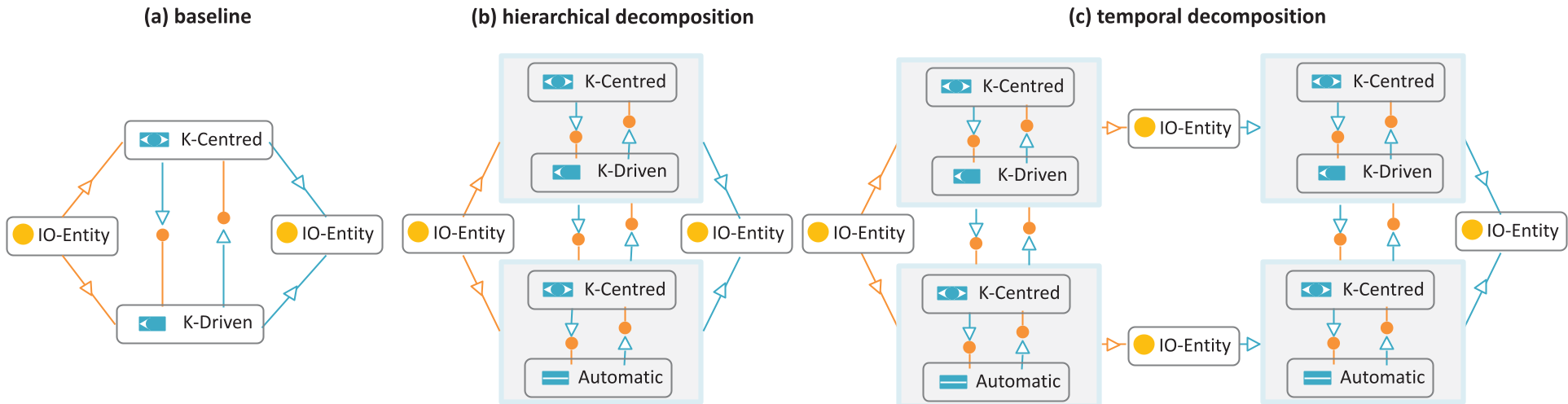 Figure 1: The Diamond Layout. This encourages designers to think about augmenting machine decisions with human intelligence (top-down) and supporting human decisions with algorithms (bottom-up).
2. The Four Stages of VIS4ML
The ontology decomposes the ML lifecycle into four navigable stages:
- Prepare-Data: Cleansing, annotation, and outlier detection (G1).
- Prepare-Learning: Selecting frameworks, defining templates, and feature engineering (G2, G3).
- Model-Learning: Monitoring and active steering of the training process (G4).
- Evaluate-Model: Result analysis, quality metrics, and comparative studies (G5, G6).
Validating the Map: SOTA Pathways
To prove the ontology's utility, the authors mapped the "pathways" of existing high-impact systems.
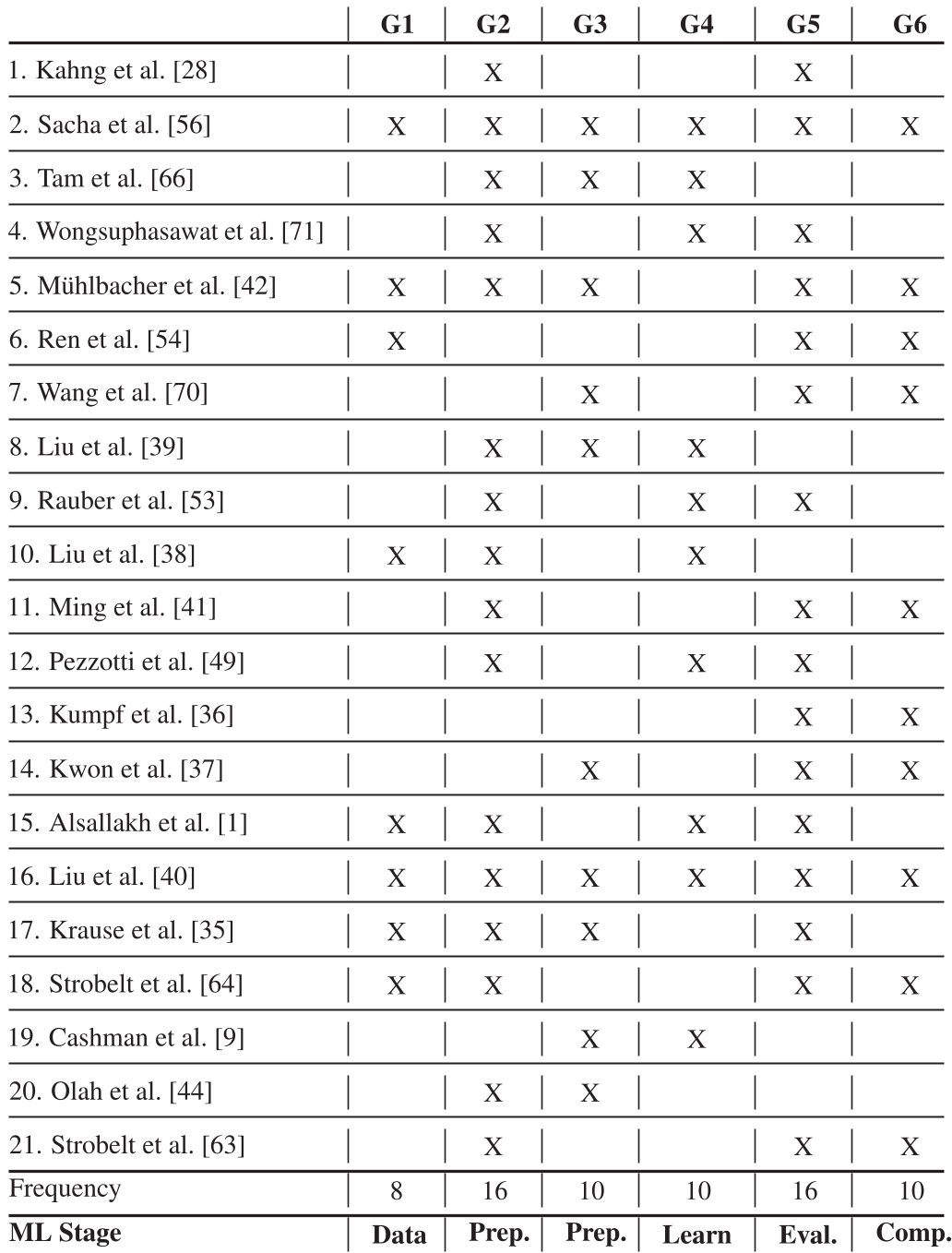 Table 1: Analysis of 21 VA-assisted ML workflows. Note the high frequency of G2 (Understand Model) and G5 (Quality/Result Analysis), indicating areas where VA is currently most mature.
For instance, ActiVis (a system for industry-scale Deep Learning) follows a specific pathway:
- It begins at Prepare-Learning (setting the CNN template).
- Moves to Evaluate-Model, where users explore neuron activations.
- Loops back to Prepare-Data based on human insight to improve the training set.
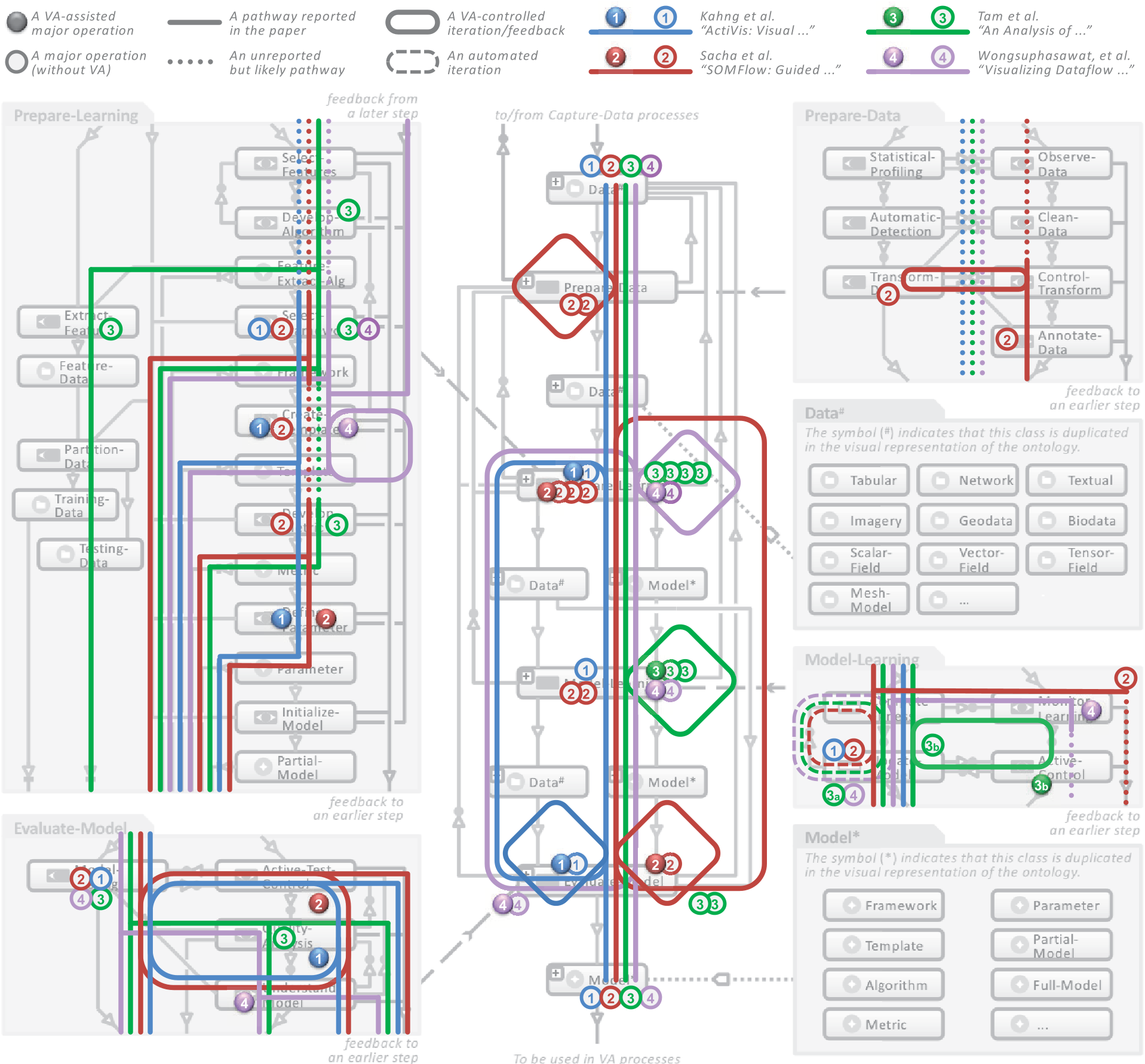 Figure 2: Superimposed pathways of SOTA systems (Red: SOMFlow, Blue: ActiVis, Green: Decision Trees, Purple: TensorFlow). The ontology successfully accommodates wildly different ML paradigms.
Critical Insights: Where do we go from here?
The most striking takeaway from the VIS4ML mapping is the "Data Preparation Gap." While 16 out of 21 studied papers focused on understanding the model or evaluating results, only 8 looked at preparing the data. This suggests that the "human-in-the-loop" for data cleaning and labeling is a massive, underserved area of research.
Future Outlook
As we move into the era of Foundation Models and LLMs, the VIS4ML ontology remains a vital tool. The process of Reinforcement Learning from Human Feedback (RLHF), for example, is a perfect candidate for a VIS4ML pathway—it represents a complex loop of human knowledge directly steering model learning.
Conclusion
VIS4ML is more than just a classification system; it is a theoretical foundation. For practitioners, it provides a checklist to optimize model-development. For researchers, it highlights the "white spaces" in the field where VA has yet to be fully exploited. By standardizing the language of VA-assisted ML, the community can move away from ad-hoc visualizations and toward a systematic engineering of human-AI collaboration.