
Beyond Object Detection: How Vision Language Models are Revolutionizing Construction Safety
Using vision language models for safety hazard identification in construction
This paper introduces a Vision Language Model (VLM)-based framework for automated construction safety hazard identification. By leveraging state-of-the-art VLMs like GPT-4o and Gemini 1.5 Pro alongside prompt engineering, the system translates safety regulations into contextual queries to detect complex hazards, achieving superior semantic alignment with a BERTScore of up to 0.906.
Executive Summary
TL;DR: Researchers from the University of Alberta have developed a framework that replaces rigid object detectors with Vision Language Models (VLMs) to identify construction hazards. By combining visual perception with the reasoning power of models like GPT-4o and Gemini 1.5 Pro, the system moves from simply "seeing" a worker to "understanding" that a worker's proximity to an unsecured trench violates specific safety codes.
Positioning: This work represents a significant paradigm shift from Discriminative AI (identifying labels) to Generative/Reasoning AI (interpreting scenes) in the AEC (Architecture, Engineering, and Construction) industry.
The "Context" Gap: Why Current AI Fails on Sites
For years, construction sites have used YOLO (You Only Look Once) or Faster R-CNN to detect hard hats and vests. However, safety isn't just about wearing equipment; it's about interactions.
- Discriminative AI sees an excavator and a worker.
- Real-world safety needs to know: Is the worker in the excavator's "blind spot" or a "caught-between" zone?
Existing CV methods are "site-specific"—if regulations change, you must re-annotate thousands of images. This paper argues that the bottleneck isn't more data, but better reasoning.
Methodology: Prompting Safety into Vision
The researchers' core insight is the use of Prompt Engineering as a bridge between textual regulations and visual data.
1. The Framework Architecture
The framework operates in two distinct stages:
- Prompt Engineering Module: An LLM (like GPT-4-turbo) ingests raw safety manuals and produces a "structured query" (e.g., "Look for workers at heights without Fall Protection").
- Inference Module: The VLM receives the image + the structured prompt. It uses cross-modal attention to ground the safety concepts in the visual pixels.
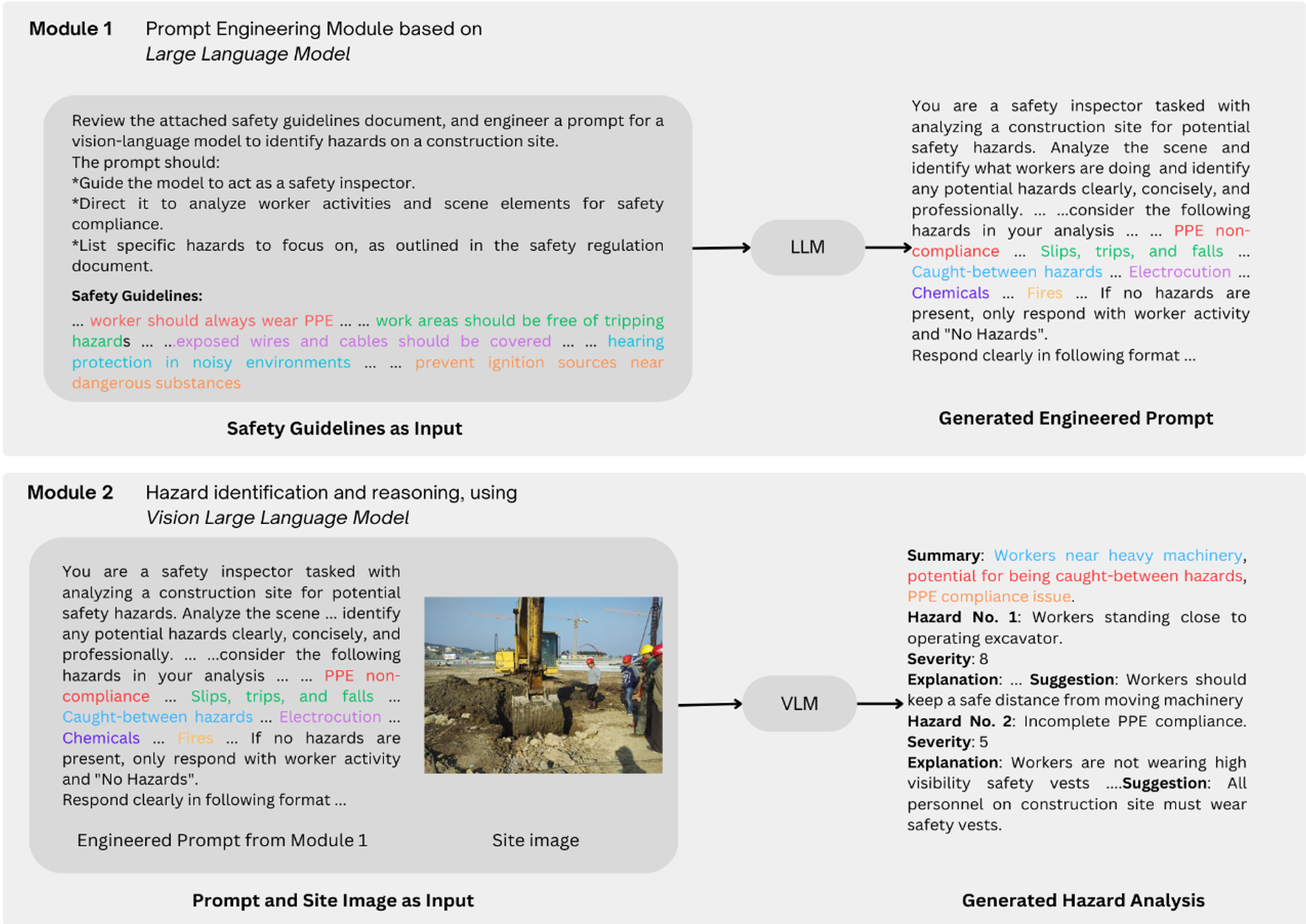
Image 1: The two-module pipeline for VLM-based hazard inference.
Experiments: Performance Benchmarking
The study evaluated a diverse fleet of models, including proprietary giants (GPT-4o, Gemini) and open-source contenders (Llama 3.2 Vision, InternVL2).
SOTA Results
GPT-4o and Gemini 1.5 Pro dominated the "Judge Evaluation," proving they possess the most robust internal world models for construction scenes.
- GPT-4o: BERTScore F1 of 0.906.
- InternVL2-8B: The strongest open-source model, outperforming even some mid-tier proprietary models in specific reasoning tasks.

Image 2: Comparative examples of VLMs identifying hazards like PPE non-compliance and caught-between risks.
The Latency-Accuracy Trade-off
While GPT-4o is accurate, it is slow (4.57 seconds per image). For true real-time safety (e.g., a camera on a crane), Gemini 2 Flash (0.94s) or small InternVL2 models are much more viable, albeit with a slight dip in reasoning depth.
Critical Insight: The Hallucination Hurdle
The paper honestly addresses a "poison pill" for VLMs: Hallucinations. In some cases, models "imagined" missing helmets because the prompt told them to "look for PPE violations," even when everyone was compliant. This suggests that while VLMs have "common sense," they still lack the "precision-first" nature of specialized safety sensors.
Conclusion & Future Outlook
The value of this research lies in its Zero-shot flexibility. A safety manager can now "chat" with their site cameras, asking them to look for specific risks based on today's weather or specific high-risk tasks without writing a single line of code or labeling a single image.
Key Takeaways:
- Proprietary models (GPT/Gemini) are current leaders in "safety logic."
- Open-source models (InternVL2) are "edge-ready" and offer better data privacy.
- Future work must focus on "Grounding"—ensuring the VLM can pinpoint the exact pixels where a hazard exists to reduce hallucinations.
Paper Reference: Muhammad Adil et al., "Using Vision Language Models for Safety Hazard Identification in Construction", 2024.