
LingBot-Vision: Why Boundaries are the Secret Sauce for Physical Intelligence
Vision Pretraining for Dense Spatial Perception
LingBot-Vision is a 1.1B parameter vision foundation model that introduces Masked Boundary Modeling for dense spatial perception. It utilizes a self-supervised teacher-student framework and achieves SOTA results on NYU-Depth v2, outperforming the 7B DINOv3 in depth estimation.
In the quest for "Physical Intelligence," modern AI models often fail at the most basic requirement: understanding the 3D structure of the world. While models like DINOv2 or CLIP excel at recognizing that a "cat" is a "cat," they often struggle to precisely delineate where the cat ends and the floor begins.
LingBot-Vision changes the status quo by introducing Masked Boundary Modeling, a paradigm shift that treats boundaries not as an output task, but as a fundamental learning signal for pretraining.
TL;DR
LingBot-Vision is a 1.1 billion-parameter Vision Transformer trained purely via self-supervision. By forcing the model to focus on image boundaries during pretraining, it achieves superior dense spatial perception—surpassing the 7B DINOv3 in depth estimation tasks despite being 7x smaller.
The Motivation: Semantics vs. Geometry
Current vision foundation models occupy two extremes:
- Semantic Specialists (e.g., CLIP): Great at "what" is in the image, poor at "where" things are.
- Reconstruction Specialists (e.g., MAE): Good at pixels, but lack high-level understanding.
The authors argue that boundaries are the missing link. Boundaries carry the most information and the least redundancy. If a model can reconstruct a missing boundary token from its context, it has truly mastered the spatial structure of the scene.
Methodology: Putting Boundaries Center Stage
The core innovation is a "Boundary-Forcing" teacher-student loop. Unlike standard iBOT or DINOv2 which mask tokens randomly, LingBot-Vision targets the bones of the image.
1. Dynamic Boundary Discovery
Starting from a random initialization, the teacher model predicts "boundary fields"—dense vector maps where each pixel predicts its distance and orientation to the nearest line. Crucially, these are validated using a-contrario theory, ensuring the model only learns from statistically significant structures rather than noise.
2. Boundary-Forcing Mask
The system identifies "boundary-bearing" tokens. These tokens are forced into the student's mask. While the rest of the image is masked randomly, the student must reconstruct these boundary tokens using both semantic and geometric targets.
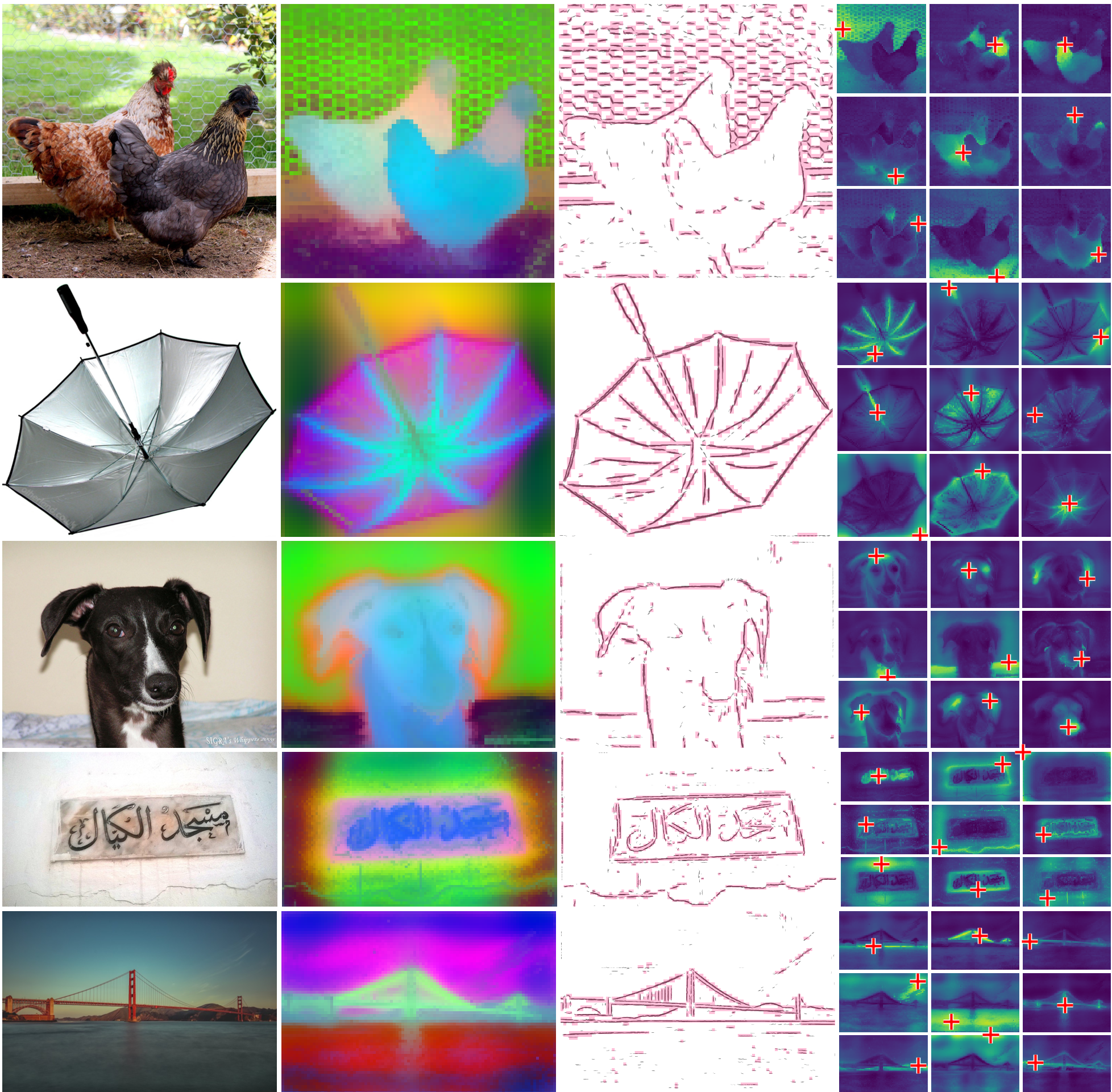 Figure 1: LingBot-Vision learning representations. Boundary tokens (pink) are used to query-patch features, showing how the model captures both semantic grouping and geometric crispness.
3. Categorical Reparameterization
To prevent "unstable" regression (which often causes self-supervised loops to collapse), the authors treat boundary field prediction as a categorical classification problem. This allows them to use the same stabilization tricks (centering and sharpening) used for high-level semantic tokens.
Experiments: Efficiency at Scale
LingBot-Vision was trained on a curated corpus of 161M images—an order of magnitude smaller than the data used for DINOv3. Yet, the results are striking.
SOTA Depth Estimation
On NYU-Depth v2, LingBot-Vision (1B) achieves an RMSE of 0.296. This beats the 7B DINOv3 (0.309) and 2B V-JEPA 2.1 (0.307). This suggests that "boundary awareness" is a better scaling lever for spatial tasks than raw parameter count.
 Table 2: Dense representation benchmarks. Note how LingBot-Vision outperforms models 7x its size in Depth tasks.
Real-World Application: LingBot-Depth 2.0
The authors applied this backbone to a robotics-centric task: depth completion. By using LingBot-Vision as the starting point, they created LingBot-Depth 2.0, which handles difficult materials like glass and mirrors far better than prior active sensing technologies.
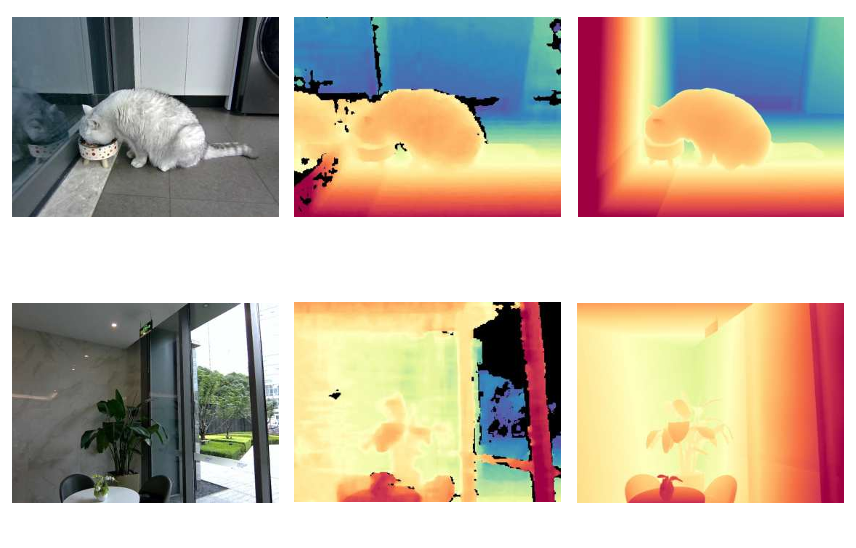 Figure 9: LingBot-Depth 2.0 completing missing sensor data for transparent and reflective surfaces.
Critical Insights & Conclusion
Why does it work? Standard Masked Image Modeling (MIM) is too easy. Most patches in an image are redundant (e.g., a blue sky). By forcing the model to reconstruct boundaries—the hardest parts of the image to predict—the model develops a far more robust "internal map" of the world's geometry.
Limitations While the model is a beast globally and for dense tasks, it still trails the 7B DINOv3 slightly in pure ImageNet-1K classification. This suggests a classic trade-off: localized geometric sensitivity versus global semantic invariance.
The Future LingBot-Vision sets a new bar for how we pretrain "spatial" AI. For robotics, world-models, and navigation, where a 1cm error in geometry matters more than a correct label, this boundary-centric approach is likely the way forward.