
Visual People Counting: Beyond Simple Math via Gender Features and LRU Memory
Visual people counting using gender features and LRU updating scheme
The paper introduces a real-time vision-based system for digital signage that performs both person counting and gender classification. It utilizes Adaboost for face detection, a multi-feature matching algorithm (face and torso) for identification, and a Least Recently Used (LRU) updating scheme for database management, achieving over 90% accuracy in counting and 94% in gender classification.
TL;DR
This research presents a robust, real-time vision system tailored for the digital signage industry. By moving beyond simple motion detection and incorporating facial/torso identification, LRU-based database management, and adaptive gender classification, the system achieves high-precision analytics (90%+ accuracy) at 20 frames per second. It doesn't just count bodies; it understands who is watching and for how long.
Context: The Digital Signage Blind Spot
Advertisers pay premiums for exposure, yet measuring "impressions" in the physical world has historically been imprecise. While infrared beams or simple "blob" tracking can count movement, they cannot tell if the same person walked past twice or if the viewer was the intended demographic (e.g., male vs. female). The central challenge lies in identity persistence and feature robustness under varying lighting and distances.
The Intuition: Why Simple Rules Fail
Prior works often used a FIFO (First-In-First-Out) queue for storing viewer data. If a crowd gathered, the person who arrived first—and might still be watching—would be deleted from memory to make room for a new passerby, leading to massive re-counting errors. Furthermore, gender classification often failed because it relied on static color models that broke down when lighting changed or when different ethnicities were involved.
Methodology: The Core Innovations
1. The Identification Pipeline (Face + Torso)
The system doesn't rely on a single feature. It uses a weighted sum of:
- Facial Similarity: Normalized SAD (Sum of Absolute Differences) and NCC (Normalized Cross Correlation).
- Torso Traits: A critical addition because people in groups often dress distinctly even if their faces are partially obscured.
- Histogram Matching: Specifically using the H-channel of the HSV space, which proved more resilient for clothing differentiation than the V-channel.
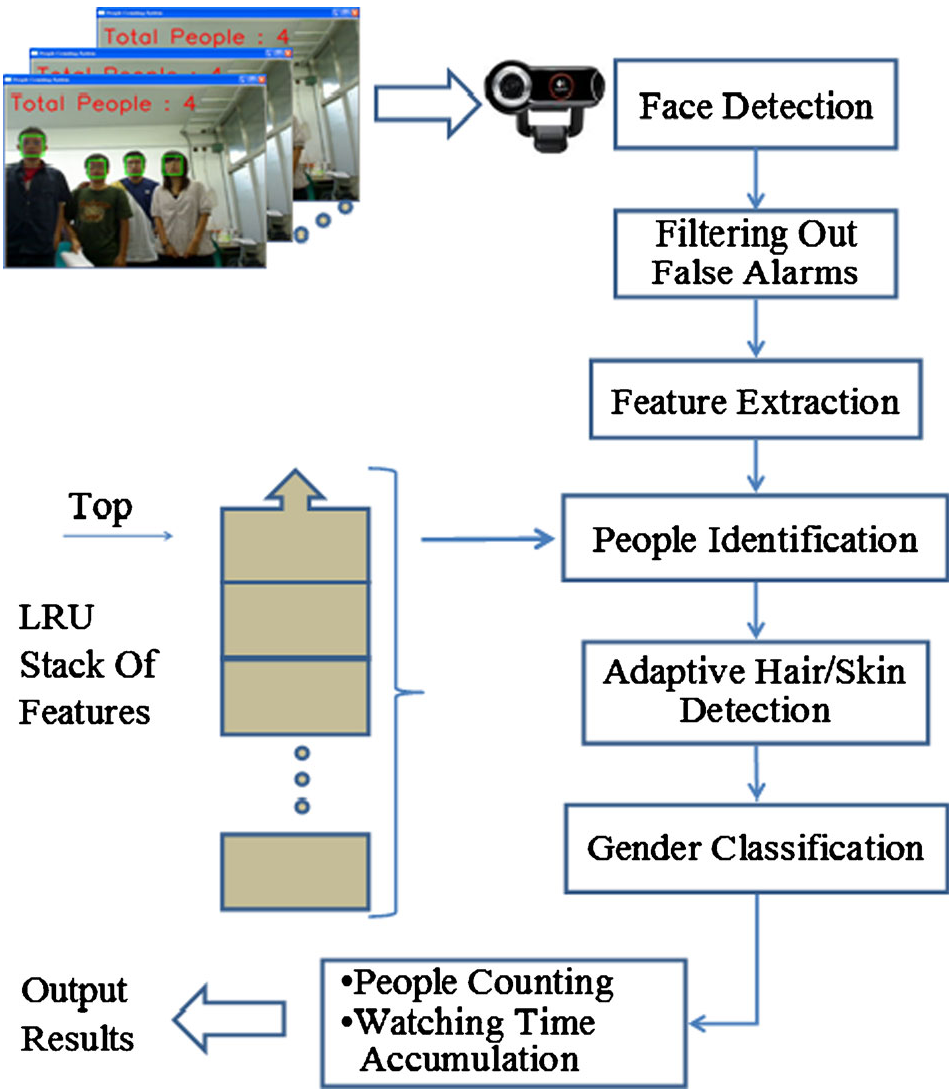
2. LRU Stacking: Smart Memory
Instead of FIFO, the authors utilized Least Recently Used (LRU) logic. This ensures that the most "active" viewers stay in the database, while only those who have likely left the camera's field of view are purged. This simple pivot in data structure design solved a major hurdle in "double-counting" errors.
3. Adaptive Gender Recognition
To classify gender, the authors didn't just look for "long hair." They built adaptive color models for every individual.
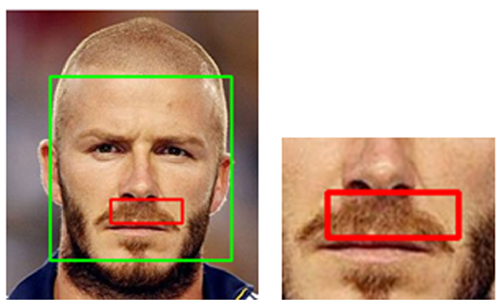
- The system samples the center of the face for skin color and the area above for hair color.
- It calculates the ratio of hair volume to skin area across four specific ROIs (Upper/Lower Left/Right of the neck).
- These ratios are fed into a Nonlinear SVM (RBF Kernel), which outperforms simple thresholding by handling the non-linear distribution of gender-specific traits.
Experiments and Critical Results
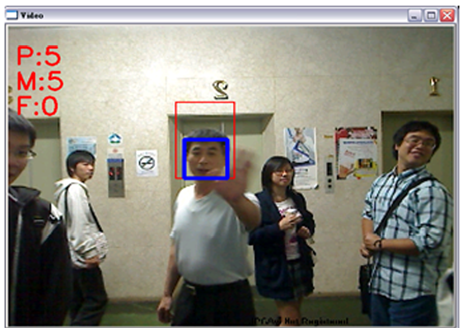
The system was stress-tested in real-world scenarios, including the SecuTech Expo.
- Accuracy: True positive counting hit 94.57% in restaurant hallway tests.
- Efficiency: The pipeline maintains 15-20 FPS on standard PC hardware.
- Robustness: By setting a "watching time" threshold (e.g., 3 seconds), the system effectively filters out disinterested passersby, providing "True Impression" metrics for marketers.
Critical Insight: The "Gender-Neutral" Challenge
One of the most honest aspects of the paper is the analysis of failure cases. The authors note that "gender-neutral" appearances—short-haired women or long-haired men—remain a hurdle for hair-ratio-based classifiers. This highlights a shift in the field: as social norms evolve, visual heuristics must move toward more subtle features (bone structure, gait, or clothing style) to maintain accuracy.
Final Summary
This work demonstrates that SOTA performance in industrial computer vision isn't just about the "hottest" model, but about intelligent system design. By combining established algorithms like Adaboost and SVM with clever data structures (LRU) and adaptive features, the authors created a highly practical solution for real-world retail analytics.