
Beyond "Happy" or "Sad": Decoding the Complexity of Compound Facial Emotions
SPECIAL SECTION ON VISUAL SURVEILLANCE AND BIOMETRICS: PRACTICES, CHALLENGES, AND POSSIBILITIES
This paper introduces the iCV-MEFED dataset, a large-scale collection of 31,250 facial images across 50 fine-grained compound emotion categories. It systematically evaluates three top-performing CNN-based methods from the FG 2017 challenge, establishing a new benchmark for recognizing dominant and complementary emotions (e.g., happily-surprised).
TL;DR
Human emotions are rarely pure. We often feel "happily surprised" or "angrily disgusted." While AI has mastered the seven basic emotions, it struggles with these nuanced "compound" expressions. This paper introduces the iCV-MEFED dataset—a 50-class benchmark labeled by psychologists—and analyzes why current deep learning models fail to distinguish the "dominant" emotion from its "complementary" counterpart.
Background: The Affective Wall
For decades, the computer vision community has relied on Paul Ekman’s six or seven basic emotions. However, real-world Human-Computer Interaction (HCI) demands more. Existing attempts to solve compound emotions faced a data wall: EmotionNet is massive but noisy (auto-labeled), while others are too small for deep learning. iCV-MEFED fills this gap with 31,250 high-resolution images across 50 categories, providing a "high-fidelity" playground for researchers.
Why iCV-MEFED is Difficult
The core challenge is Fine-Grained Similarity. If you are "surprisingly happy," your face combines specific Action Units (AUs) from both surprise and happiness. Determining which one is the dominant signal is a subtle task that requires the model to understand the intensity and hierarchy of facial muscle movements.
Methodology: Three Paths to Emotion Recognition
The paper evaluates three winning strategies from the FG 2017 Challenge:
1. The Multi-Modal Fusion (Winner)
The top-ranked method recognized that pixels alone aren't enough. It combined:
- Texture: Standard AlexNet features.
- Geometry: "Landmark Displacement" (the difference between a subject's neutral face and their current expression). Insight: By providing the model with a "residual" of how much the eyes or mouth moved, it gains an inductive bias about the physical deformation of the face.
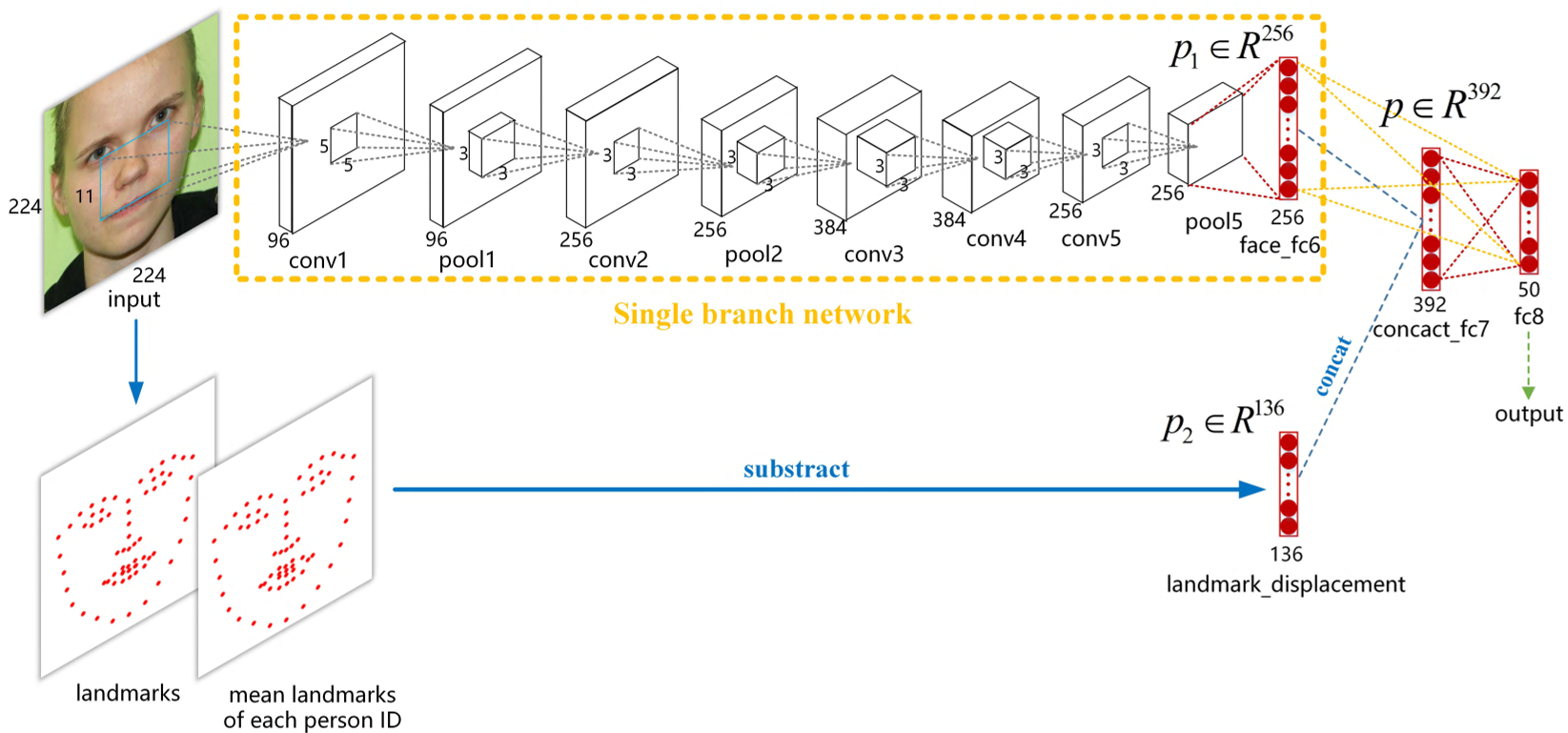 Figure 1: The winning multi-modality architecture fusing landmark geometry with texture features.
2. Unsupervised Feature Learning
The second-place method used a shallow CNN where filters were learned via k-means clustering instead of backpropagation. While simpler, it proved that for highly controlled environments, wide shallow networks can sometimes outperform deeper "black boxes."
3. Discriminative Latent Spaces
The third-place method used Inception-V3 with Center Loss. Insight: Since "happily-angry" and "surprisingly-angry" are semantically close, standard Cross-Entropy loss pushes them apart indiscriminately. Center Loss forces the model to learn a compact "cluster center" for each emotion, making the boundaries more robust.
The Results: A Reality Check for AI
The experiments yielded a humbling result: current SOTA models are still significantly worse at compound emotions than basic ones.
- Basic Emotion Accuracy: ~51.84%
- Compound Emotion Accuracy: ~13.7%
The most frequent errors occurred between "inverted" pairs. For example, models consistently confused surprisingly-happy with happily-surprised.
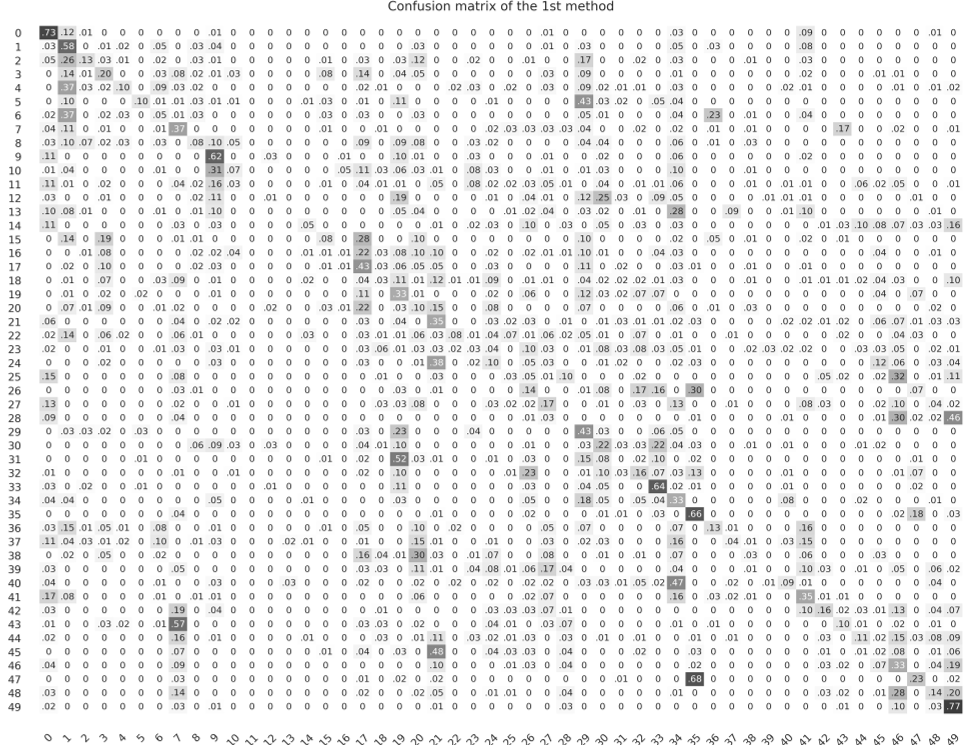 Figure 2: Confusion matrix showing the high error rate in distinguishing dominant vs. complementary hierarchy.
Critical Analysis & Conclusion
The iCV-MEFED dataset proves that emotion recognition is far from "solved." The main takeaway is that classification is the wrong framework for compound emotions. Current models treat all 50 classes as independent (One-Hot), ignoring the fact that "happily-surprised" shares 90% of its DNA with "surprised."
Future Outlook: To bridge the gap, researchers should move toward multitask learning—where one branch detects the dominant emotion and another detects the complementary one—or use Graph Neural Networks (GNNs) to model the intrinsic relationship between emotion labels.
Final Takeaway
If you want your robot to truly understand humans, don't just look at the face—look at the displacement of the landmarks and the hierarchy of the feelings.