
Mapping the Intelligence Revolution: A Bibliometric Deep Dive into AI in Marketing
Visualising the Knowledge Domain of Artificial Intelligence in Marketing: A Bibliometric Analysis
This study presents a comprehensive bibliometric analysis of Artificial Intelligence (AI) in Marketing, utilizing 617 research outputs from the Web of Science (1992–2020). Using CiteSpace, the authors visualize the knowledge domain, identifying key journals like "Expert Systems with Applications" and mapping the surge in publications since 2017.
Executive Summary
TL;DR: This study provides a rigorous quantitative architectural map of how Artificial Intelligence has permeated marketing science over three decades. By analyzing over 600 core publications, the research highlights a massive 2017 pivot point, moving from basic neural networks to complex ecosystems like autonomous shopping and digital sentiment mining.
Academic Positioning: This is a core bibliometric "landscape" paper. It doesn't propose a new algorithm; rather, it provides the provenance and structural taxonomy of the field, enabling researchers to identify white spaces and understand the "genealogy" of marketing-tech.
Problem & Motivation: Beyond Qualitative Guesswork
For years, AI in marketing was treated as a collection of isolated tactical tools—a recommender system here, a forecasting model there. However, as the volume of research exploded (especially post-2017), it became nearly impossible for scholars to track the dominant intellectual clusters.
The authors recognized that traditional literature reviews were too subjective. They aimed to answer:
- Which countries and institutions are driving the "Brain Gain" in marketing AI?
- Is the field collaborative or fragmented?
- What are the "underground" clusters that will define the next decade of commercial strategy?
Methodology: Visualizing the Knowledge Domain
The authors utilized CiteSpace, a Java-based visualization tool, to perform a co-citation and keyword co-occurrence analysis. This transforms static bibliography data into dynamic "Knowledge Maps."
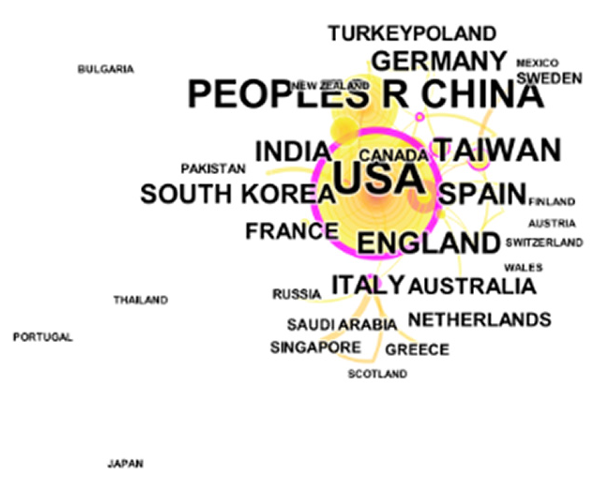 Fig 1. The geography of innovation: USA and China emerge as central hubs, but England displays the highest "Betweenness Centrality," acting as a crucial bridge between diverse research nodes.
Key Hotspots: Where the Heat Is
The analysis identified 8 major clusters through Log-likelihood Ratio (LLR) clustering. The most influential ones include:
- Blog Mining (#0): Focusing on extracting "Customer Intelligence" from unstructured online text.
- Lean Global Startup (#1): High-speed internationalization driven by AI-informed strategic decisions.
- Revenue Model (#2): Using eye-tracking and ANN (Artificial Neural Networks) to maximize gaze hits and sponsorship value.
- Marketing Excellence (#3): Linking AI-driven social media sentiment directly to stock market performance.
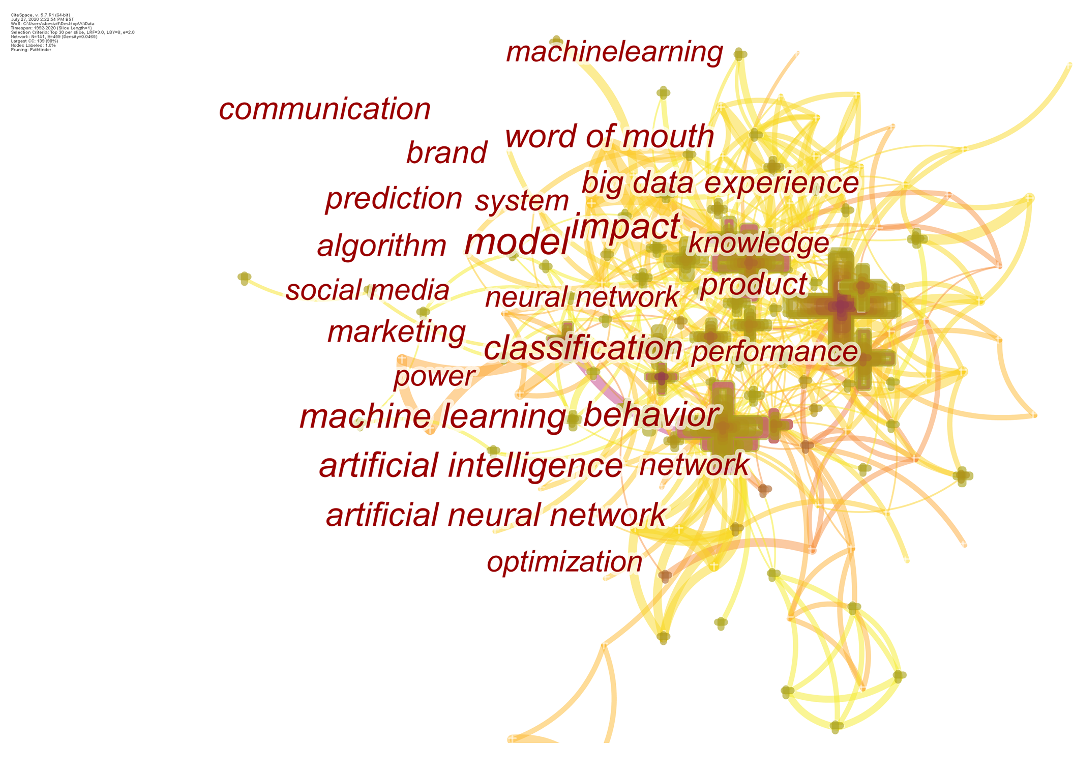 Fig 2. The Keyword Map reveals that "Neural Network" and "Machine Learning" are the foundational anchors, while "Social Media" and "Classification" represent the primary application layers.
Critical Analysis & Insights
The data reveals a striking lack of high-intensity collaboration (Network Density: 0.0751). Most research is still being done in silos. This suggests that the "grand unified theory" of AI-Marketing is yet to be written.
Furthermore, the surge post-2017 isn't just coincidental; it aligns with the democratization of Deep Learning and the availability of massive historical datasets. The move toward "Autonomous Shopping Systems" (Cluster #6) indicates the field is shifting from "AI as a tool" to "AI as the environment."
SOTA Comparison: Leading Journals
| Journal | Articles | Impact |
|---|---|---|
| Expert Systems with Applications | 45 | Dominant Technical Outlet |
| IEEE Access | 14 | Rising Engineering Interest |
| Industrial Marketing Management | 9 | Core Business Application |
Conclusion & Future Look
Takeaways: This paper proves that AI in Marketing is no longer an emerging niche but a mature, multi-billion-dollar research domain. The focus is shifting from "can we predict?" to "how does this create business value (BV)?"
Limitations: The study is restricted to the Web of Science and English-language papers. As China (ranked 2nd in volume) increases its domestic research output, non-English databases will become essential for a truly global view.
Future Outlook: We expect the next iteration of this analysis to be dominated by Generative AI and Ethical AI (Privacy), clusters that were only just beginning to form when this data was collected.