
Seeing Through Others' Eyes: Why Privacy Visualization is the Mirror Social Media Needs
A visualization tool for evaluating access control policies in facebook-style social network systems
The paper introduces a prototypical visualization tool for Reflective Policy Assessment (RPA) designed for Facebook-style Social Network Systems (FSNSs). It enables users to evaluate topology-based access control policies by visualizing their extended social graph and simulating how their profile appears to specific potential accessors.
TL;DR
Managing privacy on modern social networks is a cognitive nightmare. This paper introduces a visualization tool for Reflective Policy Assessment (RPA), allowing users to navigate an interactive social graph and see their profile exactly as a "friend of a friend" or a "stranger" would. Experimental results show a staggering 150% improvement in users' ability to correctly identify who can see their data.
The Problem: The Topology Trap
In the early days of the web, access control was simple: User A can see Folder B. In the era of Facebook, privacy is topology-based. Your "Friends-of-Friends" policy doesn't just depend on you; it depends on every connection your friends make.
The authors argue that users suffer from a lack of "Impression Management." We check a mirror before a date to see what others see; why don't we have a mirror for our digital lives? Without one, it's nearly impossible to mentally track the reach of sensitive info like sorority photos or contact details in a constantly shifting social graph.
Methodology: The Digital Mirror
The core innovation is the Reflective Policy Assessment (RPA) prototype.
1. Privacy-Preserving Graph Generation
One major challenge is that showing Alice her entire extended network might violate the privacy of people she doesn't know. To solve this, the authors used a clever insight: an RPA tool doesn't need to be 100% accurate about who is out there, just what type of connection they have. They used the R-MAT algorithm to generate synthetic nodes that mimic real social network behaviors (like the Small-World characteristic), ensuring the "mirror" reflects realistic scenarios without leaking real data.
2. Interaction Design
The tool provides a "What-If" analysis interface. By hovering over different vertices (nodes) in the social graph, the user sees a real-time configuration of their profile.
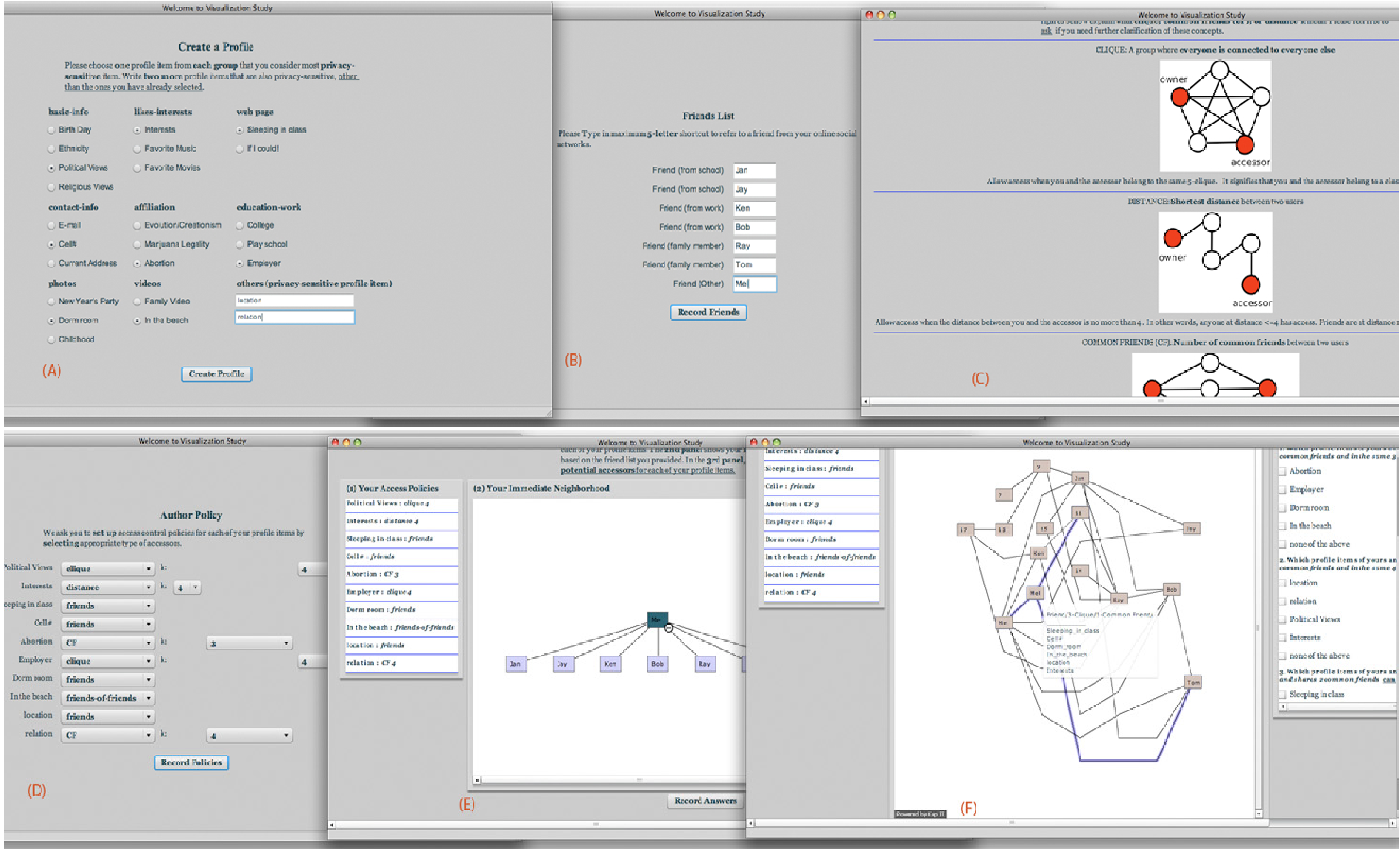 Figure: The prototype workflow, from profile creation (A) to the interactive RPA visualization tool (F).
Experiments: Measuring the "Aha!" Moment
To prove the tool's value, the researchers conducted a within-subject study involving 36 participants. They compared how well users understood their own privacy settings under two conditions: manual mental checking vs. using the RPA tool.
Key Results:
- Accuracy Boost: When asked "Who can see this specific photo?", users using the tool scored 86.71%, compared to a dismal 33.72% for those relying on memory and standard menus.
- User Confidence: 20 out of 36 participants felt "obviously" more confident about their privacy settings after using the tool.
- Social Awareness: One participant noted, "After using the tool, I understand that a lot more people can access my profile than what I thought."
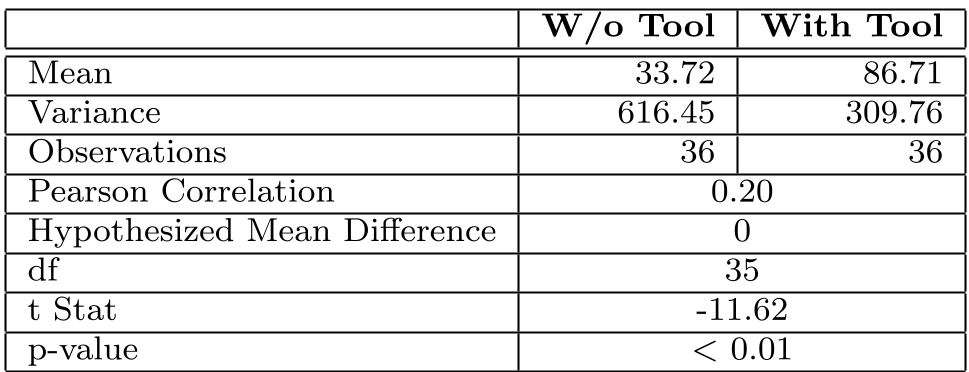 Table: Comparison of test scores showing significant improvement with tool support.
Critical Insight: Beyond the "Friend" List
The real power of this method lies in its support for advanced topology-based policies like k-cliques (groups where everyone knows each other) and common-friendsk. These are mathematically robust but human-unfriendly concepts. By transforming these abstract predicates into a visual map, the tool bridges the gap between complex security logic and human intuition.
Conclusion & Future Outlook
While this study was performed on a desktop application, the implications for modern mobile social apps are huge. As privacy becomes a competitive advantage for platforms, moving away from "Privacy Checklists" toward "Privacy Simulators" is the logical next step.
Limitations: The current tool relies on synthetic data for unreachable nodes. Future work could investigate how to integrate real-time "Social Distance" metrics from actual Facebook or LinkedIn APIs without compromising the privacy of non-consenting third parties.