
Mirrors in the Social Cloud: Solving the Privacy Visualization Dilemma
Visualizing Privacy Implications of Access Control Policies in Social Network Systems
The paper introduces a privacy-enhanced visualization tool for Facebook-style social network systems (FSNS) that enables "reflective policy assessment." It utilizes an R-MAT graph generation algorithm to create synthetic surrogates of a user's extended neighborhood, allowing users to safely visualize their profile from a third-party perspective without breaching others' privacy.
TL;DR
Managing privacy on social networks is often a guessing game. This paper proposes a "Mirror-based" visualization tool that allows users to see their profile through the eyes of others. To avoid stalking while checking for stalkers, it uses synthetic graph generation (R-MAT) to create a "surrogate neighborhood" that behaves like a real social network without exposing private user identities.
The Cognitive Gap in Digital Privacy
In our physical lives, we use mirrors for Impression Management. Before heading out, we check how we look to ensure the world sees what we intend. In social networks, "looking good" means controlling information flow.
However, modern Facebook-style systems (FSNS) use Topology-Based Policies. Unlike simple "Public" or "Private" settings, these depend on the social graph (e.g., "Only show to people who share 3 mutual friends"). Because the social graph is a massive, shifting entity co-constructed by millions, it is mentally impossible for a user to know exactly who can see what.
The Privacy Dilemma
If Alice wants to see how Bob sees her profile, she needs to know where Bob is in the graph. But what if Bob has set his privacy to be "invisible" to friends-of-friends like Alice? To help Alice assess her privacy, the system would have to violate Bob's privacy. This is the Asymmetric Trust Dilemma.
Methodology: Synthetic Neighbors and Reflective Assessment
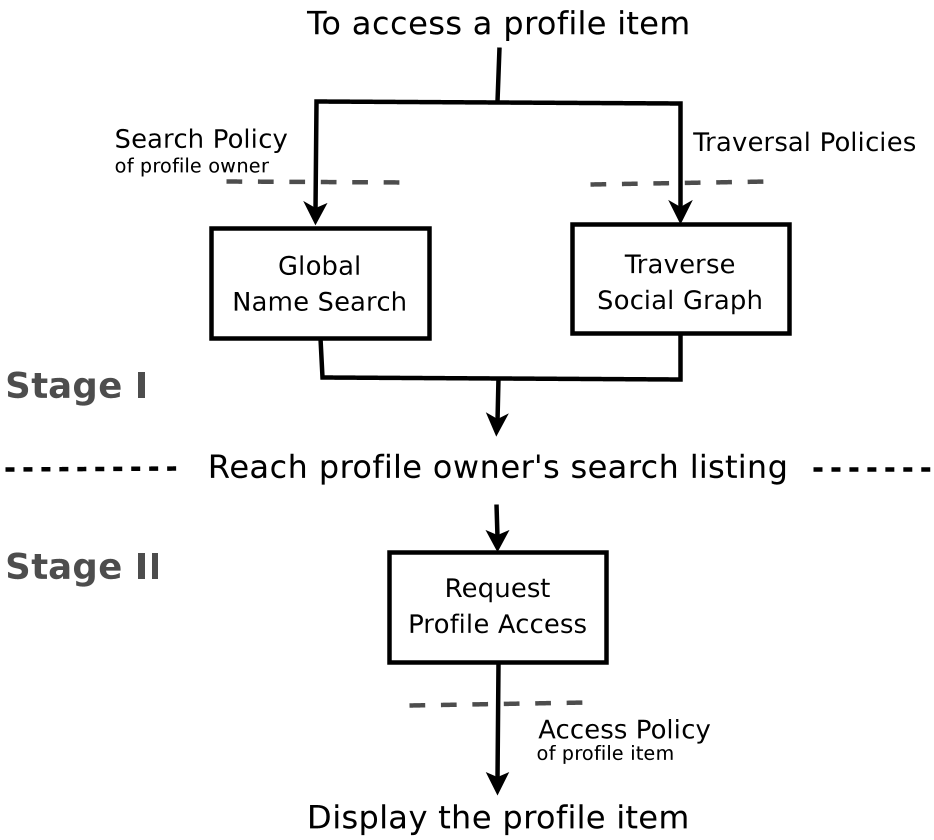
The authors introduce Reflective Policy Assessment. The core idea is to provide a visualization that doesn't just show "who" is looking, but "what kind of topological relationship" is looking.
1. The Social Graph Surrogate
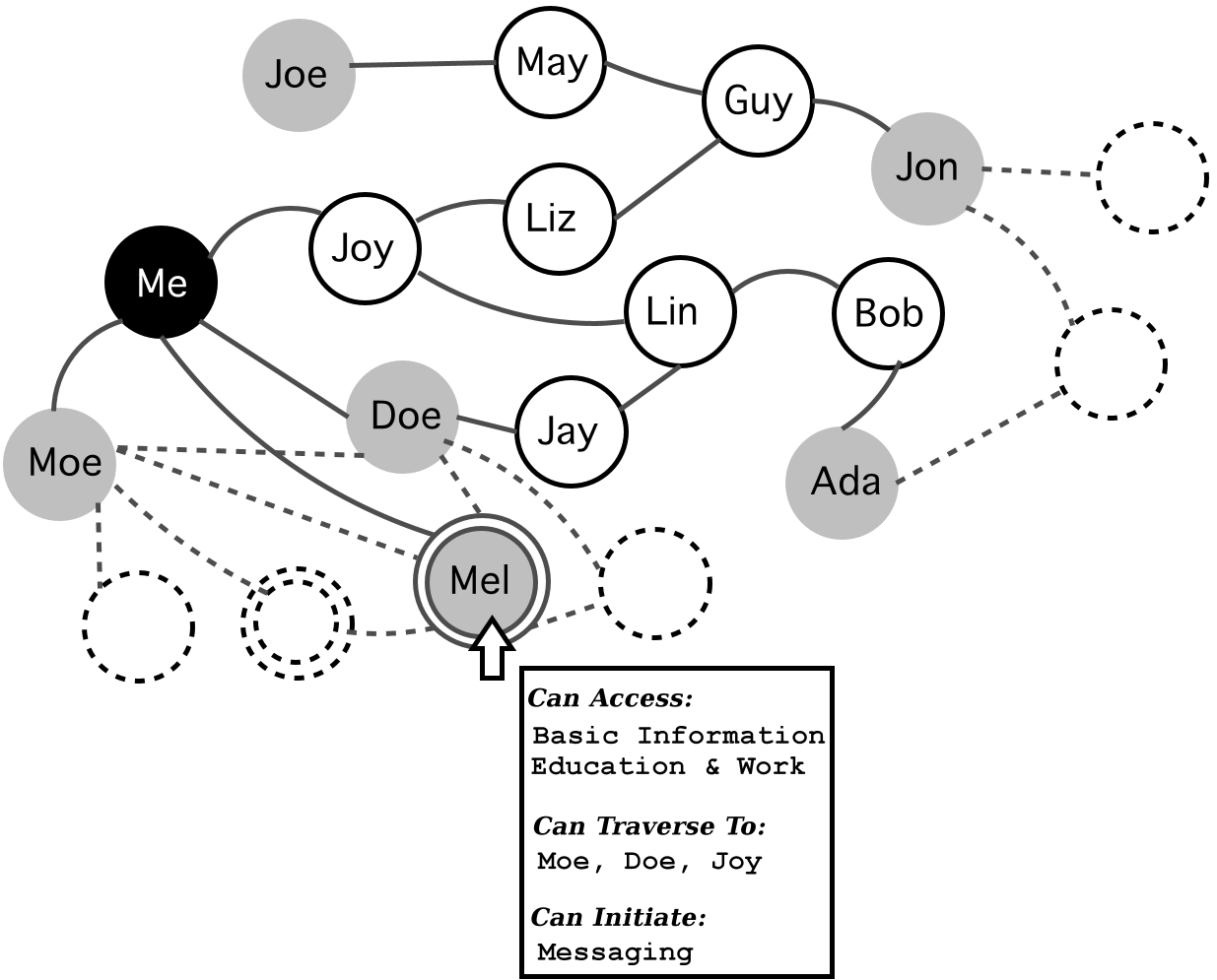
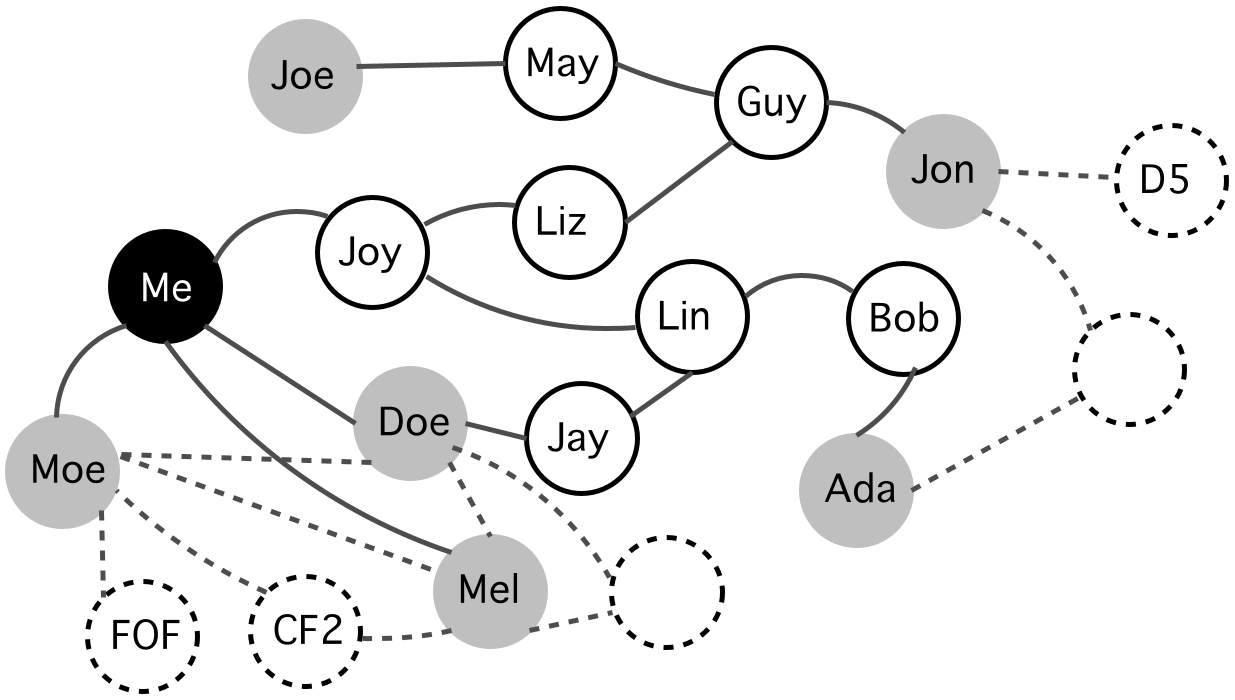
Instead of showing the real, restricted parts of the network, the tool builds a hybrid graph:
- Reachable Region: Real nodes and edges that Alice is allowed to see.
- Unreachable Region: "Synthetic" nodes and edges generated using the R-MAT algorithm.
By using R-MAT, the generated graph maintains the Power-Law and Small-World characteristics of real social networks. This allows Alice to test her "Distance-k" or "Clique-k" policies on realistic—but fake—data.
2. Identifying "Interesting Access Scenarios"
You don't need to check 10,000 friends if most of them see your profile exactly the same way. The authors define Equivalence Classes for access. If Alice has different policies, there are at most distinct "views" of her profile. The tool intelligently highlights "interesting" nodes that represent these unique viewpoints.
Why This Matters: From "What" to "Why"
Most privacy research focuses on the "What"—the encryption or the hard math. This paper focuses on the "Why"—the human intent.
- Reflective Interaction: The tool acts as a "What-if" simulator. Alice can move her cursor to a synthetic node and instantly see a pop-up of what that person sees.
- Safety Analysis: It proves that as long as the system only uses topology-based policies, visualizing the "mirror" doesn't leak any private information that wasn't already topologically reachable.
Critical Analysis & Conclusion
The brilliance of this work lies in using Synthetic Data not just for privacy preservation in datasets, but as a UX bridge. It acknowledges that human users aren't experts in graph theory; they need visual evidence to feel secure.
Limitations & Future Work
- Scalability: In a network of millions, how do we efficiently pick which "unreachable" nodes to simulate? The authors suggest "Focus + Context" using hyperbolic planes, but the computational cost of real-time graph generation remains a challenge.
- User Truthfulness: Does seeing a "fake" neighbor actually give a user "real" confidence? A broader user study is required to see if this visualization actually changes user behavior for the better.
Takeaway: Future privacy interfaces should stop showing us lists of rules and start showing us "reflections" of ourselves in a simulated digital mirror.