
NWI Algorithm: Identifying Power Spreaders in 5G Mobile Social Networks via User Behavior
17203_Vital nodes extracting method based on user's behavior in 5G mobile social networks.
This paper introduces the Node Willingness and Influence (NWI) algorithm, a novel method for extracting vital disseminators in 5G Mobile Social Networks (MSNs). By integrating user behavior metrics like "willingness to share" with topological features, NWI achieves superior performance in identifying influential spreaders across various real-world datasets.
TL;DR
In the era of 5G, the efficiency of wireless communication can be vastly improved by leveraging Device-to-Device (D2D) links. However, the bottleneck is identifying who should be the origin of information. This paper proposes the Node Willingness and Influence (NWI) algorithm, a hybrid approach that combines dynamic network snapshots with personal "willingness" to share data. It consistently outperforms traditional metrics like Degree Centrality and Betweenness Centrality in both spreading speed and computational speed.
Background: Why Networks aren't Just Dots and Lines
Most current algorithms treat social networks as static collections of binary links (you are either connected or you aren't). In the real world—especially in 5G mobile social networks (MSNs)—connectivity is fluid. Some users are "selfish," staying invisible when others need data, while others are "willing" spreaders.
The researchers argue that to find a "vital node," we must answer two questions:
- Topology: Where is the node located?
- Behavior: How much does the node actually interact with its neighbors?
Methodology: The NWI Framework
The NWI algorithm is built upon two sophisticated graph models: Temporal Evolution Graphs (capturing duration and time order) and Time-Aggregated Graphs (summarizing total contact frequency).
The Core Components:
- Influence (In): Measures the "Willingness" (). If a node has high contact times () relative to the network average, it is considered highly willing.
- Weighted Strength Degree (WSD): A balanced metric () between a node’s own weight and its neighbors’ total influence.
- Clustering Impact Coefficient (CIC): This applies a Sigmoid function to social clustering. It rewards nodes located near the "core" of the network, ensuring they aren't just loud, but also well-positioned to reach diverse communities.
 Figure 1: Visualizing how intermittent contacts are aggregated into a weighted graph model.
Experiments: Performance in the Real World
The authors validated NWI using several datasets, including Zachary’s Karate Club and MIT Reality Mining.
1. Spreading Efficiency (SIR Model)
Using the Susceptible-Infected-Recovered (SIR) model, the authors "infected" the top 10 nodes identified by NWI and compared them to other methods. In the MIT network, NWI-selected nodes reached a higher stable infection rate faster than any other benchmark.
2. Computational Speed
Scale is the enemy of network analysis. As shown in the training time comparison, NWI scales linearly and stays well below the processing time required by CbM or EBC algorithms, making it viable for large-scale 5G deployments.
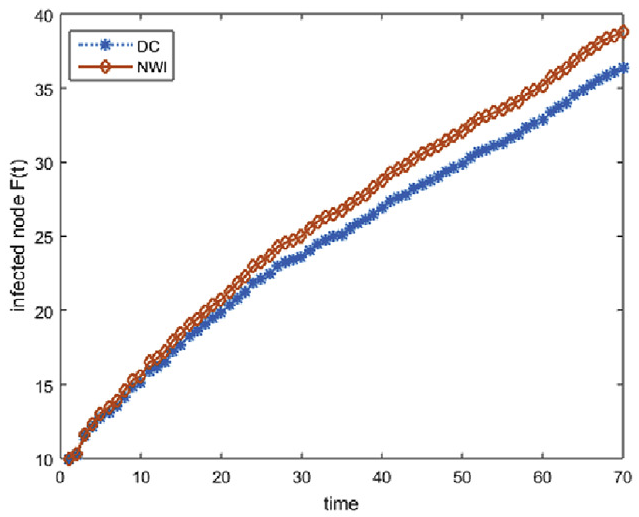 Figure 2: SIR model results showing NWI (blue/top line) consistently leading in spreading capability.
Critical Insight & Takeaway
The genius of NWI lies in its behavioral-weighted approach. By penalizing "selfish" nodes (those with low contact weights despite high degrees), NWI ensures that the selected seeds are actually active participants in the network.
Key Takeaways:
- Context over Topology: A high degree (many friends) means nothing if the user rarely interacts. NWI captures this "silent friend" phenomenon.
- Scalability: By using time-aggregated matrices, NWI avoids the memory explosions common in dynamic graph analysis.
- D2D Potential: This work provides a mathematical roadmap for 5G network operators to choose relay nodes for data offloading, effectively saving cellular bandwidth.
Future Outlook
While NWI is robust, future work could integrate content awareness. Currently, the model assumes a node's willingness is universal, but in reality, a user might be willing to share sports news but not technical papers. Integrating NLP with NWI could be the next frontier in MSN analysis.