
Vivisecting WhatsApp: A Deep Dive into the Infrastructure of a Messaging Giant
Vivisecting whatsapp through large-scale measurements in mobile networks
This paper presents the first large-scale characterization of WhatsApp traffic using a multi-vantage point methodology combining passive core network measurements, active global DNS probing, and end-device analysis. The study reveals a highly centralized US-based architecture and identifies key traffic patterns, such as video content accounting for nearly 40% of total volume.
TL;DR
This seminal 2013-2014 study provides a rare "vivisection" of WhatsApp's network behavior during its period of explosive growth. By analyzing millions of flows at a national carrier level, researchers discovered that WhatsApp relied on a surprisingly centralized US-based infrastructure, where video content dominated bandwidth (40%) and device operating systems (iOS vs. Android) dictated network heartbeat intervals.
Background: The SMS Killer
In 2014, WhatsApp was already handling 64 billion messages daily, effectively rendering traditional SMS/MMS obsolete. For Mobile Network Operators (MNOs), this represented a "black box" of encrypted traffic. This paper aims to peel back the encryption layer to understand how WhatsApp scales and how it impacts global mobile networks.
Problem & Motivation: The Opaque Cloud
Existing research at the time struggled with two things:
- Encryption: Since WhatsApp traffic is encrypted via TLS/XMPP, simple Deep Packet Inspection (DPI) wasn't enough to distinguish between a simple "Hello" text and a heavy video file.
- Infrastructure Complexity: Does WhatsApp use a Global CDN? Are there local caches? Understanding this is critical for ISPs to optimize routing and peering.
Methodology: DNS as the Skeleton Key
The researchers didn't break the encryption; they looked at the "labels" on the packages. By monitoring DNS requests for *.whatsapp.net at the core of a European mobile network, they mapped specific IP addresses to different services (chat, media, control).

They categorized servers into:
- Chat Servers: Port 5222 (XMPP) or 443, kept alive constantly.
- Multimedia (MMS/MMV) Servers: Dedicated HTTPS connections for photos and videos, closed immediately after transfer.
Key Insights: Centralization and OS Bias
1. Extreme Centralization
Surprisingly, despite having half a billion users, WhatsApp was not distributed. Active measurements via RIPE Atlas showed that no matter where you were in the world, your phone talked to servers in Dallas or Houston, Texas (hosted by SoftLayer).
2. The Video Elephant
While 93.4% of flows were for chat, they occupied only 17% of the downlink volume. Video sharing, despite being a small fraction of total flows, consumed 40% of the total traffic volume.
3. Idle Timeouts and OS Fingerprinting
The study found that the "heartbeat" of the application—how long it keeps a connection idle—depended on the phone's OS.
- iOS: Very aggressive, timing out after just 3 minutes.
- Android: Used "steps" at 10, 15, and 24 minutes. This revealed how different mobile OS backgrounds manage battery vs. network persistence.
Analyzing the Great Outage
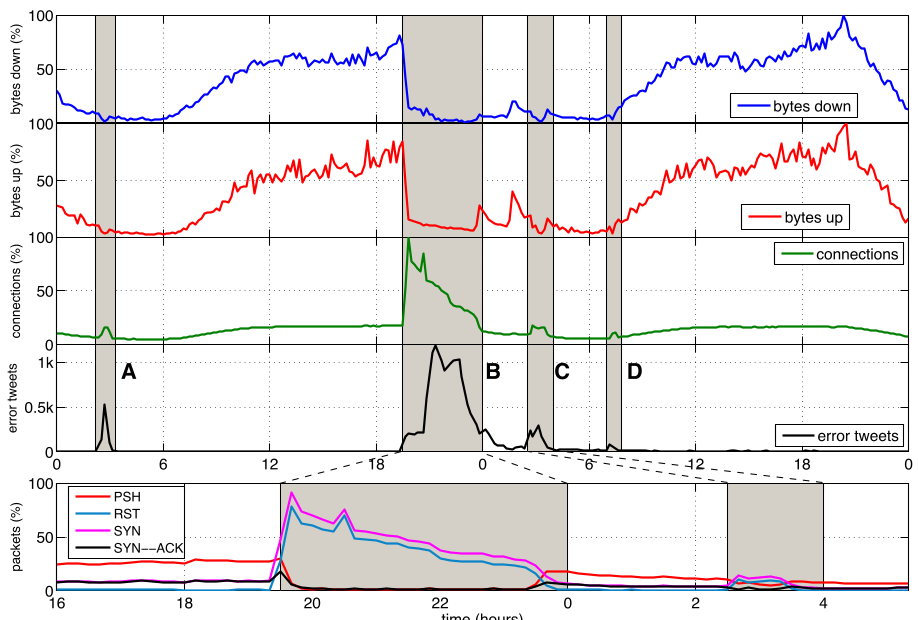
The paper captures a historic moment: the WhatsApp outage of February 22nd, 2014. By correlating network spikes in SYN and RST packets (indicating failed reconnection attempts) with real-time Twitter data ("error tweets"), the authors proved that user frustration could be predicted through network anomalies.
Takeaways and Future Perspective
This research demonstrated that even "black box" encrypted services leave a massive footprint in the DNS and transport layers. While WhatsApp has since modernized its infrastructure (moving closer to Facebook's edge networks), the methodology of "vivisecting" app behavior through core network measurements remains a gold standard for ISP traffic management.
Limitations: The study was conducted before WhatsApp's full integration into Facebook’s (Meta’s) global infrastructure, meaning its findings on extreme centralization likely changed as the service migrated to Meta's proprietary global CDNs.