
Deciphering the Language of Crisis: A Linguistic Analysis of Romanian Hazard Posts
Vocabulary, Synonyms and Sentiments of Hazardrelated Posts on Social Networks An analysis for Romanian messages
This paper presents a computational linguistics analysis of Romanian social media posts during emergency situations (earthquakes and fires). Utilizing the DUMBONET framework, it establishes specific vocabularies and sentiment patterns on Twitter and Google+ to optimize keyword-based search logic for disaster monitoring.
TL;DR
When disasters strike, the way we talk changes. This paper analyzes Romanian social media behavior during earthquakes and fires, revealing that while our vocabulary shrinks and becomes repetitive, it carries heavy emotional weight. By identifying the most frequent terms and synonym preferences, the research provides a blueprint for building more accurate emergency monitoring systems.
Problem & Motivation: The Noise in the Signal
Monitoring Social Networks (SNs) for emergencies isn't as simple as searching for the word "Fire." In a crisis, data streams are flooded with noise—irrelevant news, metaphors, or unrelated discussions. Prior work often ignored the "sub-language" of natural disasters: the specific set of words and rules that emerge when people are under stress. For Romanian emergency services, the challenge is localized: do people say cutremur or seism? Understanding this linguistic nuance is the difference between a system that detects an earthquake in seconds and one that misses it entirely.
Methodology: From Raw Tweets to Linguistic Insights
The researcher employed a structured pipeline to process messages from Google+ and Twitter, specifically targeting seismic activity in the Vrancea region and fire incidents across Romania.
The Processing Pipeline:
- Logical Filtering: Using conditions like
(Cutremur OR Seism) AND Vranceato capture relevant data. - Lemmatization: Utilizing the RACAI TTL processor to reduce words to their base forms (lemmas), ensuring "burned," "burns," and "burning" are counted as one concept.
- Statistical Analysis: Applying probability and dispersion formulas to identify "Stable" keywords.
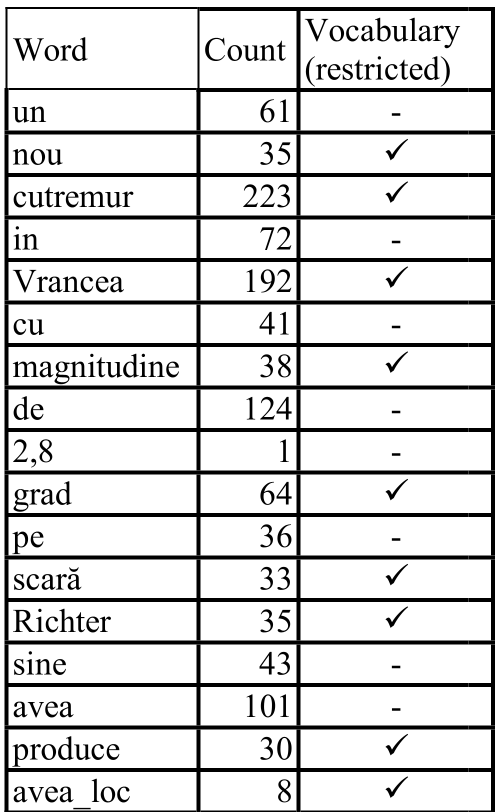 Table 1: Example of lemmatization and frequency counting for earthquake-related terms.
Key Findings: Synonyms and Sentiments
The study reveals a fascinating hierarchy in crisis communication. In earthquake scenarios, the vocabulary is remarkably rigid, focusing on magnitude, location (Vrancea), and intensity. Conversely, fire-related vocabulary is much broader because the context varies significantly (forests, apartments, cars).
High-Frequency Dominance
The data shows that for earthquakes, the word cutremur dominates its synonym seism in almost every context. In fire-related posts, incendiu is the technical preference, though foc (fire) remains a strong secondary term in informal settings.
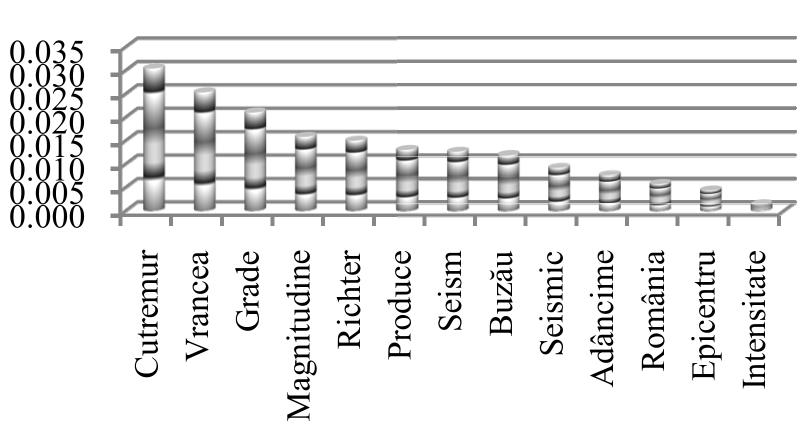 Figure: The probability distribution of keywords within the Earthquake (CUTREMUR) database on Google+.
The Emotional Layer
Beyond facts, the paper highlights the transition from information-sharing in mass media to emotional-unloading on forums like SNAS. Key emotional responses identified include:
- Panic/Terror: Phrases like "the earth boils" or "silence."
- Mercy: Specifically regarding casualty counts (dead/injured).
- Fear: Discussions about building resistance and "cataclysm."
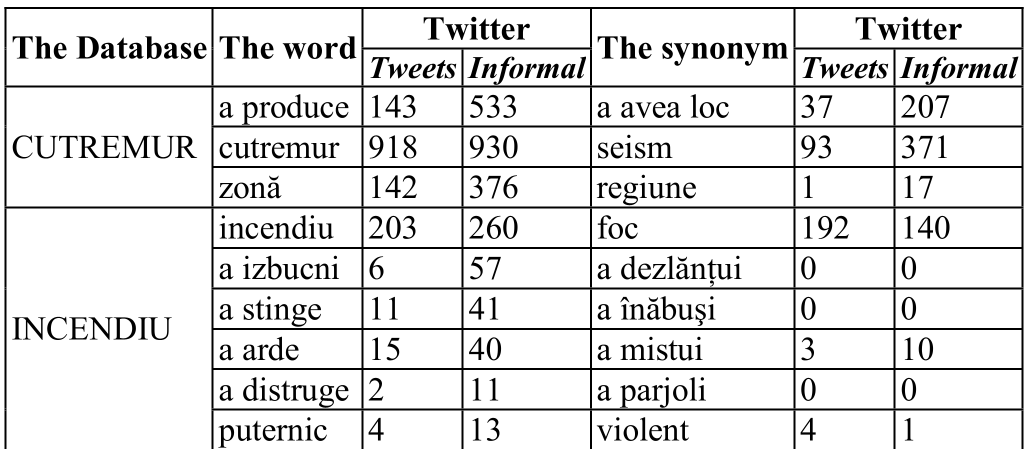 Table 2: Comparison of synonym frequency across different types of social media content.
Critical Analysis & Conclusion
The study concludes that while social media language is "poor" (limited in variety), it is highly predictable. This predictability is an advantage for emergency responders. To create a high-recall monitoring system, one must use at least three keywords and their most common synonyms.
Takeaway for Future Research: The paper sets the stage for shifting from simple keyword search to "Sentiment Monitoring." By understanding that "Panic" often precedes "Action," emergency systems could potentially use the emotional intensity of a post as a weight to prioritize alerts. However, the study's reliance on 2015 data suggests that modern slang and the rise of video-first platforms (like TikTok) would be the next logical frontier for this Romanian linguistic model.