
Voice-Based Crowdsourcing: Empowering Independent Living for the Visually Impaired
Study of Voice-Based Crowdsourcing Platform for the Enhancement of Self-support for the Visually Impaired
This paper introduces a voice-based crowdsourcing platform designed to assist visually impaired people in identifying daily products like medicines and food. By combining QR code scanning, TTS (Text-to-Speech), and community-driven data sharing, the system enables independent information retrieval and achieves a high task completion rate with minimal errors.
TL;DR
This research tackles the "information gap" faced by visually impaired individuals in their daily lives. By developing a voice-based crowdsourcing platform, the authors enable users to identify medicines, food, and clothing independently using QR codes and smart devices. The platform's success lies in its community-driven data model and an auditory-first UX design.
Problem & Motivation: The Danger of Information Deprivation
For the visually impaired, misidentifying a product isn't just an inconvenience—it can be life-threatening. The paper cites statistics from the KFDA showing that nearly 44% of Grade 1 disabled individuals have experienced drug abuse or misuse simply because they couldn't distinguish between breakfast, lunch, and dinner medications.
Existing assistive technologies often fail because:
- Display-Centric Design: Most apps are designed for sighted users, making navigation a nightmare for screen readers.
- Limited Scope: Many tools focus only on specific niches (e.g., GPS for navigation or barcode scanners for clothing).
- Static Databases: Information for the millions of consumer products available today cannot be updated by a single company.
The authors' insight was to apply Crowdsourcing (Collective Intelligence) to accessibility, allowing the community to build a living database of product descriptions tailored for audio consumption.
Methodology: The Virtuous Cycle
The platform's architecture is built on a "Virtuous Cycle" where information flows between public institutions, the sighted public, and the visually impaired.
1. Hierarchical Information Delivery
Auditory information requires more patience than visual scanning. Based on in-depth interviews, the authors implemented a "Main and Sub" information structure. Users hear the most critical data first (e.g., "Tylenol - Pain Reliever") and can choose to trigger "Sub" information (e.g., dosage, expiration) via a button press, preventing "audio fatigue."
2. Multi-Modal Retrieval (Voice & QR)
The system offers two primary methods for finding information:
- Voice Search: Utilizes automatic verification. Searching for "Tylenol" reads out a list of specific versions (Women's, 100mg) for the user to select.
- QR Code Recognition: Uses a camera-based approach with an "error recovery function" that can restore data even if 30% of the code is damaged—a vital feature for users who may struggle to align the camera perfectly.
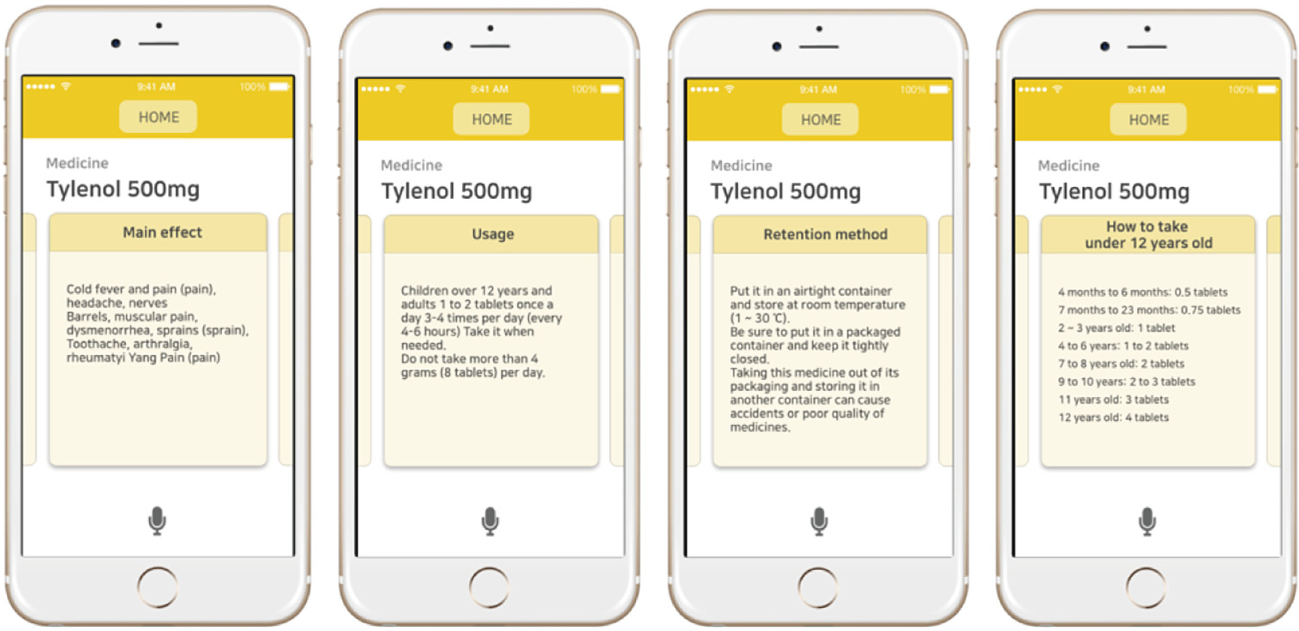 Figure: The interaction flow from product recognition to hierarchical voice output.
Experiments & Results
The authors conducted usability testing with 11 participants to measure the platform's effectiveness.
- Efficiency: Task completion time dropped by an average of 10 seconds as users learned the system.
- Accuracy: Errors were reduced to less than two per task, indicating a very high learnability curve for the voice-based UI.
- User Satisfaction: 100% of participants felt the process was "fast and easy," and 90% specifically praised the divided information structure.
One significant finding was the "importance of QR code location." Participants suggested that manufacturers should place tactile markers or standardized positions (e.g., bottom right) to help them scan more efficiently.
Critical Analysis & Conclusion
Takeaway
The study moves beyond mere "image-to-text" conversion by creating a social ecosystem. By allowing companies and individuals to register product data, the platform creates a scalable solution for the "Right to Know."
Limitations & Future Work
- Tactile Scanning: While the software works well, the physical act of finding the QR code remains a barrier. Future work should investigate tactile markings.
- Long-form Voice Input: The current system relies on TTS-based writing because AI voice-to-text for long, complex technical descriptions (like medical instructions) still faces accuracy challenges. As NLP evolves, a fully voice-input model will be the next frontier.
In conclusion, this voice-based crowdsourcing platform represents a fundamental shift in how we approach accessibility: moving from "assisting" the visually impaired to "empowering" them through shared intelligence.