
Beyond the Crowd's Wisdom: Optimizing Vote Aggregation in the Geo-Wiki Challenge
Vote Aggregation Techniques in the Geo-Wiki Crowdsourcing Game: A Case Study
This paper presents a case study on vote aggregation techniques within the Geo-Wiki "Cropland Capture Game," a crowdsourcing initiative for image-based land cover mapping. The researchers compare specialized crowdsourcing algorithms (EM, KOS, Reputation-based) against machine learning baselines (Random Forest, AdaBoost) while proposing "Weighted Majority Voting" to handle volunteer reliability.
TL;DR
In the "Cropland Capture Game," volunteers classify satellite images to map global agriculture. This study reveals that while specialized algorithms like EM and KOS are mathematically elegant, they often struggle to beat simple Majority Voting in real-world scenarios. The key to high accuracy (up to 96%) lies not in complex modeling, but in rigorous data cleaning (deduplication and blur removal) and accounting for long-term volunteer reliability.
Problem & Motivation: The Noise in the Crowd
Crowdsourcing is a powerful tool for processing massive datasets, like the 170,000 satellite images in the Geo-Wiki project. However, the data is inherently "dirty." Identical geographic locations might appear multiple times (duplicates), and atmospheric conditions often result in blurry, unidentifiable images.
From an algorithmic perspective, the challenge is two-fold:
- Task Irregularity: Some images get dozens of votes, while others get only one or two.
- Worker Reliability: How do we distinguish a dedicated volunteer from a "spammer" who clicks randomly?
Methodology: Cleaning First, Modeling Second
The authors argue that the quality of the dataset is as important as the aggregation algorithm.
1. Perceptual Preprocessing
Before aggregating votes, the team used pHash (Perceptual Hash) to find 8,300 duplicate images. Unlike standard cryptographic hashes, pHash identifies images that look the same to the human eye even if their file metadata differs. They also applied a Blur Detection algorithm based on wavelet transforms to filter out 2,300 images that were too low-quality for even experts to judge.
2. Weighted Majority Voting (WMV)
The paper introduces a refined Weighted MV (Algorithm 1) that assigns weights to volunteers based on their historical accuracy against a "Golden Standard" (expert-labeled images). It iteratively removes volunteers with the highest "penalty" scores.

Experiments: The "Majority Voting" Paradox
The study compared three categories of models:
- Classical ML: Random Forest, LDA, and AdaBoost (using SVD for dimensionality reduction).
- SOTA Crowdsourcing: EM (Dawid-Skene) and KOS (Iterative learning on graphs).
- Heuristics: Simple Majority Voting and the proposed Weighted MV.
Key Findings
As shown in the table below, when the number of votes per image increases (Threshold), the accuracy of all methods climbs, but they all remain remarkably close to one another.
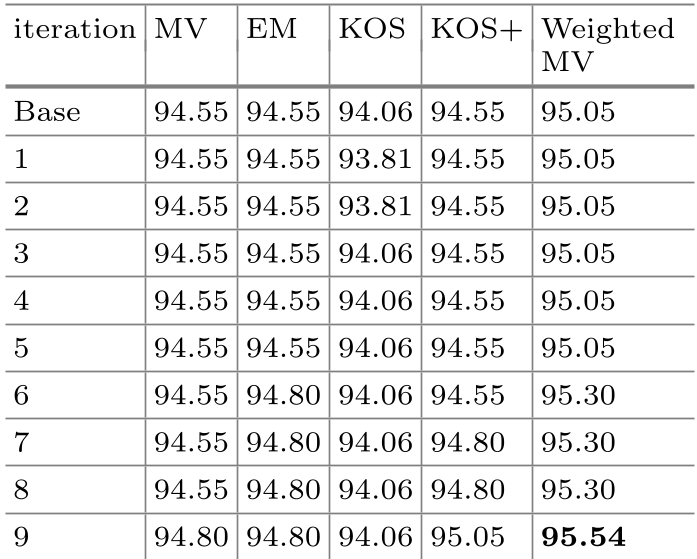
At high thresholds (>9 votes), Weighted MV hit 95.54% accuracy, slightly outperforming EM and standard MV.
Critical Insight: Why Sophisticated Models "Fail" to Dominate
The researchers used ROC (Receiver Operating Characteristic) plots to analyze individual performance. They discovered a surprising truth: The Geo-Wiki "gamers" are actually very good.
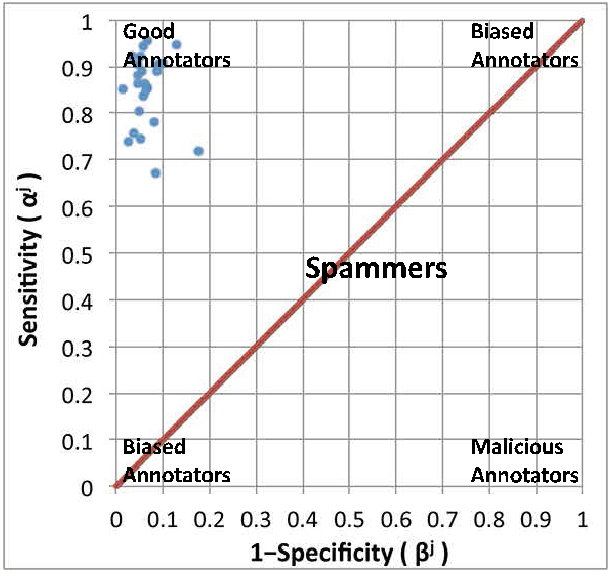
- No Spammers: Volunteers who contributed more than 12 votes showed almost no random-walk behavior.
- Irregularity: Because the graph of "workers-to-tasks" was highly irregular (not a regular bipartite graph), the theoretical guarantees of algorithms like KOS did not materialize.
- Expert Parity: Frequent voters were often as accurate as the "experts" themselves.
Conclusion & Future Outlook
This case study serves as a reality check for the crowdsourcing community. While EM and graph-based iterative algorithms are superior in high-noise environments with many spammers, they offer little advantage in community-driven "games" where volunteers are motivated and reliable.
The Takeaway: If you want to improve your crowdsourcing pipeline, start by deduplicating your images and filtering out blur. A clean dataset and a simple weighted voting scheme based on historical reliability are often all you need to reach expert-level performance.