
VotestratesML: "Pulling Back the Curtain" on AI through Politics and Pedagogy
Votestratesml: A High School Learning Tool for Exploring Machine Learning and its Societal Implications
The paper introduces VotestratesML, a collaborative web-based tool designed for high school students to explore Machine Learning (ML) through the lens of social studies. Utilizing real-world Danish election data, it allows students to build, test, and compete with predictive models of voter behavior to foster "Computational Empowerment" (CE) and AI literacy.
TL;DR
Artificial Intelligence is no longer just a technical subject; it is the infrastructure of modern life. VotestratesML is a novel educational tool that shifts the focus of ML learning from "how to code" to "how it impacts society." By letting high school students predict voter behavior using real election data, researchers proved that students can grasp complex ML concepts—and their ethical dangers—when grounded in a subject they already understand: social studies.
Background: Beyond the Black Box
While "Computational Thinking" (CT) has dominated K-12 education for a decade, it often focuses on the instrumental skills of decomposition and automation. The authors of this paper argue for Computational Empowerment (CE). This Scandinavian-rooted philosophy suggests that students shouldn't just learn to program; they must learn to challenge the manifestations of power and ideology embedded in digital technology.
The core challenge? AI is often seen as "too much math" for humanities-focused students. VotestratesML addresses this by framing ML not as a math problem, but as a political tool.
Methodology: Predictive Politics
VotestratesML is a web application that bridges the gap between raw data and societal reflection. The tool uses a 5-step iterative workflow:
- Data Processing: Shuffling and splitting training/test sets.
- Feature Selection: Choosing variables (age, income, gender, attitudes on tax) to predict a label (e.g., "Votes for Social Democrats").
- Algorithm Selection: Choosing between K-Nearest Neighbor (simple/explainable) or Neural Networks (complex/opaque).
- Training: The iterative loop of model building.
- Evaluation: Testing against real-world test data to see "who won."
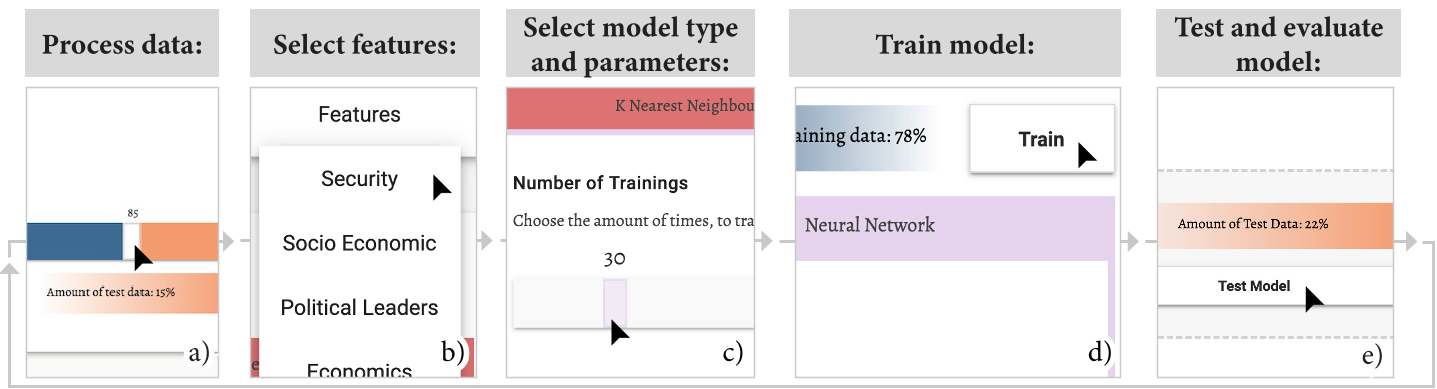 Figure: The iterative process from shuffling data to testing the refined model.
The Power of Competition and Context
The researchers deployed the tool in a "Collaborative-Competitive" format. Students worked in groups of 3-4, but their results were projected onto a "Competitive Component" on the classroom wall.
Why this worked:
- Emotional Investment: Students weren't just "training a model"; they were "winning" against their peers. This motivated them to dive deeper into why certain "features" (like parent's voting habits) increased their model's accuracy.
- Grounding in Prior Knowledge: Because students already knew about politics from their curriculum, they could debate the meaning of the data. For example, they discussed whether "micro-targeting" single issues is healthy for a coherent democratic ideology.
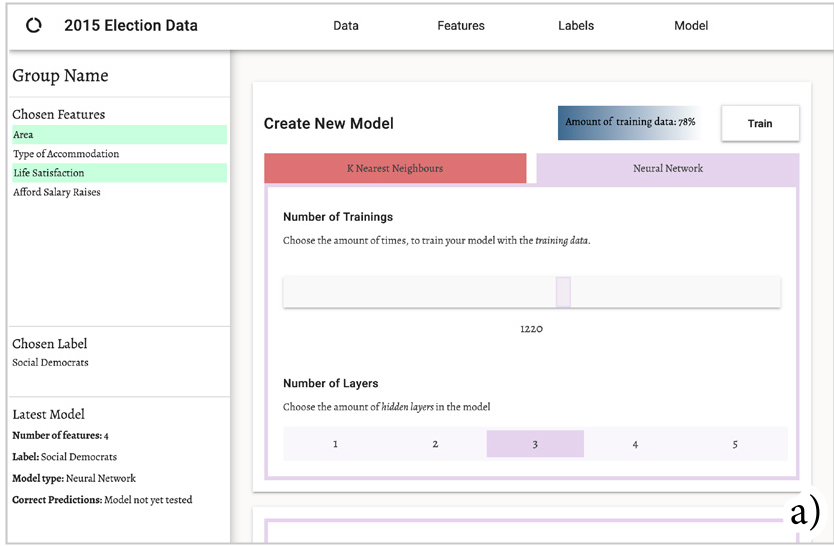 Figure: (Left) The interface for building models; (Right) High school students collaborating in the field.
Key Results & Ethical Epiphanies
The study found that once students were "empowered" to build their own systems, their critical thinking sharpened. One student noted, "Machine only look at what we ask them to look at... Humans are better at marginalising than machines are."
However, the study also revealed a "Glass-Box" paradox:
- The Persona Problem: When models behaved unexpectedly, students often blamed the "data" rather than questioning their own assumptions or the limitations of the algorithm itself.
- Generalizability: Some students struggled to understand that a model predicts statistical trends, not the specific behavior of a single person (like a researcher).
Critical Analysis & Takeaways
VotestratesML proves that the "STEM-only" approach to AI literacy is a mistake. By moving ML into the Social Studies classroom, we engage a broader demographic of future citizens who will soon be governed by these very algorithms.
Takeaways for Educators & Researchers:
- Black-box intelligently: You don't need to teach calculus to teach AI ethics. Focus on high-level design choices (features and parameters).
- Leverage Competition: A public scoreboard is a massive motivator for iterative refinement.
- Mind the Terminology: While "Features" and "Labels" are industry standard, using curriculum-familiar terms like "Variables" might bridge the gap even faster.
Future Outlook: The next frontier for "Digital Literacy" isn't learning to write Python; it's learning to ask, "Who decided this data was representative, and what are the consequences of its predictions?"