
Righteous Argument: Uncovering Truth in a Socializing World
Voting with Social Influence: Using Arguments to Uncover Ground Truth
The paper introduces the "Righteous Argument" model, a Maximum Likelihood Estimator (MLE) for uncovering ground truth in voting scenarios influenced by social networks. By assuming that agents holding the truth are more persuasive, the method outperforms naive majority voting on complex network topologies like Erdös-Rényi and Barabási-Albert graphs.
TL;DR
Voting is rarely a solitary act. Discussions with colleagues and friends shape our views, often creating echo chambers that can drown out the ground truth. This paper proposes the Righteous Argument model—a Maximum Likelihood Estimator (MLE) that uses the structure of social networks to "de-bias" election results and find the actual truth.
Why Naive Voting Fails in Social Networks
In a perfect world (or a Condorcet Jury model), every voter is an independent sensor of the truth. But in reality, social influence creates clusters. Imagine a small group of influential people who are all wrong. If they are highly connected, they can reinforce each other and convince their neighbors, leading to a "majority" that is objectively incorrect.
The authors highlight a critical flaw in current systems: they treat every vote as an independent data point. If a cluster of voters is simply echoing one another, we are essentially "double-counting" the same error.
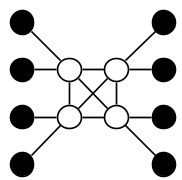 Figure 1: A clique of 'white' voters can influence peripheral nodes, potentially flipping the election despite the ground truth being 'black'.
The Core Insight: The "Righteous Argument"
The authors introduce a powerful intuition: it is easier to convince someone of the truth than a lie.
They formalize this as a dependency between the observed votes and the ground truth . In their model, the likelihood of a candidate being the "truth" is determined not just by how many people voted for them, but by how many consensus edges exist between those voters.
The Likelihood Function
The model defines the likelihood as:
Where:
- is the probability an individual observes the truth.
- is the probability that two connected neighbors agree, given the ground truth.
This means that if Candidate A has many supporters who are also connected to each other, the model views this as stronger evidence of truth than a disjointed group of voters for Candidate B.
Evaluation and SOTA Comparison
The authors tested their model using Erdös-Rényi and Barabási-Albert graphs. They simulated social dynamics where agents could "flip" their opinions based on their neighbors' views.
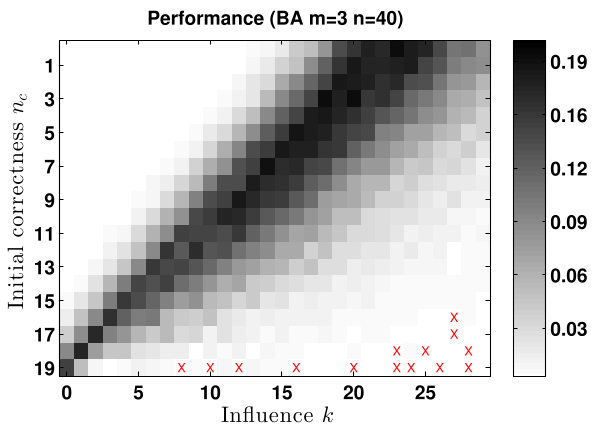 Figure 2: Darker cells show where the Righteous Argument model outperforms naive voting. The advantage is most pronounced when social influence is at its peak.
Key Findings:
- Complexity: The winning candidate can be computed in linear time relative to the network size.
- Accuracy: When social interactions reinforce the truth (the "Righteous Argument" assumption holds), this model correctly identifies the ground truth even when naive majority voting fails.
- Robustness: It effectively ignores "discordant edges" (neighbors who disagree), focusing the analysis on the most stable parts of the social structure.
Critical Insight & Conclusion
This paper bridges the gap between Opinion Dynamics and Social Choice Theory. Instead of merely watching how opinions evolve, it provides a mathematical tool to "reverse-engineer" the social influence process and find the starting point of truth.
While the model assumes a binary choice and an undirected graph, its foundations are ripe for extension into multi-candidate elections and directed "influencer" networks. The takeaway for AI researchers is clear: when aggregating data from agents, don't just count the votes—look at the connections.