
vrSensory: Engineering Inclusivity via Sensory-Driven VR Design
vrSensory: Designing Inclusive Virtual Games with Neurodiverse Children
The paper introduces vrSensory, an inclusive virtual reality (VR) gaming framework designed for neurodiverse children (Autism, ADHD, and neurotypical). By mapping Dunn’s Sensory Quadrants to the MDA (Mechanics, Dynamics, Aesthetics) framework, the authors demonstrate how sensory processing needs can serve as primary design requirements for accessible play.
TL;DR
vrSensory is a research initiative that rethinks game design through the lens of Neurodiversity. By merging occupational therapy principles (Dunn’s Sensory Quadrants) with formal game design (the MDA framework), the researchers created VR environments where children with Autism, ADHD, and neurotypical profiles can play together comfortably. The study proves that sensory-driven mechanics don't just provide comfort—they act as a catalyst for social inclusion and "Fellowship."
The "Sensory Gap" in Modern Gaming
For many neurodiverse children, the digital world is a sensory minefield. A game that is "exciting" for a neurotypical child might be physically overwhelming for a child with a low neurological threshold. Conversely, a calming environment might fail to engage a "sensory seeker."
The authors argue that the industry's failure to account for these sensory patterns (Autism, ADHD, etc.) is a major barrier to inclusive play. Their insight? If we treat sensory needs as mechanics rather than limitations, we can build spaces that are "Socially Accessible."
Methodology: Mapping Senses to Mechanics
The core of this work is the mapping of Dunn’s Sensory Quadrants onto the MDA (Mechanics, Dynamics, Aesthetics) Framework.
The Framework Mapping
- Aesthetics (The Goal): Sensory comfort and "Fellowship."
- Dynamics (The Behavior): How the game feels during runtime (e.g., the ball slowing down).
- Mechanics (The Rules): The underlying code (e.g., volume sliders for thunder, simplified collision).
The team developed three distinct prototypes:
- Baseball: Focused on the Submission aesthetic, using a "slow-motion ball" mechanic to lower the entry barrier for passive users.
- Thunderstorm: Targeted at Sensation and Discovery, allowing users to control environmental intensity (volume/light) while exploring a desert landscape.
- Dance & Sing: Focused on Expression, providing visual cues (lyrics/avatars) to support active sensory seekers.
 Figure 1: The vrSensory design philosophy, centering the child's sensory profile within the VR environment.
Key Findings: From Sensory Needs to Social Fellowship
The most striking result wasn't just that the children were comfortable, but that they were social.
1. The Fellowship Aesthetic
In the multi-player "Thunderstorm" game, even though the environment was designed for a passive profile, all children—regardless of their diagnosis—engaged in spontaneous social play. They used voice chat to coordinate movements, played "hide and seek" by teleporting behind virtual rocks, and experienced what the authors call the Fellowship Aesthetic.
2. Validation of Sensory Patterns
Participants' behaviors mirrored their clinical profiles. "Max" (Autistic, high threshold, passive) was delighted by the sensory-controlled thunderstorm, while "Cassidy" (ADHD, high threshold, active) used the VR teleportation mechanics to "stress test" the environment, flying through trees and spinning her physical body.
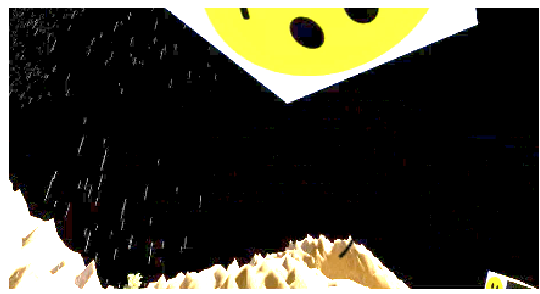 Figure 2: A multi-user session showing one participant's avatar looking down on another, demonstrating social spatial awareness.
Critical Insight & Future Outlook
The success of vrSensory lies in its Universal Design approach. By making the environment "safe" for the most sensory-sensitive child, the researchers created a space where everyone felt empowered to interact.
Limitations
- Sample Size: The study used a convenience sample of three children, which limits the statistical generalizability.
- Hardware: The reliance on physical bat controllers and high-end VR tethering may present physical barriers for some neurodiverse populations.
Conclusion
vrSensory proves that sensory inclusive design is social design. When we build for sensory diversity, we don't just accommodate individuals; we build bridges between them. For the future of VR, this means that "comfort settings" shouldn't be an afterthought—they are the foundation of the Metaverse's social fabric.
Takeaway for Devs: Start with the sensory threshold. If the environment is comfortable, the "Fun" (Aesthetics) and the "Community" (Fellowship) will follow naturally.