
Infrastructural Contestation: When Grids and Pipes Become Battlegrounds for Democracy
VU Research Portal Defining and Classifying Infrastructural Contestation
This paper presents a cross-disciplinary framework to define and classify "Infrastructural Contestation," focusing on the 2008–2017 period in Greece. By synthesizing ethnographic knowledge with data science visualization techniques, the authors establish a new typology of grassroots movements that emerge in response to the "infrastructural gap."
TL;DR
In the wake of the 2008 financial crisis, infrastructure has shifted from being a background utility to a central site of socio-political struggle. This paper explores "Infrastructural Contestation" in Greece (2008–2017), mapping how citizens moved from protesting hospital closures to building their own "solidarity clinics." It provides a robust methodology for combining anthropology with data science to track these transfigurative shifts in real-time.
The "Infrastructural Gap" and the Visibility of Failure
For decades, social science has relied on the adage that infrastructure is "visible only upon breakdown" (Star & Ruhleder). However, the authors argue that the post-2010 era has fundamentally challenged this. Between austerity measures and the "fourth industrial revolution," the infrastructural gap—the space between service provision and public need—has become so wide that infrastructure is now perennially visible and local.
The motivation for this study is to move beyond viewing these protests as mere "NIMBY" (Not In My Back Yard) reactions. Instead, the authors identify a sophisticated evolution of Infrastructural Citizenship, where the public claims a right not just to use the grid, but to govern and recreate it.
Methodology: Bridging Anthropology and Data Science
The core of this work is a 7-stage methodology that converts heterogeneous sources (movement blogs, union reports, and ethnographic field notes) into a structured dataset of 880 events.
The Taxonomy of Struggle
The authors propose six distinct modes of contestation:
- Labour & Working Conditions: Industrial actions affecting the flow (e.g., transport strikes).
- Right to Access: Struggles for fair distribution (e.g., Refusal to pay road tolls).
- Ownership & Governance: Anti-privatisation movements.
- Infrastructural Effects: Opposition to local impacts (e.g., landfill sites).
- Remodification: Re-purposing existing sites (e.g., turning "brown fields" into parks).
- Transfigurative Contestation: The most radical form, involving "infrastructuring" as a verb—creating new, alternative prototypes like renewable energy cooperatives.
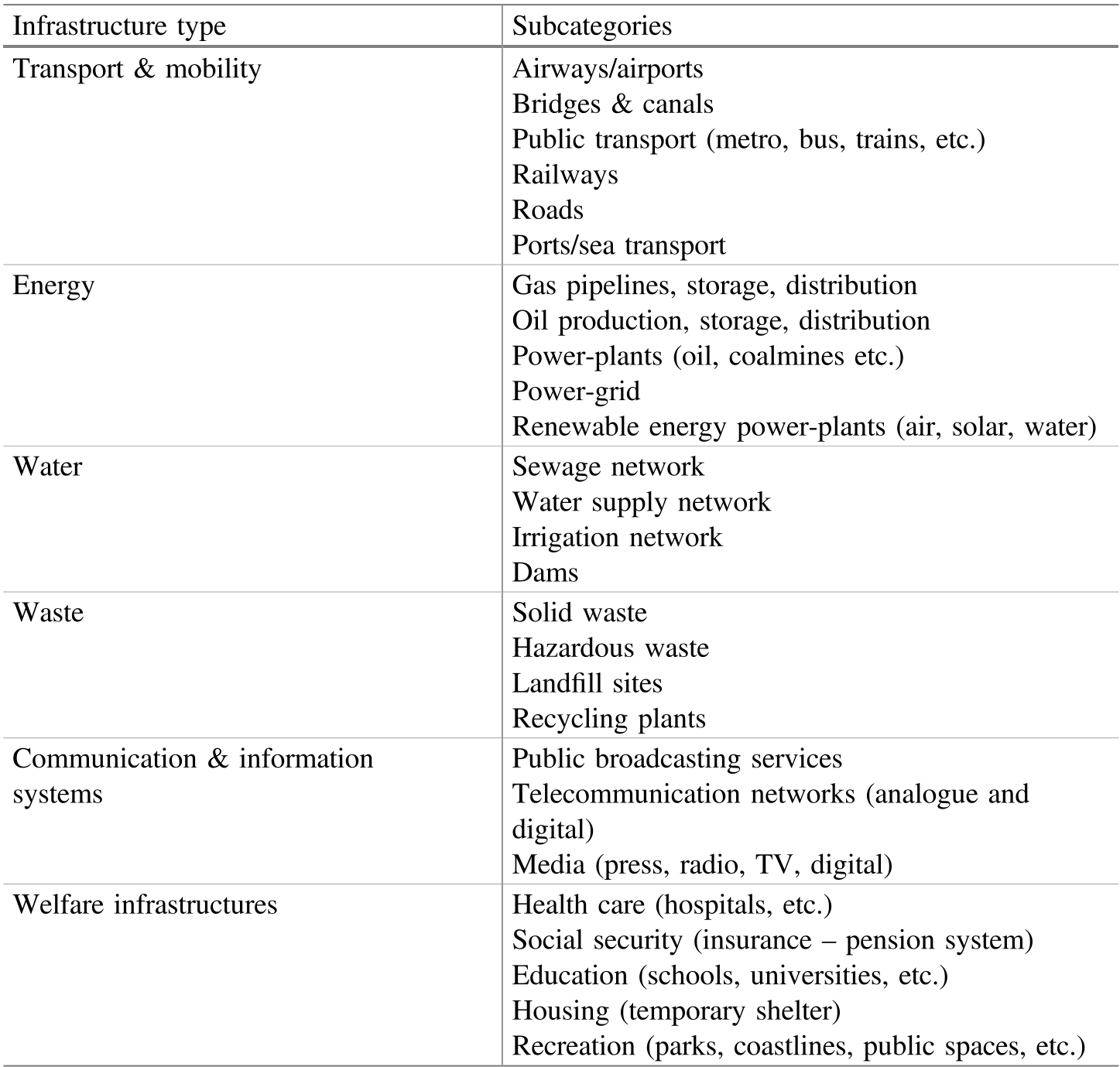 Table 1: The classification of infrastructure types used to categorize the 880 recorded events.
Visualizing the Evolution of Resistance
Using the Timeline Storyteller, the researchers identified a striking trend. In the early years of the Greek crisis (2008-2009), most incidents were defensive community struggles. As the crisis deepened (2011-2015), there was an explosion in civil disobedience and, eventually, self-management/recuperation.
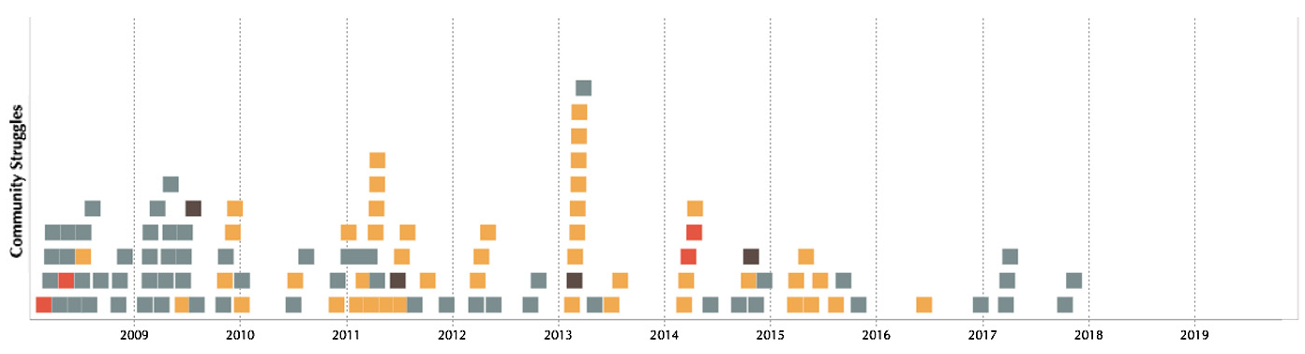 Figure 1: Visualization showing the rise and shift of different modes of contestation during the 10-year period.
Key Insights from the Data:
- The Power of Soft Infrastructure: 80% of "transfigurative" attempts—those creating new social systems—occurred in welfare sectors (schools, clinics). This suggests that "soft" infrastructure is the primary laboratory for social innovation.
- The Labour Gap: Interestingly, while labor strikes (59% of events) were the most frequent, they showed the least tendency toward "transfigurative" change. They focused on preserving the state-led model rather than redesigning the system itself.
Depth Insight: From Noun to Verb
The most profound contribution of this paper is the conceptualization of "infrastructure as a verb." When a community in Greece starts a solidarity clinic because the state hospital has been defunded, they are not just "using" infrastructure; they are "infrastructuring."
This shift represents a democratization of technology. It suggests that future "smart cities" should not just install sensors to optimize flow but should act as "sentient platforms" that can register and incorporate the specialized, in-situ knowledge of non-expert communities.
Critical Analysis & Conclusion
Takeaway
The paper effectively demonstrates that infrastructural contestation is a permanent feature of modern governance. These movements "unveil unjust power relations" that are often hidden inside the cement and cables of our cities.
Limitations
As the authors admit, the dataset relies heavily on organized union reports for labor data, which might over-represent strikes compared to more ephemeral, informal grassroots actions. Additionally, while the Greece case study is extreme, it provides a "laboratory" view of what happens when the modernist ideal of infrastructure collapses.
Future Outlook
This work lays the groundwork for urban planners and data scientists to build "participatory infrastructure." Instead of meeting protest with engineering solutions alone, the goal should be to create systems that allow for legitimate social contestation and collective ownership.