
Breakdown by Rumors: How Social Media Can Paralyze D2D Networks
Breakdown by Rumors: Vulnerability of D2D Communications from Online Social Networks
This paper investigates the systemic vulnerability of Device-to-Device (D2D) communications in cellular networks to misinformation spreading within Online Social Networks (OSNs). The authors propose the Rumor the Critical Framework (RCF), a cross-layer optimization method that identifies the top-k influential social network nodes whose rumor initiation maximizes throughput degradation in the underlying cellular network.
TL;DR
Researchers from the University of Florida have uncovered a startling vulnerability: the performance of next-generation cellular networks is at the mercy of Online Social Networks (OSNs). By spreading rumors that discourage users from using Device-to-Device (D2D) features, an adversary can tank network throughput by 40% using only a handful of influential social media accounts.
The Hidden Interdependency
D2D communication is a cornerstone of modern cellular offloading. It allows phones to talk directly to each other, bypassing the Base Station (BS) to save bandwidth. However, this relies on user trust.
If a rumor goes viral on Facebook or X (formerly Twitter) claiming D2D drains battery excessively or compromises privacy, users will simply toggle it off. This paper formally defines this threat as the TMIN (Throughput Minimization in INterdependent D2D/OSN) problem. Unlike traditional jamming or hardware hacks, this is a social engineering attack on spectrum efficiency.
Methodology: Mapping Social Influence to Physical Throughput
The researchers developed the Rumor the Critical Framework (RCF) to bridge the gap between social graphs and signal-to-interference-plus-noise ratio (SINR) equations.
1. The Cellular Layer: Node Criticality Evaluation (NCE)
The team modeled the cellular network as a flow network. They used a bi-level Mixed-Integer Linear Program (MILP) to find which specific devices, if removed, would hurt the network most.
- The Challenge: Data rates are non-linear and interference-heavy.
- The Fix: They linearized the equations using dualization techniques to make the problem solvable by standard optimization engines (like Gurobi or CPLEX).
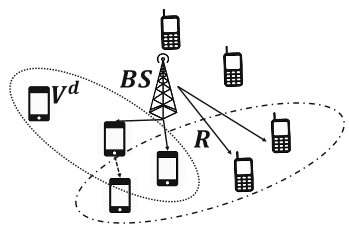 Caption: (a) Normal D2D offloading vs (b) Throughput drop due to rumor-induced opt-outs.
2. The Social Layer: Targeted Influence Maximization
Once the most "critical" cellular nodes are identified, their importance values are mapped to their corresponding owners in the social network. The RCF then uses Reverse Influence Sampling (RIS) to find the best starting nodes (seeds) in the OSN to ensure the rumor reaches these critical users.
Experimental Results: A 40% Performance Hit
Testing the framework on real-world social data from Facebook and synthetic cellular deployments (Stadium and Mall scenarios), the results were sobering.
- Throughput Collapse: In both scenarios, the RCF-identified seeds caused significantly more damage than random or degree-based seeding.
- Cost of Recovery: To maintain the same throughput after a rumor spread, the Base Station had to occupy massive amounts of extra bandwidth (up to 1400 Hz extra), essentially negating the benefits of D2D technology.
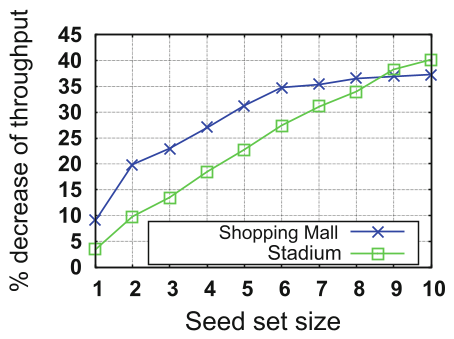 Caption: Comparing RCF against degree-centrality and random baselines. RCF consistently finds the most damaging seeds.
Critical Insight: Social Connectivity is a Double-Edged Sword
The study found that the "Mall" scenario (higher social connectivity) was far more vulnerable than the "Stadium" scenario. In denser social circles, rumor saturation happens faster, meaning the cellular carrier loses its D2D capacity almost instantaneously.
Conclusion & Future Outlook
This paper serves as a wake-up call for network architects. We can no longer design wireless protocols in a vacuum that ignores human behavior.
Key Takeaways:
- Vulnerability: Cellular networks are mathematically provable to be vulnerable to OSN-based social Engineering.
- RCF Performance: The proposed framework and the NCE algorithm effectively identify critical nodes that traditional social metrics (like degree centrality) miss.
- Future Work: This opens a new field of "Cyber-Physical Social Security," where operators might need to actively monitor social sentiment to predict and mitigate sudden surges in network load caused by misinformation.
Reference: Tianyi M.A.A., et al. "Breakdown by Rumors: Vulnerability of D2D Communications from Online Social Networks." University of Florida.