
Vyaktitv: Assessing Personality Through the Lens of Social Hindi Conversations
Vyaktitv: A Multimodal Peer-to-Peer Hindi Conversations based Dataset for Personality Assessment
The paper introduces Vyaktitv, the first multimodal dataset for Big Five personality assessment focusing on peer-to-peer Hindi conversations. It integrates high-quality video, audio, and "Hinglish" transcriptions alongside unique socio-demographic features to evaluate personality in a natural social context.
TL;DR
Personality is not just who we are in a vacuum; it is defined by how we interact with the world. Vyaktitv is a pioneering multimodal dataset consisting of 702 minutes of peer-to-peer Hindi conversations. By capturing video, audio, and Hinglish text, and pairing them with deep socio-demographic data, this research moves personality computing away from "isolated individual analysis" toward a more authentic "social behavior analysis" in a non-Western context.
Problem & Motivation: The "English-only" and "Isolation" Trap
Traditional personality assessment in AI has largely stalled in two areas:
- Contextual Loneliness: Most datasets (like the popular Brigg-Myers Twitter sets or essay benchmarks) focus on solitary acts like writing or vlogging. However, psychologists argue that traits like Extraversion or Agreeableness are fundamentally social.
- Linguistic Bias: A vast majority of SOTA models are trained on English. This ignores over 637 million Hindi speakers and fails to account for how personality manifests in different cultural and linguistic frameworks.
The authors’ intuition was simple: To truly understand personality, we need to observe humans in a "restless" state—unrestrained, social, and speaking their native tongue.
Methodology: Capturing the Multi-Dimensional Self
The data collection for Vyaktitv was meticulously designed to balance spontaneity with technical quality.
1. The Experimental Setup
Participants were paired randomly—sometimes as friends, sometimes as strangers—to ensure a variety of social dynamics. They engaged in 16-minute conversations prompted by topics ranging from Indian cricket to global warming.
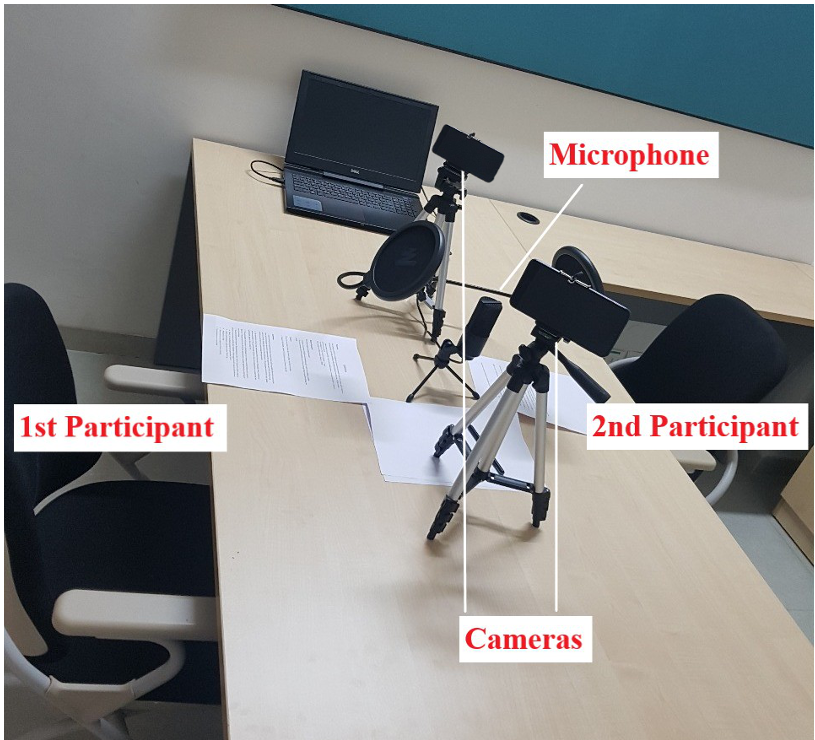 Figure 1: High-fidelity capture using dual cameras and professional microphones to ensure data quality for downstream CV and Audio tasks.
2. Lexical Annotations
Unlike standard transcripts, Vyaktitv includes annotations for "Hinglish" (Hindi-English code-switching) and lexical cues like:
- Filled Pauses (e.g., "hmm", "toh")
- Discourse Markers (e.g., "isliye", "matlab")
- Suffix Elongations (e.g., "nahiii")
Experiments & Results: Beyond the Surface
The researchers didn't just collect data; they performed a deep statistical dive using the Kolmogorov-Smirnov (K-S) test to see which factors actually move the needle on personality scores.
Socio-Demographic Impacts
The "ethnographic study" revealed fascinating insights that standard Big Five tests often miss:
- Extraversion (EXT): Strongly tied to public speaking and writing proficiency.
- Neuroticism (NEU): "Cultural inclination" and "living with parents" were significant discriminators.
- Conscientiousness (CON): Interestingly, the data suggests subjects without siblings appeared more disciplined in this cohort.
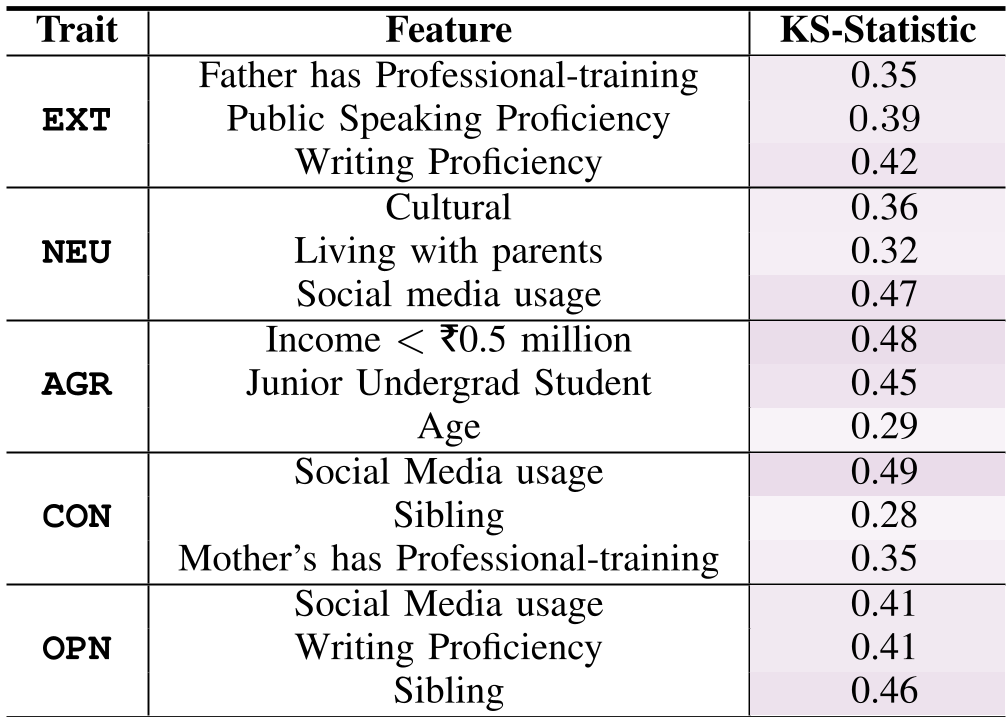 Table 1: The K-S Statistics showing which socio-demographic features align with specific Big Five traits.
Lexical Correlation
The correlation analysis between speech patterns and traits yielded another layer of truth. For instance, Neuroticism (NEU) showed a negative correlation with the total number of words spoken—meaning more confident individuals were more loquacious in these peer-to-peer settings.
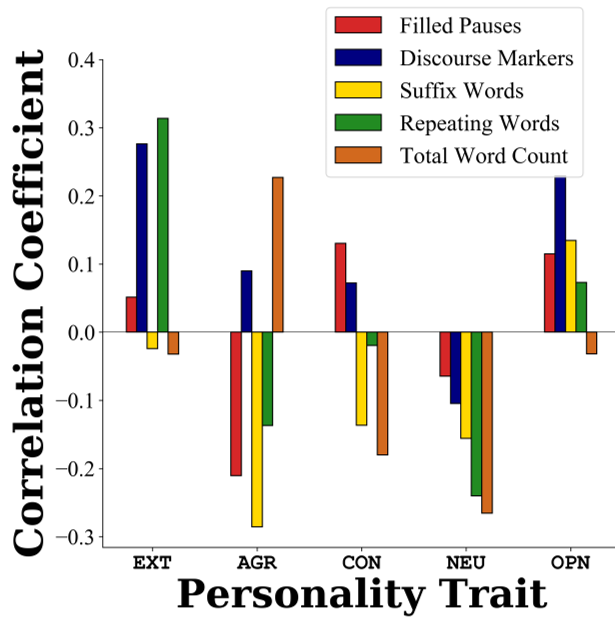 Figure 2: Pearson correlation coefficients between linguistic markers and the Big Five traits.
Critical Analysis & Conclusion
Vyaktitv is a vital contribution to the "Low Resource" AI community. By providing a multimodal Hindi dataset, it allows researchers to:
- Test if Western-centric personality models hold up in Indian social contexts.
- Develop Embodied Conversational Agents (ECA) that can predict when to "backchannel" (nod or say "hmm") in a culturally appropriate way.
Limitations: The sample size (38 participants) is relatively small for training deep neural networks from scratch. Future work will likely need to employ transfer learning or data augmentation techniques.
Takeaway: The future of personality AI lies in context. By looking at who is speaking, who they are speaking to, and what their social background is, we move closer to truly empathetic machines.