
W-Entropy Index: Beyond the Surface of Social Media "Fans"
W-entropy Index: The Impact of the Members on Social Networks
The paper introduces the W-entropy Index, a multi-dimensional metric designed to evaluate the social influence of individuals across diverse platforms such as SINA and Tencent. By integrating data from blogs, micro-blogs, and web encyclopedias, the method achieves a comprehensive ranking that outperforms traditional single-parameter metrics (e.g., visit counts or fan numbers).
TL;DR
Is a user with 10 million followers on one app more influential than a user with 5 million fans across three different platforms? This paper argues that popularity is not just about raw numbers, but the distribution of influence. By applying Shannon Entropy, the authors propose the W-entropy Index, a model that corrects for cross-platform "imbalance" to reveal the true titans of social media.
The Problem: The "One-Dimensional" Trap
In the early 2010s (and even today), social networks like SINA and Tencent used "Visits" or "Followers" as the gold standard for influence. However, the authors noted a glaring inconsistency:
- Xu Xiaoming led SINA blogs with 1.4 billion visits but had a negligible micro-blog presence.
- Yao Chen dominated micro-blogs with nearly 8 million fans but wasn't the top in long-form blogs.
These rankings create a fragmented reality. If a brand wants a spokesperson, should they pick the one with the most visits or the one with the most fans? The "impact" was high in specific silos but lacked a unified criterion.
Methodology: The Logic of Information Entropy
The authors’ core insight is that Unpredictability (Entropy) can measure how "balanced" a person’s influence is.
1. The Weighted Mean ()
First, they calculate the ratio of an individual's popularity () against the most popular person in that category (). Where represents the assigned weight for blogs (40%), micro-blogs (40%), and encyclopedias (20%).
2. The Entropy Coefficient ()
This is the "secret sauce." If a person has high popularity in one area but zero in others, their entropy () is low. If they are equally popular everywhere, approaches 1. The final W-entropy Index is simply . This penalizes users who are "undistributed" and rewards those with a holistic presence.
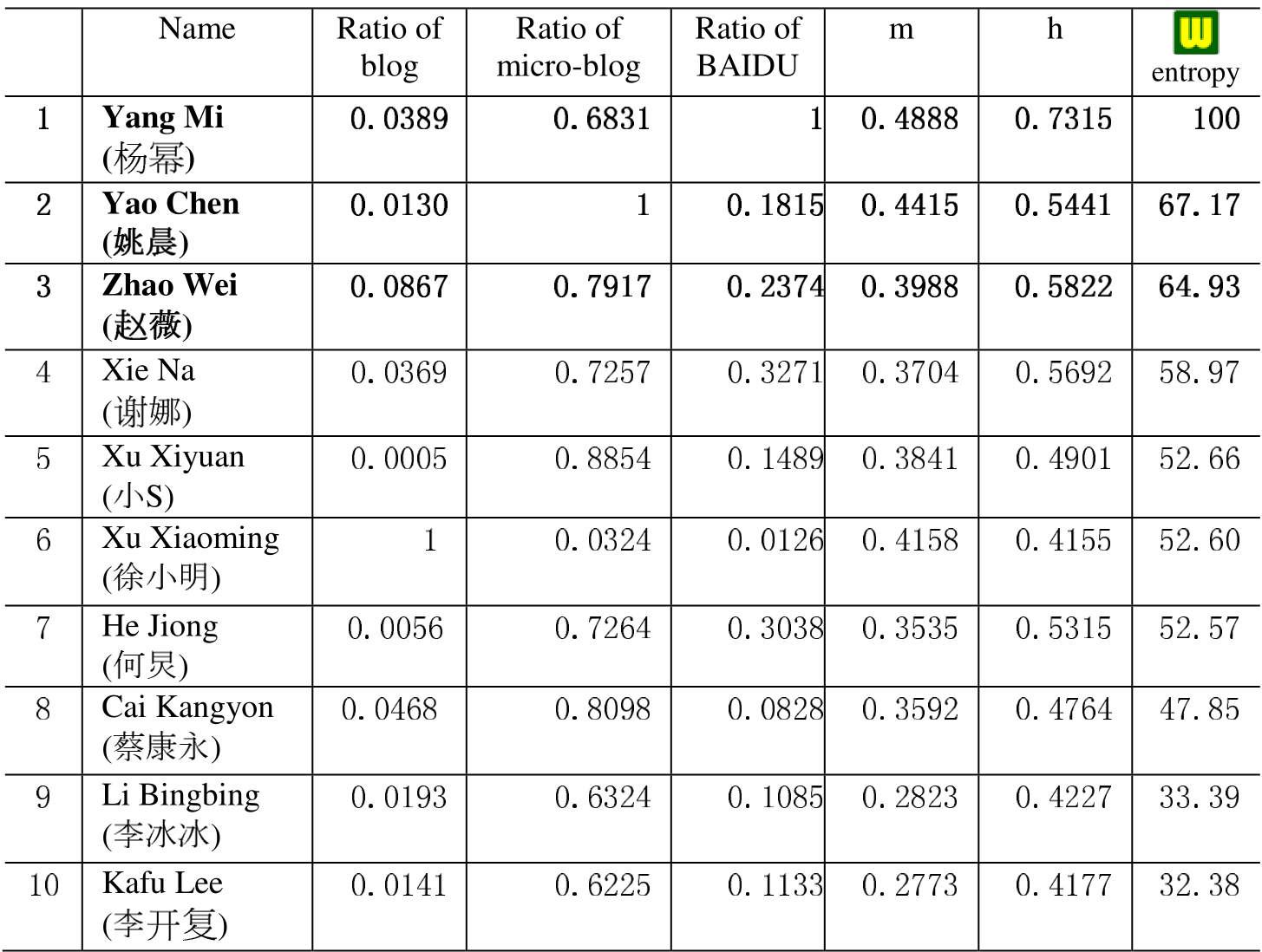 Table 2: Notice how Xu Xiaoming (Rank 6) has a Ratio of Blog of 1.0 (the best), but his low ratio in other areas results in a low entropy (h=0.4155), pulling his final rank down.
Experiments: Real-World Chinese Social Networks
The authors tested this on SINA and Tencent data. The results were telling:
- Yang Mi achieved a perfect 100 on the index because she maintained high ratios across blogs, micro-blogs, and search entries (Baidu Encyclopedia).
- Economists who dominated the "Stock Market" niche in blogs fell significantly in the rankings because they lacked broad cultural relevance outside of finance.
- Kaifu Lee was identified as a rare "Tech Sector" influencer who maintained a high W-entropy, proving the model could identify cross-over appeal beyond entertainment.
Practical Application: E-Marketing
The paper cites a fascinating case study for the China Everbright Bank. Despite being the first bank to open an official micro-blog, its W-entropy was a mere 0.072.
The takeaway for the enterprise was clear: Their impact was 1,371 times smaller than Yang Mi's. The model suggests that instead of struggling with traditional content, the bank would see a massive ROI boost by employing a "high W-entropy" spokesperson to bridge the influence gap across platforms.
Analytical Critique & Future Work
The W-entropy index provides a much-needed Inductive Bias toward multi-platform consistency. However, a few limitations remain:
- Weighting Subjectivity: The 40/40/20 weights are somewhat arbitrary. Future work could use the Analytic Hierarchy Process (AHP) to refine these based on market value.
- Data Freshness: Social media dynamics shift weekly. A real-time W-entropy index would be required for actual marketing deployment.
- Platform Scope: In the modern era, "Encyclopedia" visits might be less relevant than "Short Video Engagement" on platforms like TikTok/Douyin.
Conclusion
The W-entropy Index moves the conversation from "How many people see me?" to "How pervasive is my presence?" By borrowing from information theory, it provides a robust mathematical tool for measuring social impact in an increasingly fragmented digital world.