
Walk Globally, Act Locally: Reorganizing Influence in Dynamic Mobile Social Networks
Walk globally, act locally: efficient influential user identification in mobile social networks
The paper introduces a distributed algorithm for identifying influential users in highly dynamic Mobile Social Networks (MSNs) using the "Information Potential" framework. By mapping local node degrees to global influence values, the authors achieve robust identification and efficient route construction to influential nodes across time-varying topologies.
TL;DR
Identifying "VIPs" in a mobile crowd is difficult because everyone is moving. This paper proposes a distributed, lightweight algorithm that turns a user's social "connectedness" into a virtual "influence landscape." By following the steepest gradient on this map, any user can find the most influential person in their vicinity without needing a central server or constant global updates.
Background & Positioning
In the world of Graph Theory and Social Networks, finding "influential" nodes is usually a global optimization problem (e.g., Eigenvector Centrality). However, in Mobile Social Networks (MSNs), the graph is a "living" entity: connections appear and vanish as people walk past each other. This paper treats influence not as a static score, but as a dynamic Information Potential—a physical-like field that flows and stabilizes across the moving crowd.
The Core Challenge: Mobility vs. Overhead
Prior works face a nasty trade-off:
- Centralized Methods: Accurate but require a central controller to know everyone's location—a privacy and battery nightmare.
- Local Methods (Degree Centrality): Fast but "myopic"; a person might have many neighbors right now but be completely isolated from the rest of the network.
The authors' insight is to use Information Potential to bridge this gap. This maps a local value (node degree) to a global context through iterative neighbor exchanges.
Methodology: Shaping the Influence Landscape
The system operates on a simple but powerful iterative equation:
Key Components:
- Inhibiting Factor (): This is the "zoom lens." A high makes the influence score focus on your immediate neighbors (Local). A low allows influence to "diffuse" further, providing a Global view.
- Stable State Strategy: The authors prove that even in time-varying graphs, this process converges to a stationary distribution.
- Influence-Ascent (): To find the influencer, you don't need a map. You just look at your neighbors and move to the one who provides the highest "expectancy" of influence increase.
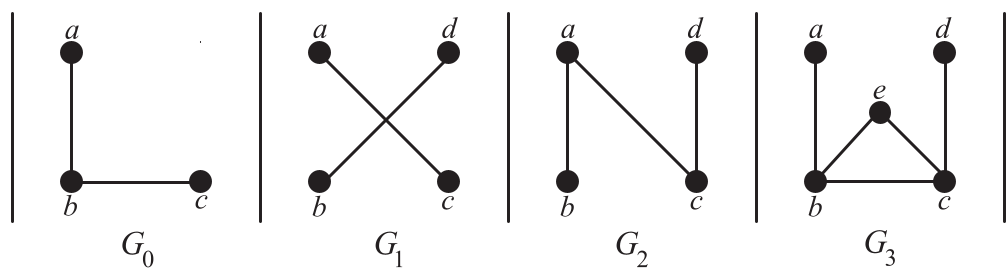 Figure 1: The model treats the network as a sequence of dynamic snapshots, where influence is computed cumulatively.
Experiments: Validating the "Hill Climbing"
The authors used the Sassy dataset (real-world encounter traces) to test their math.
1. The Global-Local Trade-off
By tuning , the researchers could literally "shape" the social landscape.
- At , the landscape is "bumpy" with many local influencers.
- At , the landscape becomes smooth, identifying only the single most dominant global leader.
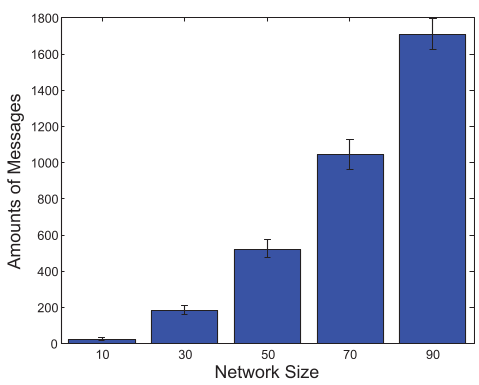 Figure 2: (a) Social graph of 25 users. (b-c) Visualizing the influence landscape where red squares represent the identified "peaks" or influential users.
2. Efficiency and Convergence
The overhead is remarkably low. The number of rounds required to reach a stable "influence map" depends on . For small networks, a high allows convergence in just a few steps, making it perfect for real-time mobile app integration.
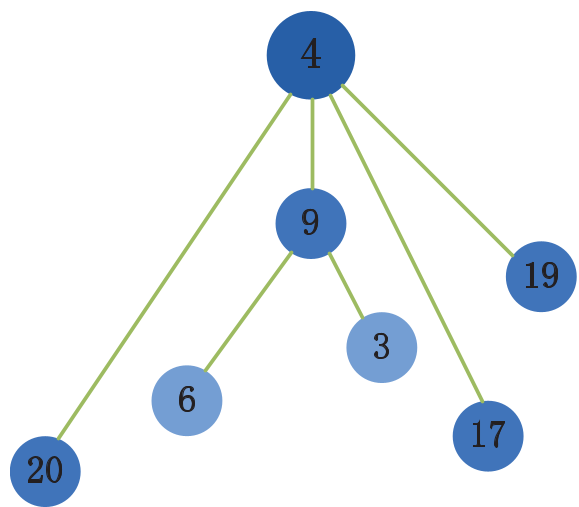 Figure 3: A practical demonstration of routing. User 6 finds the global influencer User 4 by following the gradient 6 → 9 → 4.
Critical Insight & Conclusion
The brilliance of "Walk Globally, Act Locally" lies in its mathematical simplicity. It bypasses the "NP-hard" nature of global influence maximization by treating social influence like a physical diffusion process.
Takeaway: If you are building a decentralized recommendation system or a viral marketing tool for crowded events (stadiums, conferences), don't try to map the whole crowd. Just let the "influence potential" flow locally between devices, and the leaders will naturally emerge at the peaks of the landscape.
Limitations: The model assumes users are willing to exchange these small "influence packets." In adversarial environments, "selfish" nodes could easily spoof their degree to fake influence—a potential direction for future security-focused research.