
Walking-Age: Your Gait is the New Clock for Biological Health
Walking-Age Analyzer for Healthcare Applications
The paper introduces a "Walking-Age Analyzer" that utilizes a 3-D accelerometer and gyroscope to identify gait patterns across lifespan. By leveraging Empirical Mode Decomposition (EMD) and K-means clustering, the system categorizes individuals into three distinct "walking-age" groups (Children, Adults, and Elders) to detect health anomalies through gait deviations.
TL;DR
Movement is often the first casualty of aging, yet it is rarely used as a proactive health metric. Researchers have developed a Walking-Age Analyzer—a wearable system that uses 3D accelerometers and gyroscopes to determine your "walking-age." By benchmarking your gait against standard age clusters, the system can detect "accelerated aging" in your joints and muscles long before clinical symptoms appear.
The Motivation: Moving Beyond Fall Detection
Most wearable healthcare research focuses on reactive measures, such as "Has this person fallen?" or "Is this person walking at a slope?" While useful, these metrics miss the bigger picture: Gait is a reflection of systemic health.
The authors identified a gap in existing literature: while vision-based systems can analyze gait accurately, they are intrusive and expensive. Conversely, sensor-based works were often limited to tiny datasets or specific geriatric populations. The goal here was to create a cost-effective, generalized model that maps walking patterns to a biological age, known as Walking-Age.
Methodology: From Raw Inertia to Clinical Insights
The researchers utilized a Witilt v3.0 device strapped to the leg—a choice made after finding that shoe-mounted sensors produced too much noise from foot flexion.
1. The Signal Pipeline
The raw data (3D acceleration and tilt) is processed through a sophisticated feature extraction pipeline:
- Normalization: Gait attributes are scaled by subject height to ensure a 6-foot adult's stride isn't misclassified purely due to leg length.
- Feature Extraction (EMD): The system uses Empirical Mode Decomposition (EMD). Unlike traditional Fourier transforms, EMD is better suited for non-linear and non-stationary signals like human walking. It breaks the signal into Intrinsic Mode Functions (IMFs).
- Dimensionality Reduction: A 16-length feature vector is compressed into 2D space using Principal Component Analysis (PCA) to maximize variance.
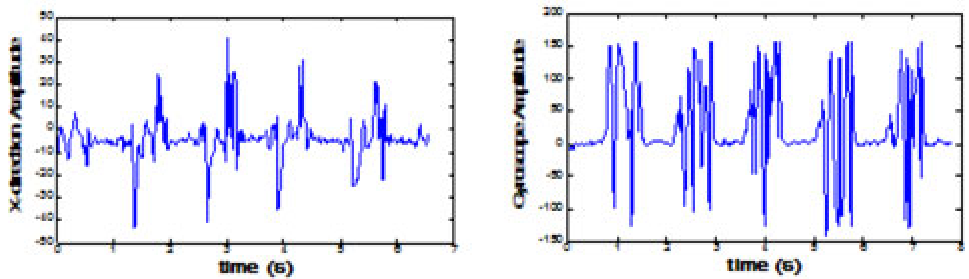 Fig. 1: The signal processing and feature extraction workflow involving LPF and EMD modules.
2. Clustering the Human Lifespan
While the researchers initially tried 4 or 5 age groups, the data revealed three fundamental biological clusters:
- Children (10s): High acceleration in X/Z axes (bouncing/rushing) and high instability (tilt).
- Adults (20-60s): Maximum efficiency—highest speed with minimum vertical bounce and lateral tilt.
- Elders (70-80s): Reduced speed and X-axis acceleration, with increased tilting indicative of weakened joint control.
Experimental Results: Identifying the "Outliers"
The study's most profound finding isn't just that it can guess your age—it's when it fails to guess correctly.
- Healthy Elders: Some individuals in their 70s were classified into the "20-60s" group, representing superior physical conditioning.
- At-Risk Adults: Conversely, some adults in their 40s or 50s were classified into the "70-80s" group. In a clinical setting, this "Walking-Age" gap serves as a red flag for weak joints, limb imbalance, or early-stage musculoskeletal disorders.
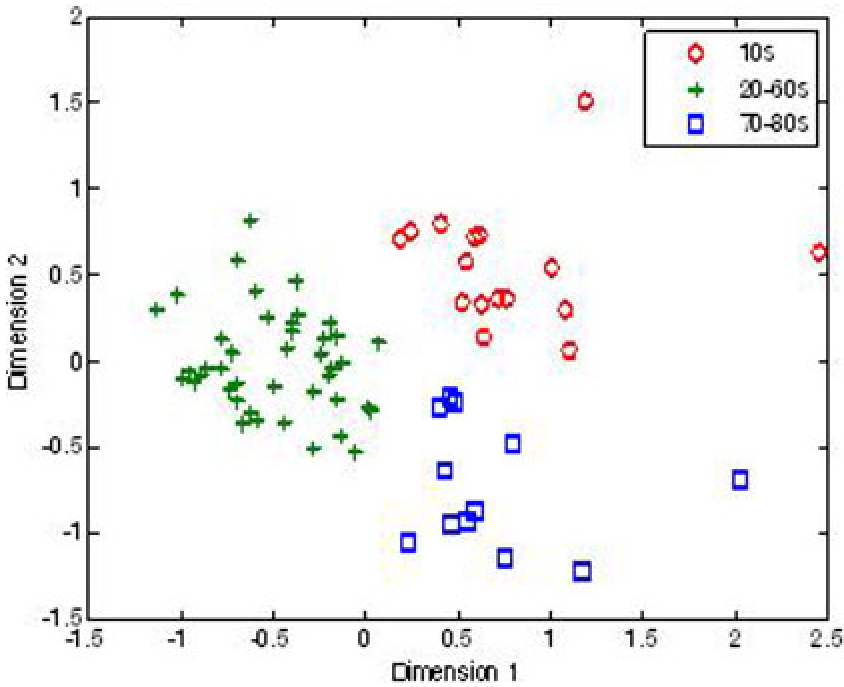 Fig. 2: Visualization of the three distinct walking-age clusters. Shaded symbols represent "outliers" whose walking-age does not match their real age.
The system demonstrated a 87% classification accuracy when validated against a held-out population, proving that even simple inertial sensors can capture nuances previously only visible to specialized cameras.
Deep Insight: Why This Matters for the Future of AI-Healthcare
This paper moves us toward Preventative Biomechanics. By shifting the focus from "identifying the person" to "identifying the health of the movement," the Walking-Age Analyzer provides a standard baseline.
Key Takeaways for Future Research:
- Small Data Robustness: The use of K-means over GMM (Gaussian Mixture Models) proved that for smaller datasets (n=79), simpler, well-initialized clustering algorithms often outperform complex probabilistic models which are prone to overfitting.
- Context Sensitivity: The authors rightly identify that surface (grass vs. concrete) and footwear are the next hurdles for making this technology ubiquitous in consumer wearables like Apple Watch or dedicated medical straps.
Conclusion
The "Walking-Age" is a powerful concept. If your phone could tell you that your gait today matches a person 20 years older than you, it might be the ultimate nudge toward physical therapy or lifestyle changes. This research provides the mathematical and algorithmic foundation to make that nudge a reality.
Check out Table III in the paper for a full breakdown of the cluster ratios and abnormal gait detections.