
Walking into the Past: Reimagining Cultural Heritage through Geo-Social Multimodality
Walking into the Past: Design Mobile App for the Geo-referred and the Multimodal User Experience in the Context of Cultural Heritage
The paper introduces "The Betrothed 3.0," a mobile application leveraging Web 3.0 principles, augmented reality (AR), and geo-localization to transform cultural heritage into a multimodal user experience. It uses Alessandro Manzoni's classic novel as a spatial-temporal framework to guide users through the physical and historical layers of Milan.
TL;DR
"The Betrothed 3.0" is a research project that breathes new life into Alessandro Manzoni’s literary masterpiece by embedding its narrative directly into the streets of Milan. By utilizing geo-localization, markerless Augmented Reality (AR), and Web 3.0 semantic structures, the app transforms a static historical novel into an immersive, multi-layered urban exploration where users transition from passive spectators to active co-authors of cultural memory.
Beyond the "Wunderkammer": The Evolution of Digital Museums
Historically, digital museums functioned as "virtual duplicates"—static web pages mirroring physical rooms. The authors argue that this "Museum 1.0" approach ignores the fluid nature of culture.
The transition from the Wunderkammer (the 16th-century "chamber of wonders") to a Web 3.0 experience involves shifting from mere collection and cataloging to a performative, nomadic interaction. In this new paradigm, knowledge isn't a fixed object but a "sedimented link" questioned through logic and physical proximity.
Methodology: The "Betrothed 3.0" Framework
The core innovation lies in the multi-layered historical storytelling. The app maps the journey of the protagonist, Renzo Tramaglino, across three distinct eras:
- 17th Century: The setting of the novel (Spanish occupation, plague).
- 19th Century: The era of the author, Alessandro Manzoni.
- Modern Day: Contemporary Milanese commercial and social reality.
Key Technical Components:
- Markerless AR (Look Around): Unlike traditional AR that requires QR codes, this system uses GPS and motion sensors (gyroscope/accelerometer) to overlay digital data—such as historical character dialogues or architectural "ghosts"—onto the user's camera view.
- Geo-referenced Interaction: The app identifies the user's coordinates to unlock context-specific multimodal content (audio, video, interactive documents).
- UGC & Social Dynamics: Users can attach their own photos and shared diaries to specific geographical points, effectively becoming "co-authors" of the city's digital archive.
Experiments and Results: A Dual-Mode UX
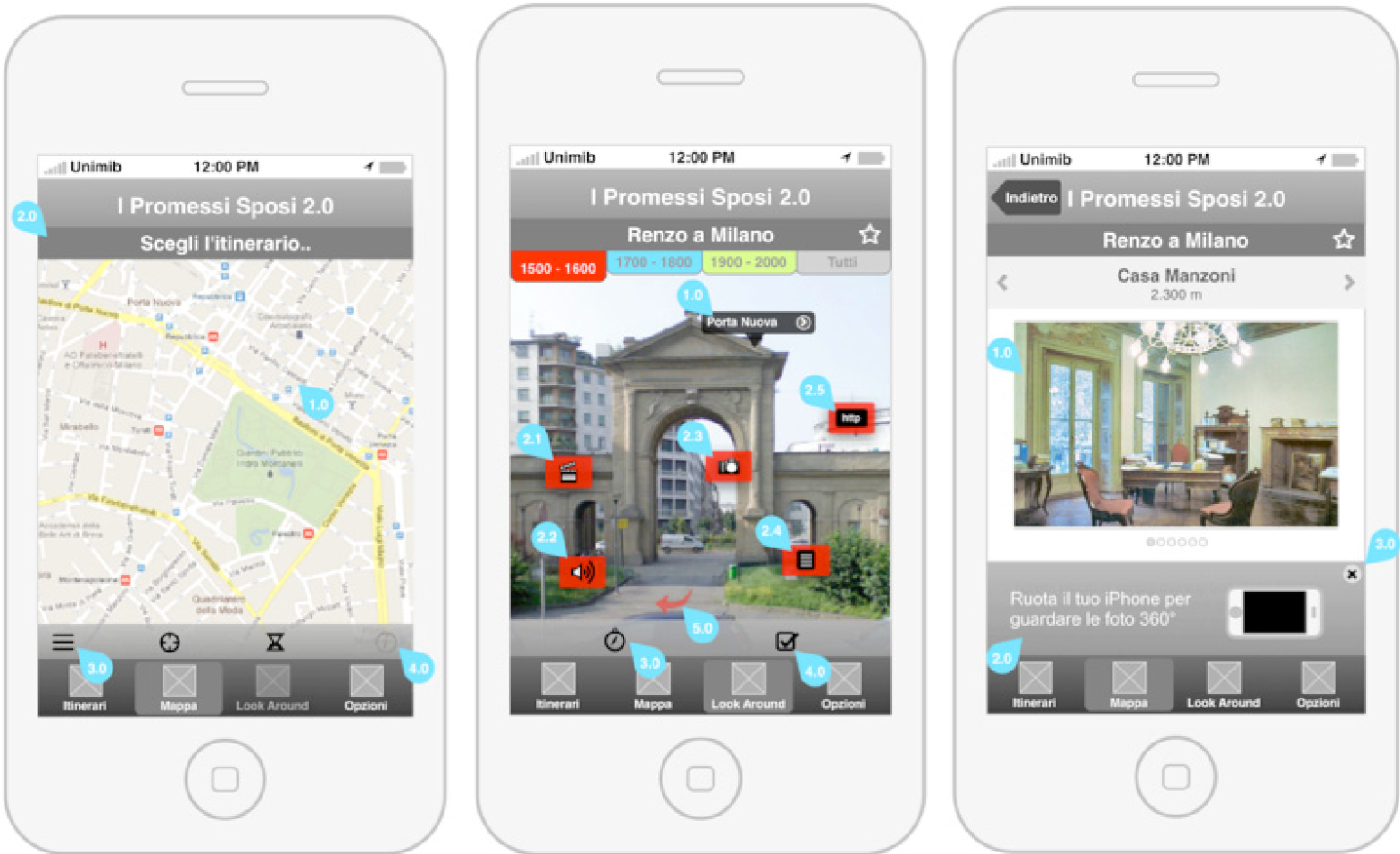
The pilot testing in Milan demonstrated a successful "Immersive Geo-located UX." The application offered two primary navigation modes:
- The Map View: A macro-perspective allowing users to visualize the entire historical route and access deep-dive information tabs for each stage.
- The Look Around View: A first-person immersive experience where AR "comics" and labels appear in real-time as the user pans their device across the city landscape.
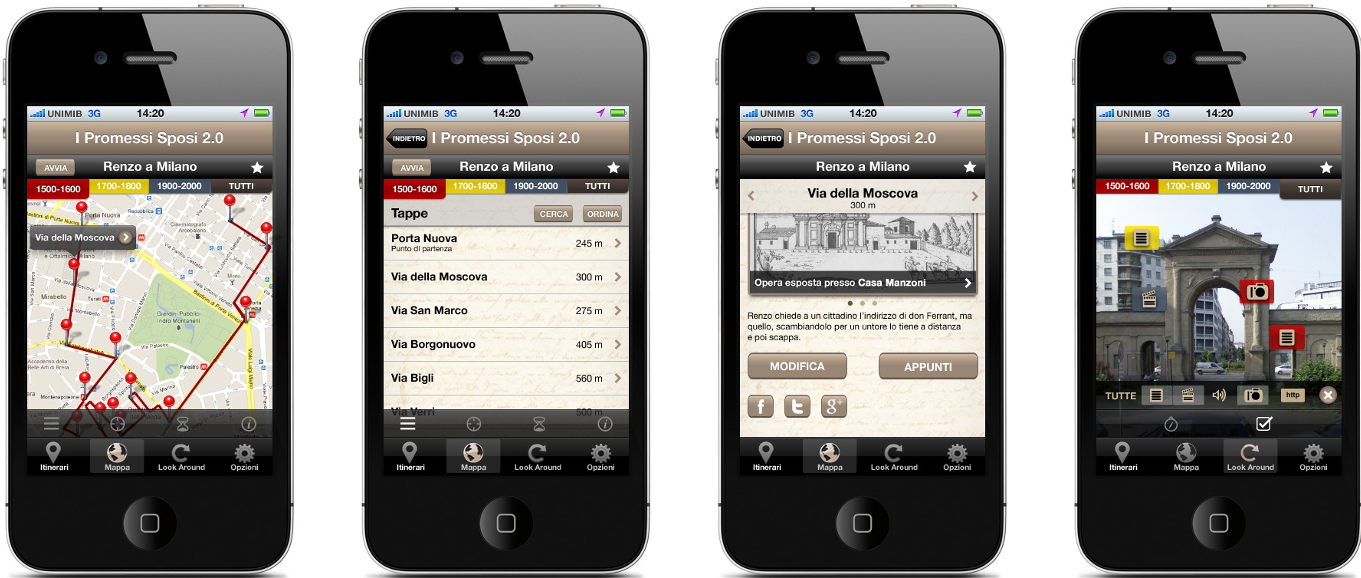
The design successfully created a "continuum" between the house-museum (the physical artifact) and the city (the living context).
Critical Insight: The Designer as a Director
The paper’s most profound contribution is the shift in the designer’s identity. The authors suggest that designing for modern cultural heritage is less about architecture (building a container) and more about directing (curating a performance).
Limitations and Future Outlook
While the project provides a robust design pattern, it relies heavily on GPS accuracy and cellular networks—potential bottlenecks in dense urban "canyons." Furthermore, maintaining the quality of User-Generated Content (UGC) over time poses a significant moderation challenge.
In conclusion, The Betrothed 3.0 serves as a blueprint for how technology can prevent historical documents from being "forgotten in specific containers" and instead integrate them into the vibrant, social fabric of 21st-century life.