
The Walls Have Ears: Balancing Maximum Visibility with Privacy in Social Networks
The Walls Have Ears: Optimize Sharing for Visibility and Privacy in Online Social Networks
This paper introduces the Maximum Circle of Trust (MCT) problem to optimize information sharing in Online Social Networks (OSNs). It proposes the Sharing-Mentioning Leakage (SML) model and develops a hybrid greedy algorithm that combines cut-based estimation with Monte Carlo sampling to maximize message visibility while strictly bounding the probability of leakage to unwanted targets.
TL;DR
Social media "word-of-mouth" is a double-edged sword: it helps your posts go viral, but it also leaks them to people you specifically tried to block. This paper introduces the Maximum Circle of Trust (MCT)—an optimized subset of friends you can share with to maximize visibility while ensuring the probability of a "leak" to an unwanted target stays below a safe threshold.
The "Alice-Bob-Chuck" Dilemma: Why Current Privacy Fails
Most OSN privacy settings are identity-based: if Bob blocks Chuck, Chuck can't see Bob's original photo. However, if Bob's friend Alice sees the photo and writes a new post mentioning it, Bob's original block is useless. The "mention" has a new message ID, and the information bypasses the platform's safety filters.
The authors argue that information travels through two distinct channels:
- Sharing: Trackable, platform-provided resharing (Retweets, Shares).
- Mentioning: Untrackable, manual retyping or summarizing of content.
The core challenge is finding an optimal group of friends to share with such that even if they mention the content, the "leakage paths" to unwanted targets are statistically minimized.
Methodology: The Core of the Circle
The authors tackle the problem across two dimensions: complexity and estimation efficiency.
1. The SML Propagation Model
The Sharing-Mentioning Leakage (SML) model assigns two probabilities to every edge : (sharing) and (mentioning). Under platforms like Facebook or Google+, the model enforces that every leakage path must contain at least one "mentioning" edge, reflecting the reality of modern UI controls.
2. Solving 2-MCT (The 2-Hop Case)
For scenarios where the target is a "friend of a friend," the problem is mapped to an Integer Linear Programming (ILP) framework. The authors prove this is NP-hard but provide a randomized rounding algorithm with an approximation guarantee, where is the number of unwanted targets.
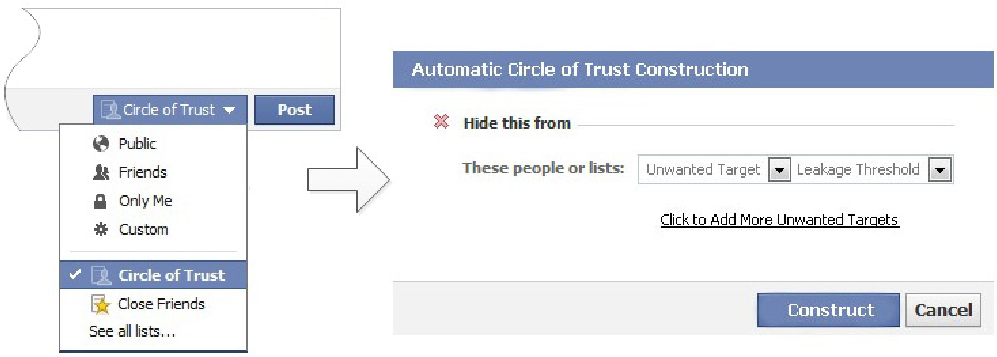 Figure 1: Conceptualizing the construction of a Circle of Trust to isolate the source from unwanted targets.
3. General Case: The Hybrid Approach
In general networks, estimating leakage is #P-hard. Standard Monte Carlo sampling is too slow for "on-the-fly" sharing. The authors introduce a Non-sampling method using Disjoint Pseudo-cutsets. By finding sets of edges that, if broken, increase the path distance to the target beyond hops, they can calculate a mathematical upper bound on leakage risk instantly.
The Hybrid Method first uses this fast cut-based estimation to build a base "Circle," then uses a limited number of sampling steps to fine-tune and add more friends, maximizing visibility without crashing the server.
Experimental Insights: Can Celebrities Have Secrets?
The study evaluated real-world data from Facebook, Twitter, and Foursquare. Key findings include:
- Celebrity Safety: Contrary to intuition, users with high degrees (celebrities) don't necessarily have to block more people. They can often share with >95% of their audience if they filter out a few "high-risk" bridge nodes.
- Efficiency: The Hybrid method is up to 100x faster than traditional methods while maintaining near-optimal visibility.
- Ties that Bind: Most "strong ties" (close friends) end up inside the Circle of Trust, meaning you don't have to sacrifice your best friends for the sake of privacy.
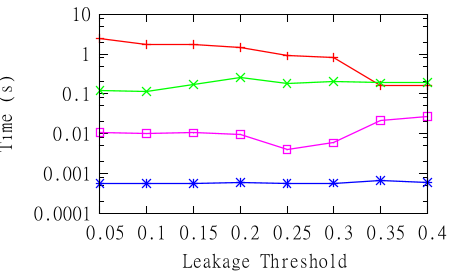 Figure 2: Visibility vs. Threshold. Even at strict 0.1 thresholds, visibility remains high (>80%) across platforms.
Critical Analysis & Future Outlook
This work provides a rigorous mathematical bridge between Graph Theory and Social Privacy. By focusing on "mentioning" as a leakage vector, it addresses a pragmatic flaw in existing OSN architectures.
Limitations: The model assumes sharing and mentioning probabilities are known, which in reality requires significant historical data mining (e.g., EdgeRank) to estimate accurately.
Future Work: As AI (LLMs) makes it easier to track semantic concepts across different posts, the "Mentioning" detection might move from a probabilistic model to a deterministic one, allowing even tighter control over our digital footprints.