
Walrasian Equilibrium in Mobile Crowdsourcing: Balancing Interests through Economics and AI
Walrasian Equilibrium-Based Multiobjective Optimization for Task Allocation in Mobile Crowdsourcing
The paper proposes a multiobjective task allocation framework for Mobile Crowdsourcing (MCS) systems by integrating a Markov and Collaborative Filtering-based Task Recommendation (MCTR) model with a Walrasian equilibrium-based optimization. It successfully achieves social welfare maximization while balancing the conflicting utilities of requesters, platforms, and workers.
TL;DR
Mobile crowdsensing is the backbone of Industry 5.0, yet it faces a persistent hurdle: how do we keep workers engaged and honest while ensuring the platform stays profitable? This paper introduces a dual-layered solution: MCTR, a recommendation engine that predicts where workers will go and what they like, and a Walrasian Equilibrium optimizer that finds the "perfect price" to satisfy requesters, workers, and the platform simultaneously.
The Trilemma of Crowdsourcing
In a typical mobile crowdsourcing (MCS) system, we have three players with conflicting goals:
- Requesters: Want high-quality data at the lowest possible cost.
- Workers: Want maximum payment for minimum effort/travel.
- Platform: Wants a cut of the transaction while maximizing total system activity.
Prior works usually optimize for one at the expense of others, or fail to account for the "human factor"—workers aren't robots; their interests fade over time (forgetting curve), and their movements are semi-predictable but constrained by space.
Step 1: MCTR - The "Human-Centric" Recommendation
The authors argue that to inspire participation, you must recommend tasks that fit a worker's trajectory and interest. The MCTR (Markov and Collaborative filtering-based Task Recommendation) model relies on four pillars:
- Pearson Correlation: Finding similar workers based on past ratings.
- Ebbinghaus Forgetting Curve: Weighting recent interests more heavily than old ones.
- Markov Trajectory Prediction: Estimating the probability a worker will enter a task's sensing area.
- Dwell-Time Factor: Using log-Gaussian distributions to analyze how long a worker "lingers" on a task description as a proxy for genuine interest.
Step 2: Finding the Equilibrium
Once we know who wants what, how much should they be paid? This is where the Walrasian Equilibrium comes in. In economics, this is the state where supply equals demand.
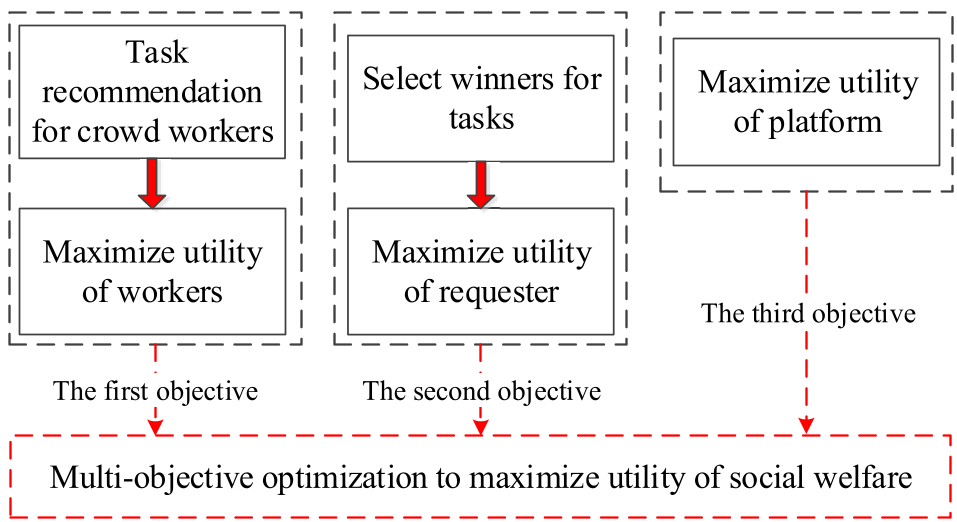
The authors formulate a Social Welfare function that sums the utilities of the Requester, Worker, and Platform. They prove a beautiful mathematical shortcut: the three-objective optimization can be converted into a two-objective global optimization because the platform's utility is essentially a ratio of the value generated.
The algorithm iteratively adjusts payments (): If demand for a task exceeds supply, the price goes up; if supply exceeds demand, it drops. This ensures the system reaches a Pareto-optimal state where no party can be better off without making another worse off.
Evidence from the Field (Yelp Dataset)
The authors didn't just stay in the realm of theory. They tested MCTR against the Yelp dataset (treating users as workers and businesses as tasks).
- Accuracy: MCTR consistently outperformed "user-based" and "dwell-time" baselines in F1-score across both small and large-scale (10,000 workers) tests.
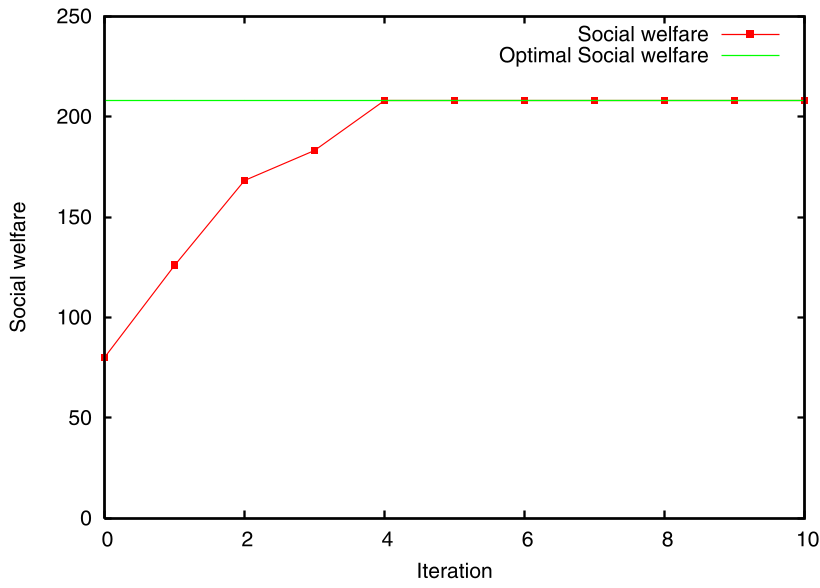
- Convergence: The Walrasian optimizer reached stability in just 4 iterations, proving it is computationally efficient enough for real-time mobile apps.
Insights for the Future
This research confirms that economic theory is an underutilized tool in AI system design. By treating a crowdsourcing platform as a micro-market rather than just a matching problem, we can create self-sustaining ecosystems.
Limitations: Currently, the model assumes basic trajectory patterns. In the future, integrating more complex AI like Graph Neural Networks (GNNs) for social relationship modeling could further refine the "Interest Matrix."
Takeaway: Effective task allocation isn't just about the shortest path; it's about the right price and the right person at the right time.