
"We Found No Violation": Why Twitter’s Threat Policy Fosters Online Toxicity
“We found no violation!”: Twitter's Violent Threats Policy and Toxicity in Online Discourse
This research paper critically evaluates Twitter's "Violent Threats" policy by comparing it against sociolinguistic and legal threat assessment frameworks. The study demonstrates that Twitter's narrow focus on explicit intent fails to mitigate toxic discourse and harassment directed at marginalized public figures.
TL;DR
A new study from the Georgia Institute of Technology reveals a dangerous gap between social media policy and reality. By analyzing Twitter’s "Violent Threats" policy through the lens of linguistics and law, researchers argue that the platform’s permissive stance—which ignores the recipient's perspective—effectively silences marginalized voices while claiming to protect "free speech."
The "Intent" Loophole: Why Moderation.is Fails
Most social media users have seen it: a report for a clear threat comes back with the automated response, "We found no violation of the Twitter Rules."
The core problem lies in Intent vs. Impact. Twitter’s policy focuses almost exclusively on the speaker's explicit intent (e.g., "I will kill you"). If a threat is "vague," "indirect," or "conditional," it often bypasses the filters. However, as sociolinguists point out, a threat is a Speech Act where the context and the listener's interpretation are just as vital as the words used.
Frameworks of Fear: Law and Linguistics
The authors contrast Twitter's policy with two robust frameworks:
- Linguistic Framework: Uses J.L. Austin's Speech Act Theory to look at "perlocutionary acts"—the actual effect speech has on the audience.
- Legal Framework: References the Watts Factors and "True Threat" tests used in U.S. courts, which consider whether a "reasonable person" would find a statement threatening.
Unlike Twitter, these frameworks recognize that a user doesn't have to say "I will" to be terrifying.
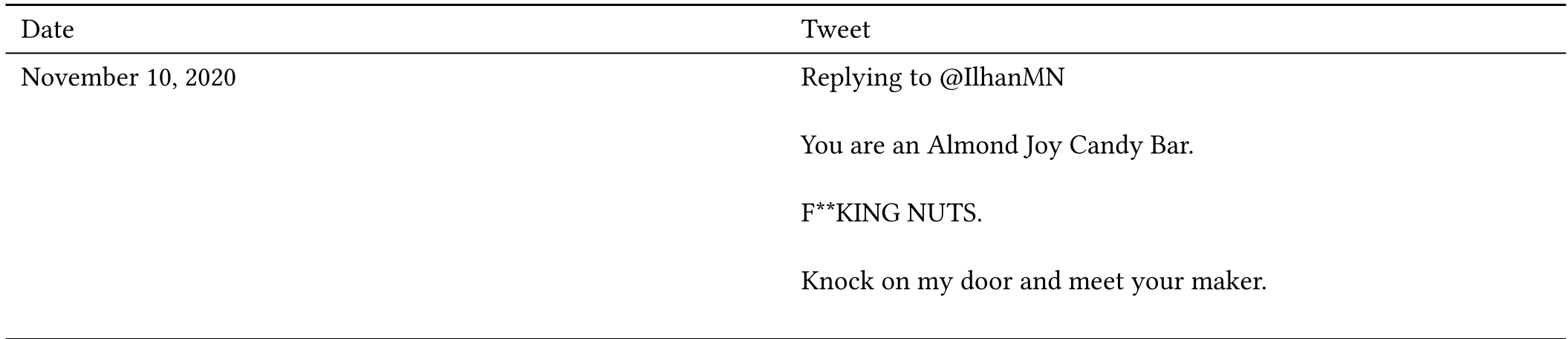 In the example above, the phrase "meet your maker" avoids explicit violent verbs like "kill," allowing it to circumvent automated moderation despite its clear threatening nature.
Case Studies in Failure
The paper analyzes three tweets targeting U.S. Congresswomen Alexandria Ocasio-Cortez and Ilhan Omar.
- Conditional Threats: One user tweeted, "I will personally hunt down AOC and put a bullet in her head if anything comes of this." Because of the "if," such tweets are often treated as "hyperbolic" rather than actionable.
- Sexual Violence: Tweets describing graphic physical assault were ignored because they lacked first-person pronouns (missing the "I will"), even though they passed the legal "Reasonable Speaker" test.

The Paradox of Free Speech
The researchers highlight a chilling irony: by being "permissive" to protect the free speech of the aggressor, platforms cause self-censorship for the target. When marginalized individuals—particularly women of color—receive constant, unmoderated death threats, they often leave the platform or quit public life entirely.
The burden of safety is currently placed on the victim, who must report, document, and relive the trauma, only to be told the threat wasn't "specific enough."
Conclusion: A Call for Interdisciplinary Design
Online moderation is not just a technical challenge; it is a social and ethical problem. The paper concludes that technology designers must:
- Incorporate Socio-Political Context: Recognize that a threat against a woman of color carries historical weight and intent to silence.
- Adopt Subjective Assessment: Move beyond keyword matching to understand how a "reasonable listener" would feel.
- Shift the Power Dynamic: Stop placing the burden of proof on the marginalized.
To create a truly open digital square, platforms must realize that "no violation found" is often a failure of policy, not a victory for speech.