
Scaling Truth: How Weak Supervision Decodes Fake News on Twitter
Weakly Supervised Learning for Fake News Detection on Twitter
This paper presents a weakly supervised learning framework for fake news detection on Twitter, using the trustworthiness of news sources as a noisy proxy for tweet-level labels. By training on a massive, automatically labeled dataset of over 400,000 tweets, the authors achieve high-performance binary classification without the need for expensive manual annotation.
TL;DR
Detection of fake news is fundamentally a data scarcity problem. This paper proposes a breakthrough by ignoring the "exact truth" of individual tweets during training. Instead, it uses the trustworthiness of the source as a noisy proxy. By training on 400,000+ automatically labeled tweets, the authors developed a classifier that identifies fake news with an F1 score of 0.9, proving that massive noisy data can outperform small-scale "perfect" data.
Problem & Motivation: The Annotation Bottleneck
Traditional machine learning thrives on high-quality labels. However, in the realm of fake news, labeling is a nightmare. Professional fact-checkers at organizations like Politifact are slow, and the sheer volume of Twitter data makes manual verification impossible.
Existing research suffered from three fatal flaws:
- Scale: Datasets were too small for modern deep learning.
- Specificity: Models were often overfit to specific events (e.g., a single election).
- Staleness: By the time a dataset was labeled, the "language" of fake news had shifted.
The authors' insight was simple: If we can't label the truth of the message, let's label the reputation of the messenger.
Methodology: High-Volume, Low-Precision Supervision
The core philosophy here is Weak Supervision. The authors collected lists of 46 trustworthy and 65 untrustworthy sources. Every tweet from a "fake news site" was labeled "fake," and every tweet from a reputable outlet was labeled "real."
The Feature Arsenal
To capture the essence of a tweet, the study didn't just look at text. They engineered five feature groups:
- User-level: Account age, follower counts, and posting frequency (the "who").
- Tweet-level: Punctuation ratios, link presence, and meta-data (the "how").
- Text (NLP): Doc2Vec and Bag-of-Words to capture semantics.
- Topic: Using LDA and HDP to see if certain topics (e.g., "conspiracy") are magnets for fake news.
- Sentiment: Polarity and subjectivity scores.
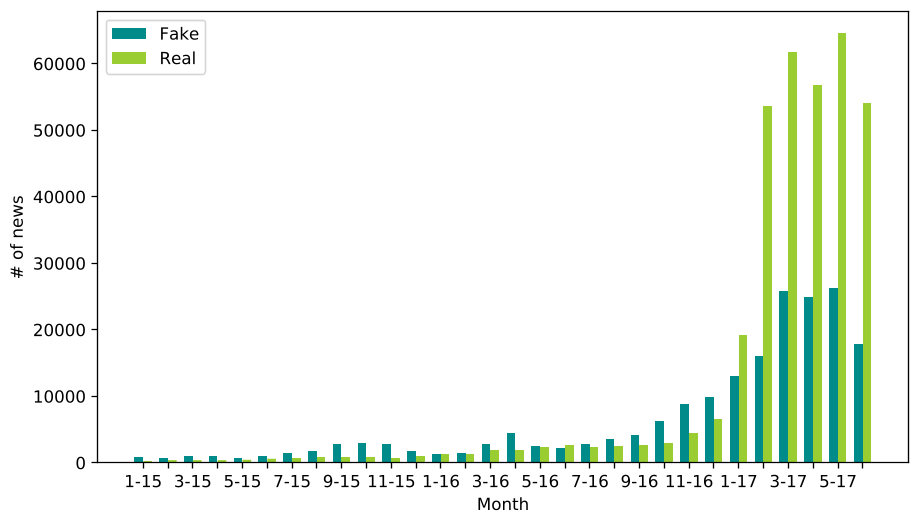 Fig 1: The temporal distribution of the collected noisy dataset.
Experiments & Results: Does Noise Matter?
The big question was: If 40% of tweets from a "fake source" are actually real news, won't the model get confused?
Surprisingly, no. Because the "real" news from fake sources also appeared in the "real" source class (at a much higher volume), the classifiers (XGBoost and Neural Networks) learned to treat the noise as outliers.
Key Findings:
- F1 Score of 0.90: When the model knows who the user is (source features), it is incredibly accurate at flagging misinformation.
- Generalization: When the model sees a tweet from a completely unknown user (Tweet features only), it still achieves an F1 of 0.77. This is critical for catching "burner accounts" used in botnets.
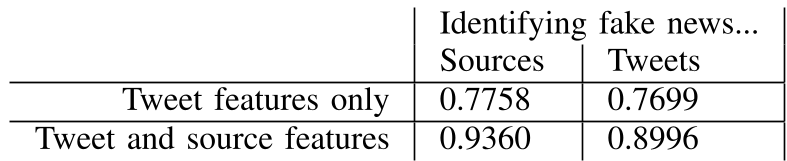 Table 1: Performance across different scenarios (Sources vs. Individual Tweets).
Critical Analysis & Conclusion
Takeaway
The paper validates a massive shift in AI strategy: Quantity has a quality of its own. By using weak labels, we can build models that are always up-to-date and cover millions of data points without spending a cent on human annotators.
Limitations
The primary risk is the Echo Chamber Effect. If a classifier is trained purely on source reputation, it might develop a bias where it flags any content from an alternative media outlet as fake, even if they occasionally break real news. Furthermore, the 2017 timeframe of the data means newer adversarial techniques (like AI-generated deepfake text) were not considered.
Future Outlook
The next step for this tech is integrating Graph Neural Networks (GNNs). Instead of just looking at the tweet content, the model should look at how it spreads through the network—fake news often has a distinct "viral footprint" compared to organic news.