
Driving Safeguard: A Mobile-Wearable Fusion for Real-Time Emotional Monitoring
Wearable Mobile-Based Emotional Response-Monitoring System for Drivers
The paper presents a wearable, mobile-based monitoring system designed to detect driver emotional responses—relaxed, stressed, and fatigued—using a fusion of PPG, EMG, and IMU sensors. By leveraging a Support Vector Machine (SVM) classifier on a mobile platform, the system achieves a state-of-the-art accuracy of 99.52% in classifying these emotional states.
TL;DR
Researchers have developed a wearable system that "reads" a driver's internal state—distinguishing between being relaxed, stressed, or fatigued with over 99% accuracy. By combining heartbeat data, neck muscle tension, and head movement patterns into a mobile app, the system provides real-time alerts to prevent accidents caused by road rage or drowsiness.
Problem & Motivation: The Hidden Cost of Negative Emotions
Road accidents are frequently the result of a driver's internal state rather than just external mechanical failure. Negative emotions—ranging from the high-arousal "road rage" (stress) to the low-arousal "highway hypnosis" (fatigue)—severely impair decision-making.
While previous research has attempted to use facial recognition or voice analysis, these methods are often unreliable due to varying lighting conditions or cabin noise. Alternatively, monitoring vehicle behavior (like steering wheel jerky movements) is often "too late," detecting the error rather than the state that caused it. The authors’ insight was to look directly at the physiological source: the autonomic nervous system and musculoskeletal responses.
Methodology: The Sensor Trio
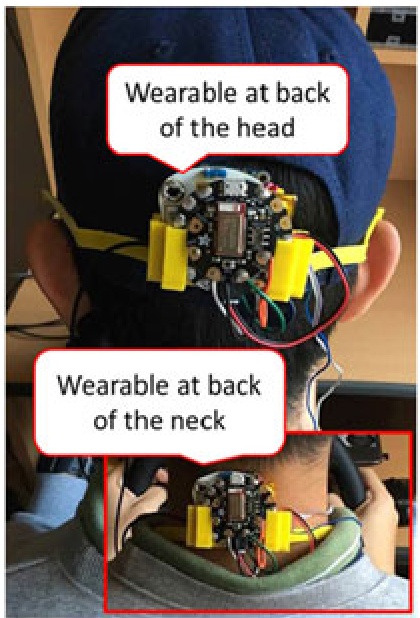
The system uses an elegant hardware stack: an Adafruit FLORA platform paired with three specific sensors:
- PPG (Earlobe): Captures Pulse Rate (PR) and Pulse Rate Variability (PRV). Stress typically spikes the PR, while fatigue causes it to drop.
- EMG (Upper Trapezius): Measures muscle tension in the neck. The trapezius is highly sensitive to mental workload and psychological stress.
- IMU (Head-mounted): Tracks 9-degree-of-freedom motion. This detects subtle "head nodding" (fatigue) and sudden "shock" movements (stress).
Feature Engineering and SVM
The core of the "intelligence" lies in how the raw data is processed. The researchers extracted 36 distinct features, including:
- Frequency Domain: LF/HF ratios from PPG and power spectral density from EMG.
- Phase Domain: Percentage of head movement points outside a "control eclipse."
They utilized a Support Vector Machine (SVM) classifier, chosen for its efficiency on mobile hardware compared to heavy Neural Networks, while still maintaining high non-linear separation capabilities.
Experiments: Simulator-Based Validation
Since inducing real fatigue and road rage on public roads is hazardous, the team used the Euro Truck Driver simulator. Subjects navigated high-traffic city scenes (to induce stress) and monotonous highways (to induce boredom/fatigue).
Key Findings:
- Pulse Rate (PR): Stress (C2) showed rapid PR increases, while fatigue (C3) resulted in PR levels lower than the neutral baseline (C1).
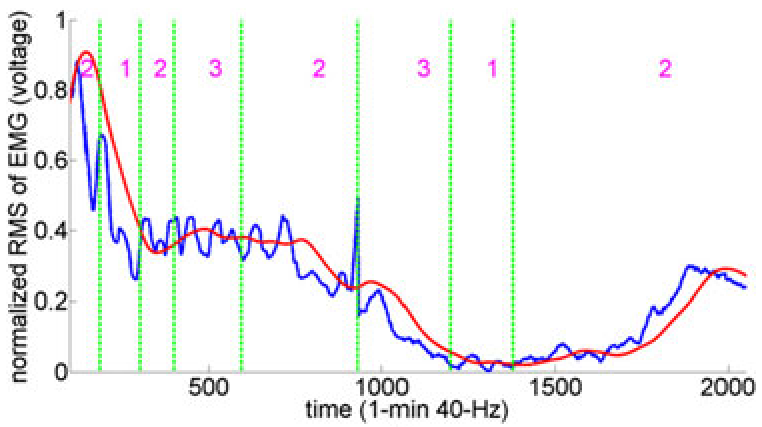
- Muscle Activity: The RMS (Root Mean Square) of the EMG signal increased significantly during stress and decreased during fatigue.
- Head Motion: Interestingly, while head nodding is a classic sign of fatigue, the study found it can also occur during stress as drivers frequently adjust their body position to maintain focus.
Results & Performance
The system achieved a 99.52% accuracy in the lab using all features. More importantly, when optimized for a mobile environment (top 15 features), it still hit 96.23%.
| Metric | Achievement |
|---|---|
| Peak Accuracy | 99.52% |
| Mobile Deployment Accuracy | 96.23% |
| Battery Life | ~8 Hours |
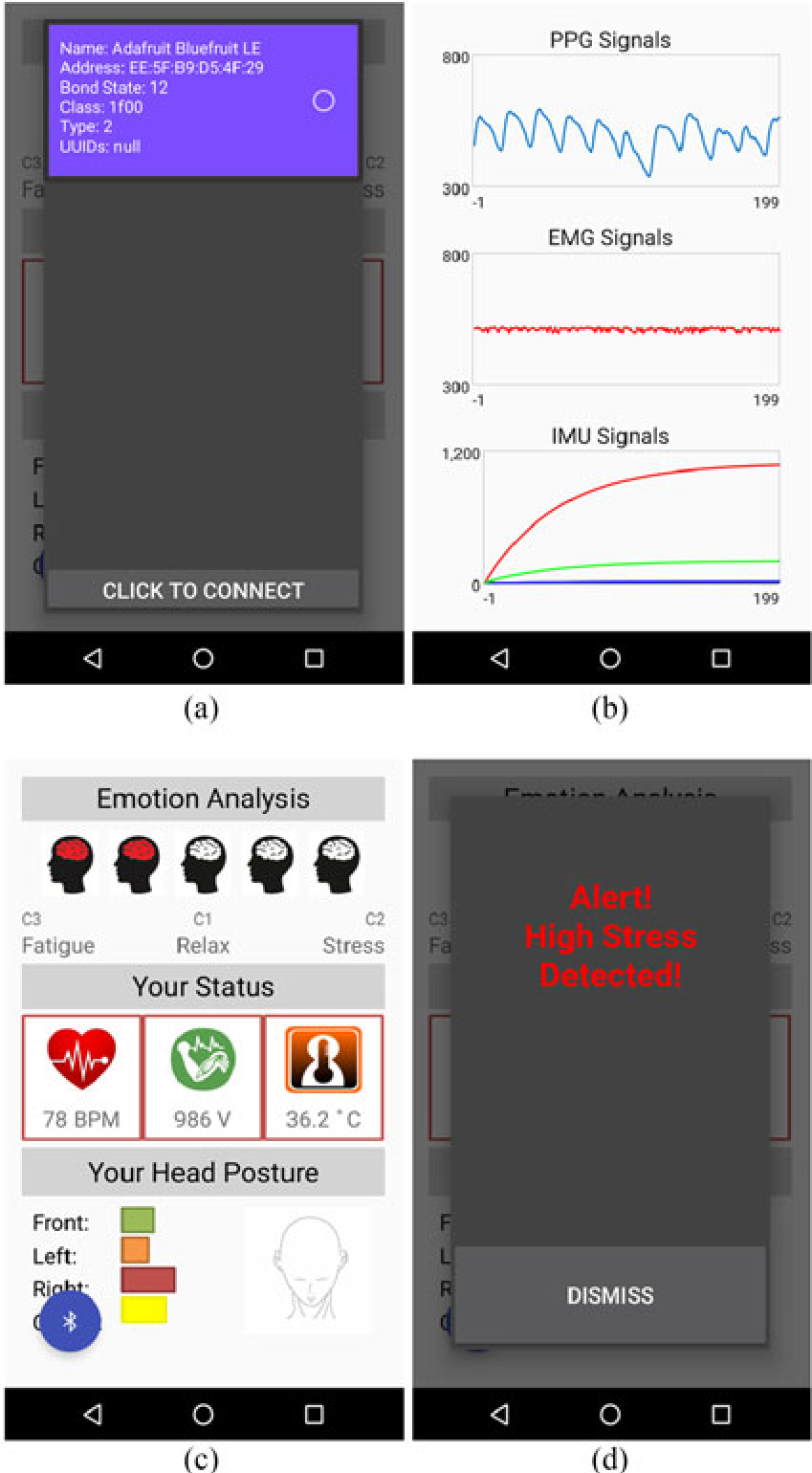
| Alert Threshold | 10 consecutive negative segments |
Deep Insight & Conclusion
The true value of this paper lies in its holistic view of the driver. By showing that stress and fatigue often have opposite physiological symptoms (C1 relaxed state sits in the middle), the authors provide a framework for a single system that can handle both the "too angry" and "too tired" driver.
Limitations: The study is limited by a small sample size (N=10) and the use of wet EMG electrodes, which are messy for daily use. Future iterations using dry electrodes and broader demographic testing will be essential for commercial vehicle integration.
In conclusion, this research marks a significant step toward an Intelligent Driver Safety Alert System that doesn't just watch the road, but watches the driver’s well-being.