
WeatherUSI: Transforming Urban Displays into Hyper-Local Weather Stations
WeatherUSI: Crowdsourcing Weather Experience on Public Displays
WeatherUSI is a novel crowdsourcing application designed for public displays that allows passers-by to report subjective and localized weather data. It is developed as a public counterpart to the Atmos mobile app to compare data accuracy, user engagement, and reporting behaviors between stationary public interfaces and mobile devices.
TL;DR
WeatherUSI is a research project exploring a fundamental shift in data collection: moving from private mobile devices to public urban screens for weather crowdsourcing. By leveraging the public nature of pervasive displays, the system aims to improve localized weather forecasting while investigating how social presence—the "eyes of others"—affects the quality and frequency of volunteer contributions.
Background & Positioning
In the hierarchy of smart city infrastructure, public displays have historically been relegated to "digital posters" with static playlists. WeatherUSI, part of the RECALL project, repositions these screens as active sensors and crowdsourcing hubs. It stands as a critical comparison piece to its mobile predecessor, Atmos, questioning whether the "publicness" of a screen acts as a feature or a bug in data reliability.
Motivation: The Contextual Gap in Mobile Crowdsourcing
Current mobile crowdsourcing (e.g., Waze or Atmos) provides massive scale but suffers from two limitations:
- Observability: It is nearly impossible to observe why or how a user provides data via their private phone in a natural setting.
- Accountability: Mobile reporting is private and anonymous, which can sometimes lead to low-effort inputs.
The authors hypothesize that a public display creates a "situated" context where the passer-by is physically immersed in the local environment they are reporting on, potentially increasing the felt responsibility for accuracy.
Methodology: The Interaction Design
WeatherUSI allows users to input subjective weather experiences—how the air feels rather than just what the thermometer says.
System Architecture & Logic
The system utilizes a localized interface where users can quickly toggle weather conditions and predict near-future changes. To understand the social dynamics, the team implemented:
- Kinect Integration: Using depth-sensing to detect if the user is an individual or part of a group.
- Ground-Truth Comparison: Validating user-generated subjective data against historical records from the Weather Underground database.
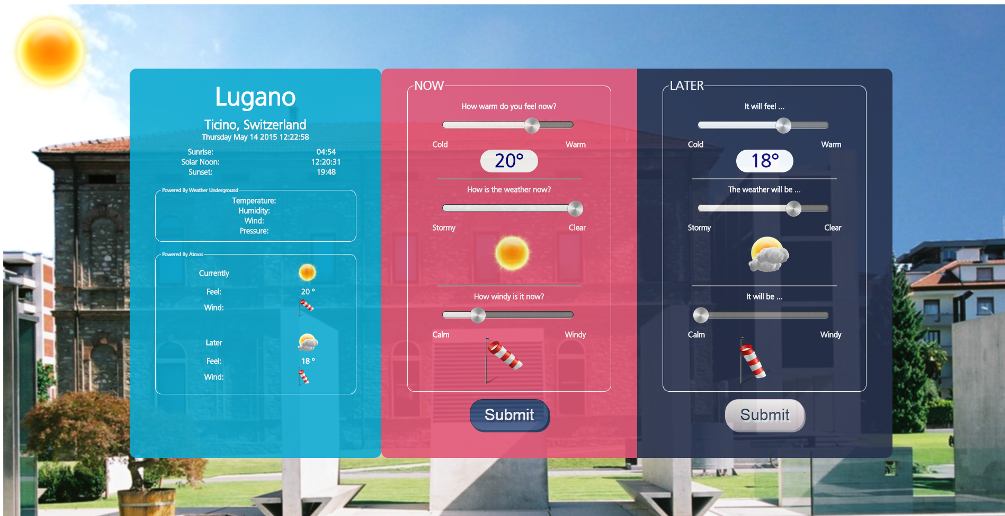 Figure 1: The UI design focuses on quick, tactile inputs for localized weather reporting.
Experiments & Research Paradoxes
The study focuses on four primary research questions, revealing a fascinating tension between individual and social behavior:
1. The Accuracy vs. Distance Paradox
While public reporting might increase "responsibility," the displays are located indoors. The researchers explore whether being shielded from the elements reduces the accuracy of the weather reports compared to mobile users who might be standing outside.
2. The "Subversive Performance" Effect
When users are in groups, they often treat public displays as a stage for "performing" for their friends rather than completing the task accurately. This social subversive behavior is a known challenge in public HCI, where accuracy is sacrificed for humor or social bonding.
3. Cross-Device Synergy
Can a public display act as a "physical notification"? The study investigates if seeing the WeatherUSI app on campus increases the usage of the Atmos mobile app, creating a cross-platform ecosystem for urban sensing.
Deep Insights & Future Outlook
The core value of WeatherUSI is not just the weather data it collects, but the behavioral data it generates about urban dwellers.
Key Challenges:
- Indoor Bias: Reporting on weather from behind glass might skew perception.
- Interface Fluidity: Public display interactions must be extremely low-friction to attract "incidental" users who are just passing by.
Conclusion: WeatherUSI proves that public displays are more than just advertisement hoardings; they are potential catalysts for community-driven data. For future smart cities, this suggests that providing localized feedback loops—where citizens see their own reports reflected on public screens—can significantly enhance the "Senseable City" paradigm.
References
- Bangor, A., et al. (2008). An empirical evaluation of the system usability scale.
- Davies, N., et al. (2012). Open display networks.
- Goncalves, J., et al. (2013). Crowdsourcing on the spot.