
Weaving a Distributed, Semantic Social Network for Mobile Users
Weaving a Distributed, Semantic Social Network for Mobile Users
The paper introduces a mobile Social Semantic Web framework that builds a distributed social network using W3C standards. It leverages WebID, FOAF+SSL, and Semantic Pingback to enable decentralized identity and social linking on Android devices, moves away from proprietary data silos like Facebook.
Executive Summary
TL;DR: This work bridges the gap between the Decentralized Semantic Web and the mobile-first era. By using WebID, FOAF+SSL, and Semantic Pingback, the authors created a framework that allows users to truly own their social data while maintaining the convenience of a modern smartphone interface.
Context: Established in the early 2010s, this research is a foundational effort in the "Small Web" or "IndieWeb" movement. It stands as a pioneer in demonstrating that mobile devices can act as active endpoints for the Semantic Web, rather than just passive consumers of centralized APIs.
The Problem: The Tyranny of Data Silos
In the current digital landscape, social giants like Facebook and Google act as centralized gatekeepers. This leads to several critical issues:
- Privacy Risks: Users must accept opaque, take-it-or-leave-it privacy terms.
- Lock-in Effects: Relationships and profiles are trapped within specific platforms, making migration impossible.
- Lack of Autonomy: Users cannot host their own social "node" as they would a personal website.
While semantic standards like FOAF (Friend of a Friend) have existed for years, they were primarily used for static RDF files on the web. Applying these to mobile devices—where data sync, UI integration, and battery efficiency matter—remained an unsolved challenge.
Methodology: The Architecture of Decentralization
The authors propose a multi-layered approach to replace the centralized social graph with a "Web of Data."
1. The Social Ingredients
- WebID: A unique IRI identifying a person, pointing to an RDF document describing them.
- FOAF+SSL: A decentralized authentication layer that uses certificates to prove identity without a central password server.
- Semantic Pingback: A notification mechanism that "pings" a user when a new social link (a friend request or mention) is created.
2. Android Integration (MSW and MSSW)
The brilliance of the implementation lies in the Mobile Semantic Web (MSW) and Mobile Social Semantic Web (MSSW) middleware.
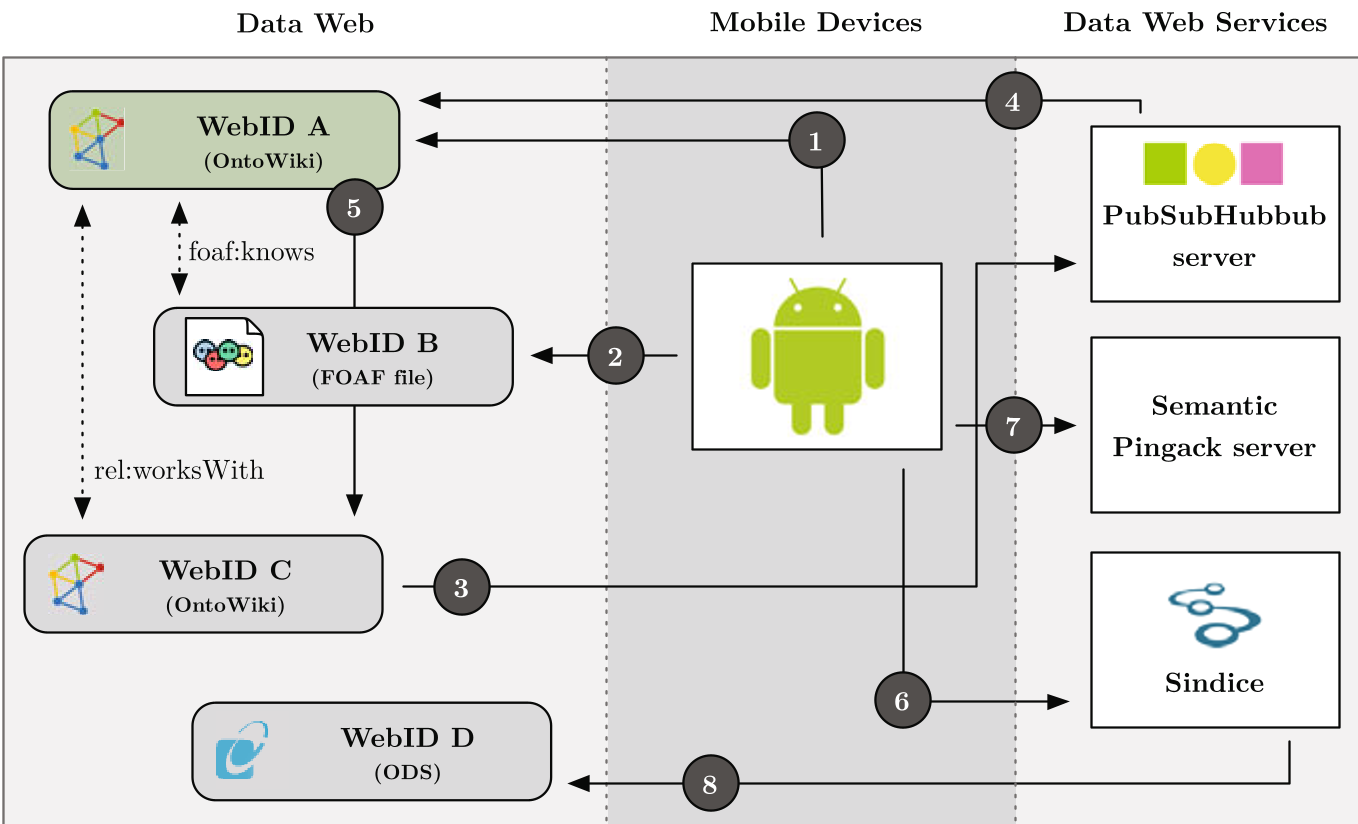
- Triple Store on SD-Card: The system stores RDF models locally on the device's storage, allowing for portability and offline access.
- Rule-Based Mapping: Using the androjena library (a port of Apache Jena), the system applies logic rules to transform complex RDF triples into flat data structures compatible with the native Android Contacts API.
Experiments & Real-World Results
The authors proved the feasibility of this architecture through a functional Android implementation.
- Native Interaction: Users don't see raw RDF. Instead, "Semantic Friends" appear directly in their phone's contact list alongside traditional contacts.
- Sync Capabilities: The client manages background synchronization of WebIDs, ensuring that if a friend updates their profile on their own server, the change is reflected on the user's phone automatically.
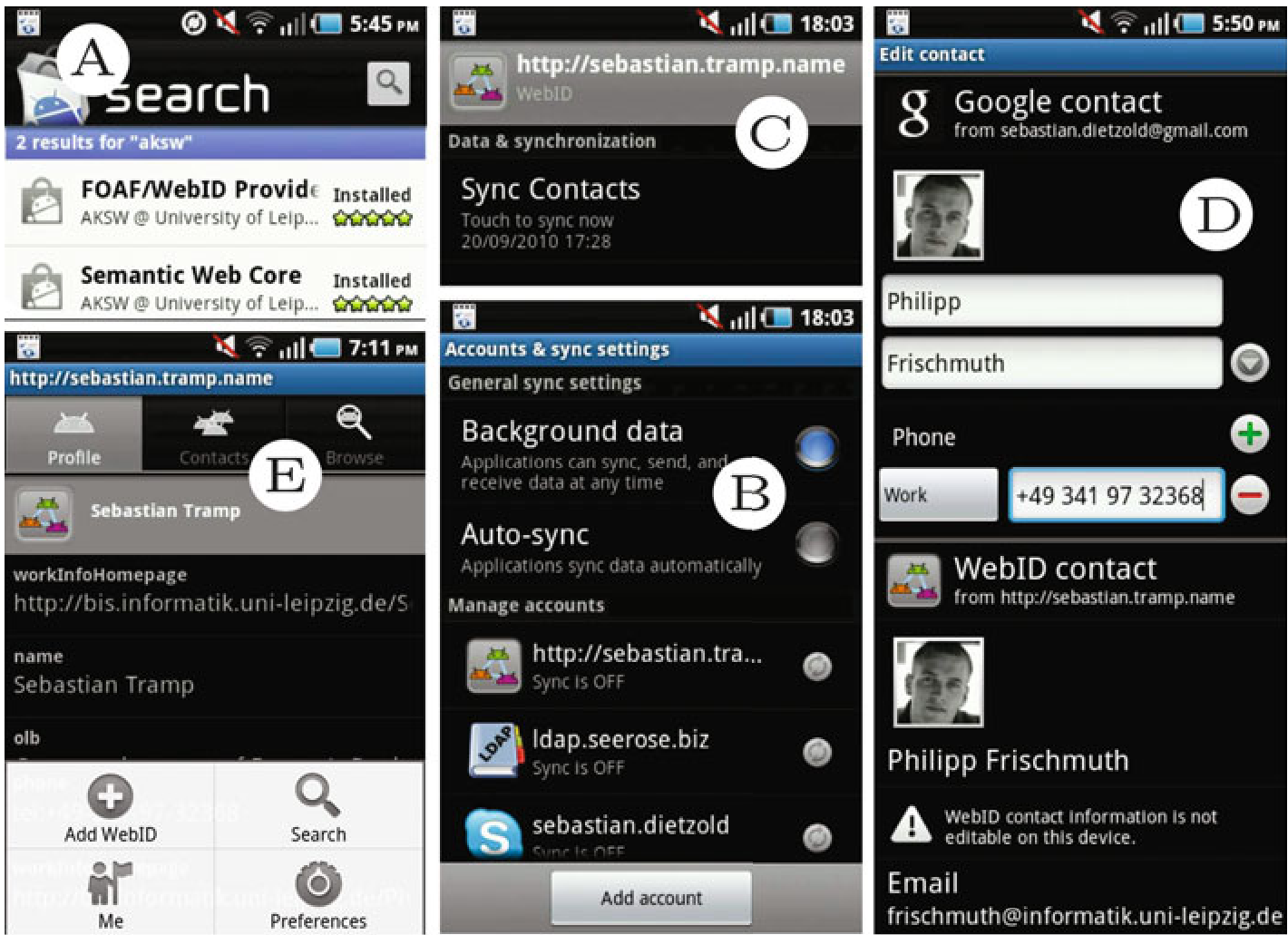
Key Outcome: The system achieved a "transparent" user experience, a core requirement (as specified in Section 2), where the complexity of the Semantic Web remained invisible to the end user.
Critical Analysis & Future Outlook
Conclusion
The paper successfully demonstrates that the Semantic Web isn't just for academic servers; it can thrive on mobile devices. By weaving together disparate standards into a cohesive architecture, the authors provided a blueprint for a distributed social future.
Limitations
- Entry Barrier: Creating certificates and hosting personal WebIDs is still too technical for average users.
- Real-time Updates: The transition from polling (checking for updates) to a true push-based system (using PubSubHubbub) was noted as a needed future improvement.
The Legacy of this Work
While centralized platforms still dominate, the architectural decisions here—specifically the use of Linked Data as an Identity Layer—directly foreshadowed modern decentralized movements like Solid (Social Linked Data) and the Fediverse.