
From Passive Registries to Social Networks: Weaving Intelligence into Web Service Discovery
Towards a framework for weaving social networks principles into web services discovery
This paper proposes a framework to integrate social networking principles into Web services discovery, establishing three types of relationships: substitution, competition, and collaboration. It introduces a methodology to structure these services into social networks using clustering and dynamic link weighing to improve discovery precision beyond traditional syntax-based registries.
TL;DR
Web service discovery is moving away from static, yellow-page-style registries. This paper introduces a framework that treats Web services as social actors, organizing them into networks based on substitution, competition, and collaboration. By using dynamic clustering and "social" weighting, the system ensures that services aren't just found by name, but by their proven ability to work together.
The "Passive Component" Problem
For decades, Web services were viewed as passive components. When a developer needed a function, they searched a registry (like UDDI) using syntactic keys. However, in the modern web, services appear and disappear unpredictably. Existing methods fail because:
- Syntax isn't Semantic: Searching for "BookFlight" might miss "AirSeatReservation."
- QoS is Ignored: Traditional registries don't care if a service is overloaded or has a history of failing.
- Relationship Blindness: They don't recognize that Service A might be a perfect backup for Service B.
The Framework: Architecture of a Social Service
The authors propose a three-tier architecture that moves beyond typical discovery.
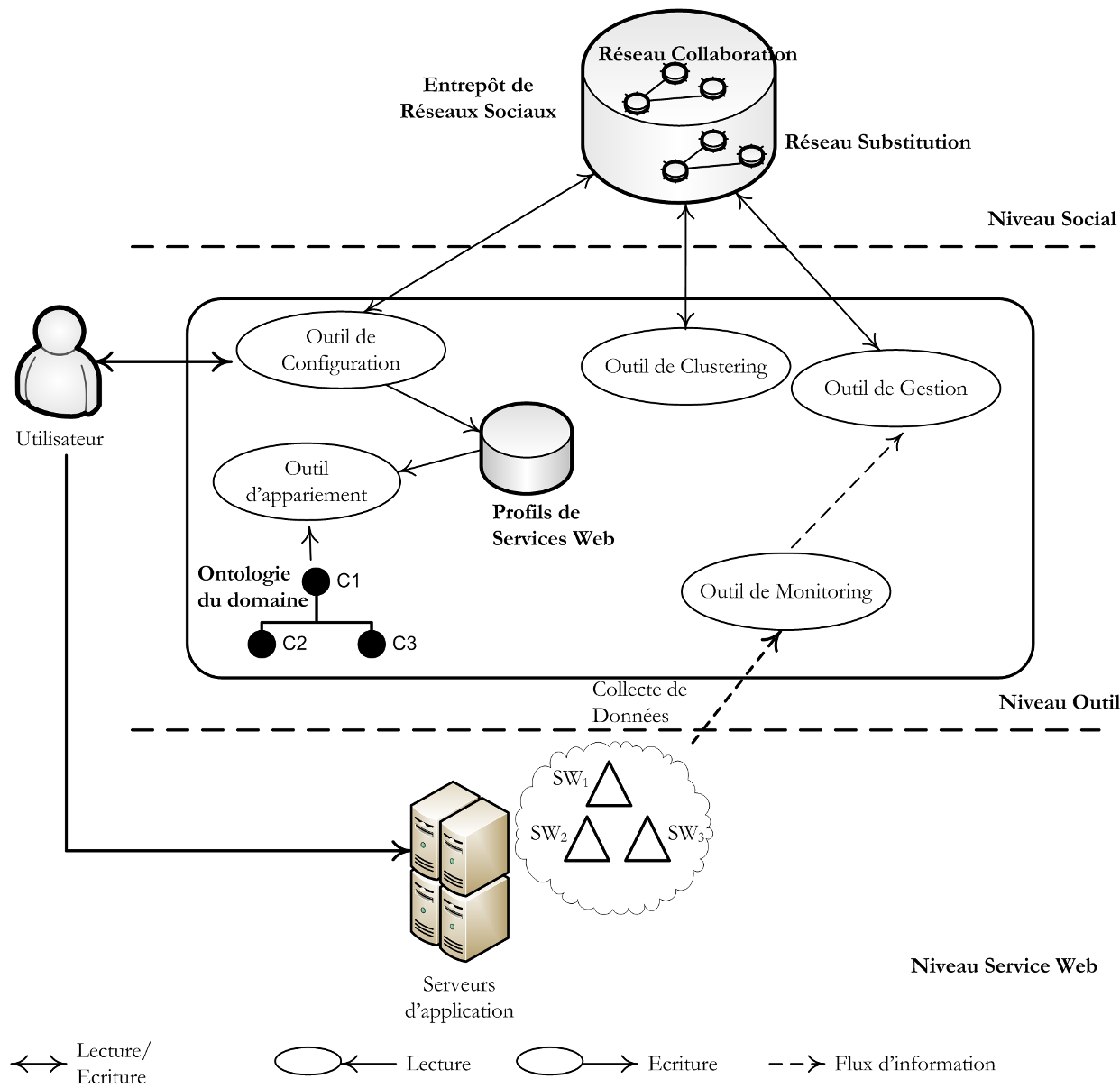
1. The Three Social Pillars
The network is built on three specific interaction types:
- Collaboration: Services recommending others to complete a task (e.g., a flight booking service recommending a taxi).
- Substitution: Semantically equivalent services that can step in during a failure.
- Competition: Services providing the same function but competing on non-functional criteria like price or speed.
2. Semantic Matchmaking & Clustering
To build the social graph, the framework calculates a Degree of Similarity (DS) and Degree of Complementarity (DC). Using an ontological approach, it measures the distance between concepts (Inputs, Outputs, Pre/Post-conditions).
Based on these scores, services are grouped into Strong, Medium, or Weak clusters relative to a "Root" service.
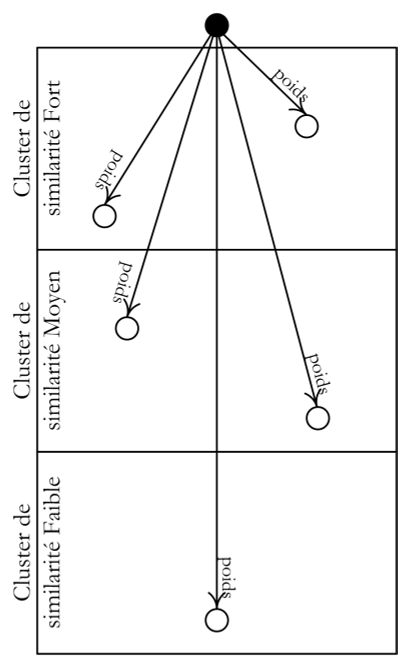
How Selection Works: The Intelligence Engine
The framework doesn't just pick the most similar service. It uses a dynamic selection function ():
- (Cost): The weight of the social link (Stronger clusters have higher priority).
- (Experience): Historical satisfaction from past interactions.
- (Load): The current real-time workload of the service.
This ensures that even if a service is "Strongly" related, it won't be picked if it is currently crashing or congested ().
Experimental Insights: Survival of the Fittest
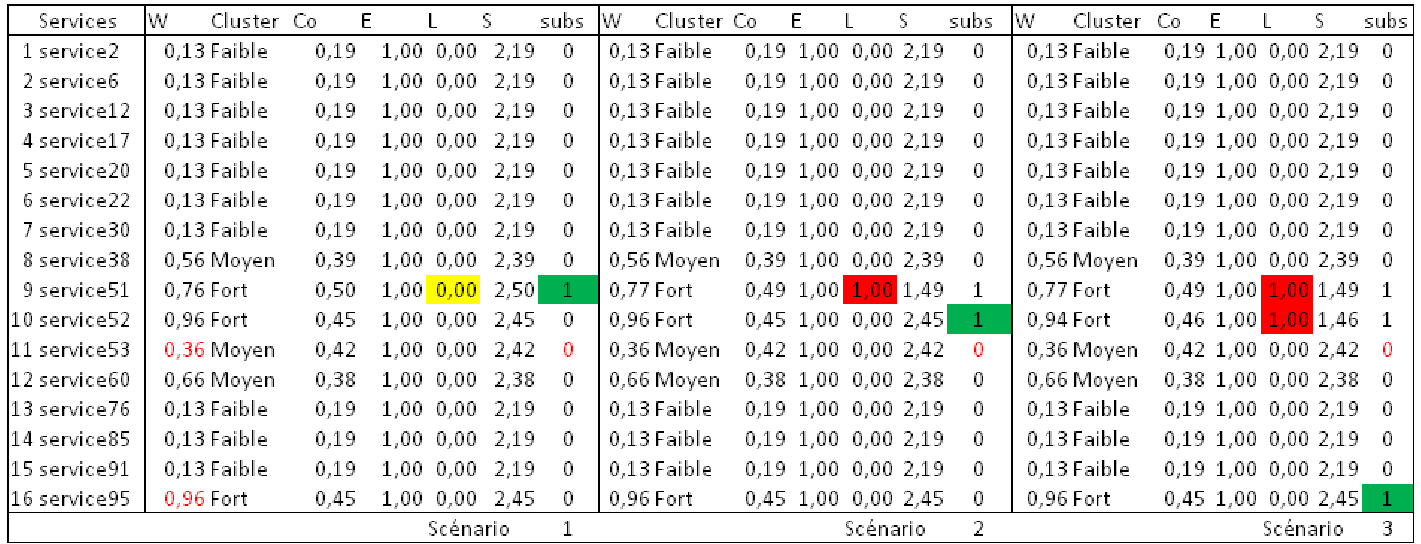
Through simulated scenarios, the authors demonstrated the framework's adaptability.
- Promotion/Demotion: If a "Weak" cluster service consistently performs well as a substitute, its link weight increases (Eq. 7), eventually "promoting" it to the Medium or Strong cluster.
- Fault Tolerance: In a scenario where all "Strong" services were overloaded, the system effectively "ventured" into the "Medium" cluster to find a functional substitute, maintaining system availability.
Critical Analysis & Future Outlook
Takeaway: This research proves that "Socializing" services is a viable path toward self-healing architectures. By offloading the discovery logic into decentralized social structures, we reduce the reliance on fragile central registries.
Limitations:
- Bootstrap Cold-Start: A new service with no interaction history will struggle to be discovered until it randomly gains "Experience" points.
- Overhead: Calculating semantic similarity across massive ontologies in real-time can be computationally expensive.
Future Work: The authors aim to further optimize discovery times and compare the performance against high-scale distributed registries. As we move toward 2026, integrating AI-driven sentiment analysis on "Social Annotations" of services could be the next frontier.