
Is the Internet Truly Flat? Decoding the Cultural DNA of Web 2.0
Is Web 2.0 Culture-Free or Culture-Bound? Differences between American and Korean Blogs
This study investigates whether Web 2.0 platforms are culture-bound or culture-free by comparing American (Blogger) and South Korean (Naver) blogs. Through content analysis, the authors demonstrate that while digital tools enable cultural homogeneity in some aspects, deep-seated cultural dimensions like individualism-collectivism and context-sensitivity significantly shape user-generated content and platform interaction.
Executive Summary
TL;DR: Despite the global reach of Silicon Valley giants, Web 2.0 is far from a "culture-neutral" zone. By comparing American and South Korean blogging behaviors, this research reveals that our digital footprints are deeply embedded in our offline cultural values. While Americans use blogs to exercise individual agency and functional control, South Koreans leverage them for high-context, multi-modal communication, often using the digital space to express personal identities that might be suppressed in their offline, collectivistic society.
Academic Positioning: This work bridges the gap between traditional cultural psychology (Hofstede/Hall) and Human-Computer Interaction (HCI). It moves beyond simple "UI localization" (colors/layouts) to analyze how User-Generated Content (UGC) and technological affordances interact to create a unique cultural hybridity.
Problem & Motivation: The Failure of Universalism
For decades, the tech industry operated under the "universal design" myth—the idea that a clean, neutral interface would work equally well in San Francisco, Seoul, or Shanghai. Yet, Facebook stalled in South Korea while Cyworld thrived.
The authors argue that online communication is an extension of offline social institutions. If a culture values high-context communication (where meaning is implicit and non-verbal), a "neutral" text-heavy platform feels alien. The core insight here is that technology is not just a tool; it's a mirror and a shaper of cultural identity.
Methodology: Mapping Culture to Pixels
The study breaks down culture into three quantifiable dimensions:
- Individualism (Me vs. We): Measured by the use of first-person pronouns ("I" vs. "We") and the type of customization (Functional for self vs. Aesthetic/Social for others).
- Context (High vs. Low): Measured by "Site Volume" (complexity) and the use of non-verbal modalities like emoticons and images.
- Space (Territoriality): Measured by copyright awareness and privacy settings.
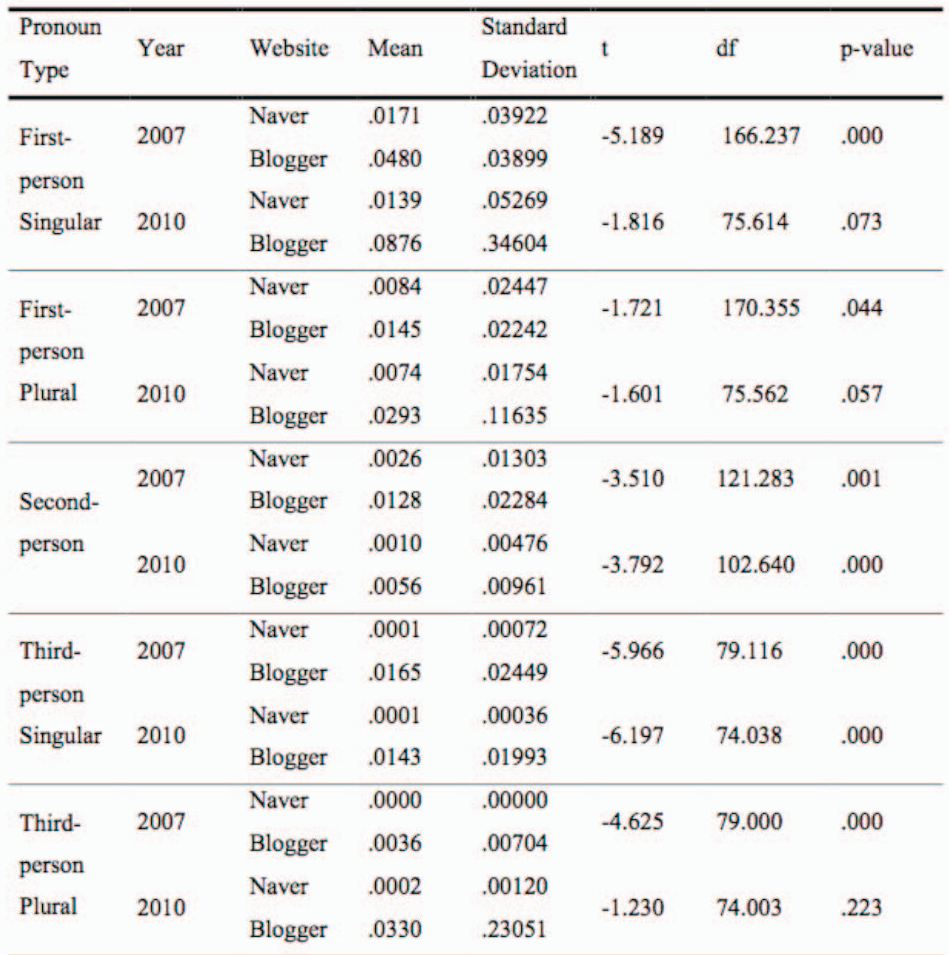 The statistical breakdown shows a clear distinction in how "I" and "We" were used in 2007 vs. 2010.
Core Findings: The "Compensatory" Individual
The results provide a fascinating nuance to the Individualism-Collectivism debate:
- The American Way: U.S. bloggers on "Blogger" disclosed significantly more personal info (name, location) and focused on functional customization—adding gadgets that served their own utility.
- The Korean Way: Naver users in South Korea utilized "High-Context" features. Their blogs had more pages, thousands of tags, and a heavy reliance on images and emoticons to convey implicit meaning.
- The Compensatory Effect: Surprisingly, Korean users wrote more idiocentric (self-centered) descriptions in 2007 than Americans. Why? The authors suggest the web acts as a "safety valve" for those in repressive or highly collectivistic offline environments to voice opinions they otherwise couldn't.
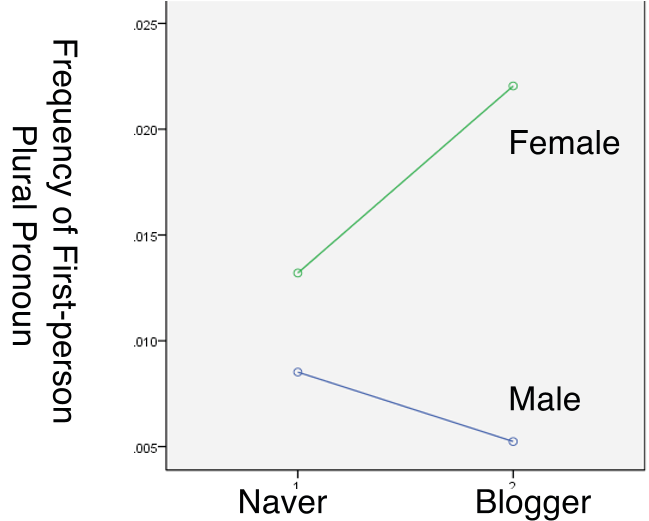 Figure 1: Analyzing the interplay between gender and culture—notably, American females used "we-ness" language more frequently than their male counterparts.
Experiments & Results: Cultural Homogeneity is Rising
The study also captured a Longitudinal Shift. Between 2007 and 2010:
- Pronoun Convergence: The gap in "I-consciousness" verbalized through pronouns narrowed.
- Homogenization: Habitual use of similar technology (blogging) led to more similar behaviors over time, suggesting that while culture bounds the web, the web also slowly erodes cultural extremes.
Critical Analysis & Conclusion
Takeaway
For product designers and researchers, the message is clear: Agency is universal, but its expression is cultural. A platform that offers "control" will appeal to all, but an American might use that control to track their fitness (Personal Agency), while a Korean might use it to decorate a digital room for their friends (Social Agency).
Limitations
The study is limited by its binary country comparison (US vs. SK) and the specific era of blogging. In today's TikTok/Instagram era, visual context has become a global standard, potentially further masking underlying cultural differences.
Future Outlook
As we move into the era of AI and Algorithmic Curation, the question shifts: Does the algorithm reinforce our cultural bubbles, or does it accelerate the "homogenization" found in this study? The "Compensatory Effect" remains a powerful framework for understanding digital discourse in restricted societies today.