
Beyond Simple Search: Identifying Communities of Practice via 3-Layer Social P2P Networks
Web 2.0 Services for Identifying Communities of Practice through Social Networks
This paper proposes a social network-based peer-to-peer (P2P) search service designed to identify ideal collaborators in Web 2.0. The core method utilizes a three-layer hierarchical social network model characterized by "knowledge relationship ties" and "social relationship ties" to measure both technical expertise and the willingness to share information.
TL;DR
In the vast, decentralized landscape of Web 2.0, finding the right person to collaborate with is a "needle in a haystack" problem. This paper introduces a three-layer social network-based P2P framework that uses two distinct metrics—Knowledge Relationship Ties and Social Relationship Ties—to identify collaborators who are not only experts but are also socially inclined and trusted enough to share their insights.
Background: The Web 2.0 Collaboration Paradox
Web 2.0 turned passive consumers into active "prosumers." However, the sheer openness of the platform makes it difficult to form "Communities of Practice"—groups with common interests and mutual trust. Most search engines focus on what a person knows (content) but ignore how likely they are to engage (social context). The authors argue that a successful collaborator must satisfy two conditions:
- Capability: Do they have the specific domain knowledge?
- Willingness: Do they have a social bond or reputation that encourages sharing?
Methodology: The Three-Layer Architecture
The authors propose a hierarchical model to filter potential peers through three distinct stages:
1. The P2P Knowledge Net (K-net)
This layer identifies peers based on Knowledge Relationship Ties.
- The Insight: Instead of simple keyword matching, the authors use the Bloom Taxonomy Matrix. This tracks both the Knowledge dimension (Factual, Conceptual, Procedural, Metacognitive) and the Cognitive Process dimension (Remember, Understand, Apply, etc.).
- The Math: A peer's knowledge relationship tie is calculated by multiplying their "Knowledge Proficiency" matrix with the "Knowledge Reputation" score.
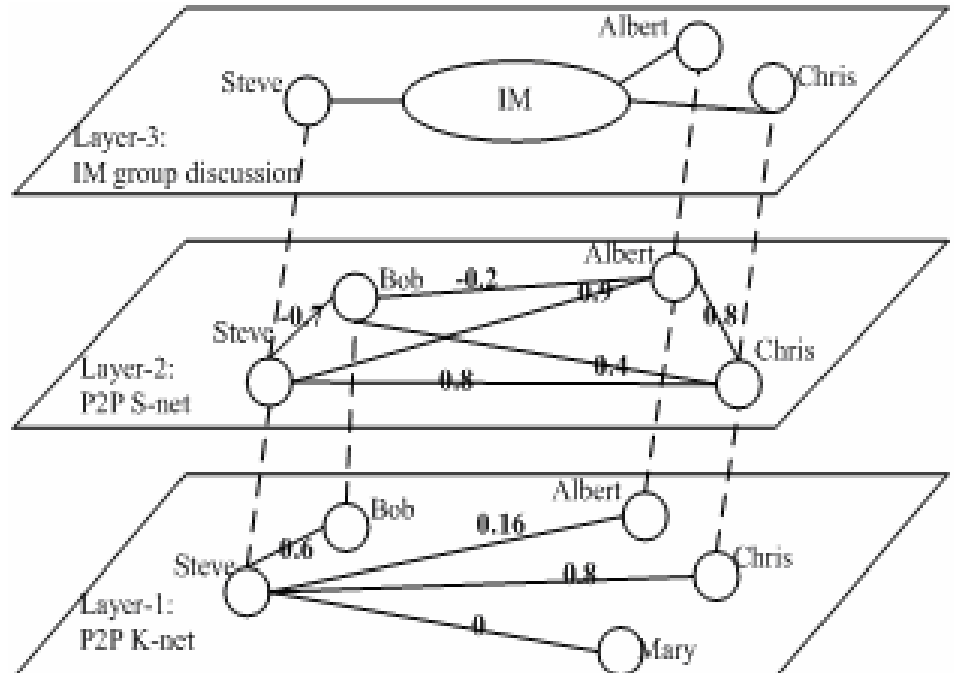
2. The P2P Social Net (S-net)
Once knowledgeable peers are found, they are filtered by Social Relationship Ties. This tie is a product of three variables:
- Social Familiarity: A scale from -1 to 1 (from negative relationships to close friends).
- Social Reputation: An average of how the rest of the network perceives the peer.
- Social Trust: Calculated using binomial probability sampling to provide a 95% confidence interval of trustworthiness based on past interactions.
3. Group Discussion Layer
The final layer invokes communication tools (like Instant Messenger) only for those peers who passed both the knowledge and social filters, ensuring high-quality interactions.
Experiments and Results
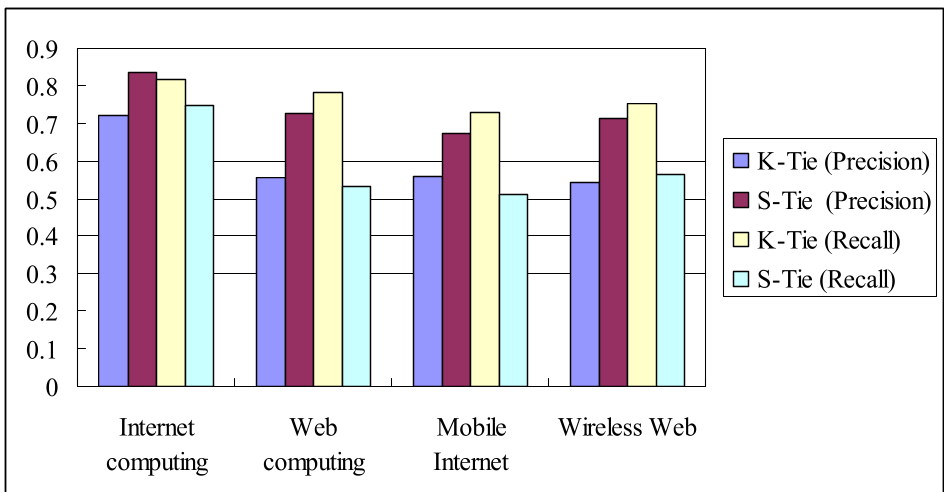
The researchers tested their model across four domains: Internet Computing, Web Computing, Mobile Internet, and Wireless Web.
- Precision (S-Tie Wins): Searching by Social Relationship Ties yielded higher precision. When you search via social links, the people you find are much more likely to be relevant and willing to respond.
- Recall (K-Tie Wins): Searching by Knowledge Relationship Ties has higher recall. If you only look for expertise, you find more "total" experts, but many may be strangers or unwilling to collaborate.
Critical Insight & Conclusion
The genius of this paper lies in its recognition that expertise is meaningless without social accessibility. By quantifying "Social Trust" and "Knowledge Proficiency" as matrix-based relationship ties, the authors moved P2P search from a data-retrieval task to a human-centric discovery task.
Limitations & Future Work
While robust, the model relies on users "filling forms and answering questionnaires" to establish initial familiarity. In a modern context, this could be automated using graph mining on existing social media interactions. Future research should look into "collaboration context"—finding the right person for a specific moment or specific task intensity.
Takeaway for Practitioners
If you are building a platform for enterprise collaboration or expert networks, don't just index "skills." Index "Social Capital." A moderately skilled expert who is highly trusted is often more valuable to a community than a world-class expert who is socially isolated.