
Bridging the Gap: Transforming Hidden Rural Charms through Targeted Digital Advertising
Effect of Web Advertisement for Finding Target Users Interested in Rural Areas
This paper proposes a digital strategy to revitalize rural Japan by identifying "implicit local charms" and transforming them into "explicit charms" using a combination of mobile application systems, web advertising, and SNS. The study introduces a seven-step "Local Charm Finding Cycle" and validates its effectiveness through targeted advertising experiments in Shizukuishi, Iwate Prefecture.
TL;DR
Rural areas in Japan are facing an existential crisis due to depopulation. This paper argues that the solution lies in "Implicit Local Charms"—valuable cultural assets known only to locals. By moving from passive mobile apps to an active, data-driven Targeted Advertisement Model, the researchers demonstrate how to identify specific high-interest user groups (e.g., women over 45) to drive tourism and economic recovery.
Background: The Failure of Passive Digital Tourism
Most rural revitalization projects fail because they assume that "if you build an app, they will come." The authors initially developed several prototype systems:
- UFFST: A university food-finding app for Tokyo.
- IFFS: A regional food-finding app for Iwate.
- RQS: A quiz system based on post-earthquake recovery.
Despite initial interest, downloads plummeted quickly. The diagnosis? These were passive services. They only catered to people who were already looking for them. To solve this, the researchers shifted their focus to an active model that uses the web's advertising infrastructure to find "Target Users" who don't yet know they want to visit these areas.
Methodology: The Local Charm Finding Cycle
The core of the paper is a transition from the "Previous System" (Travel agents pushing famous spots) to a new "Active Cycle."
The Seven-Step Model
- Resident Discovery: Locals document "implicit charms."
- Visitor Contribution: Non-residents add their experiences to a database.
- Ad Delivery: Linking this database to SNS and Search Engines.
- Target Engagement: Interested users click the ads.
- Log Analysis: Analyzing profiles to refine the "Target User" persona.
- Actionable Planning: Refined ads lead to actual travel plans.
- SNS Check-in: Physical visits reinforce the database.
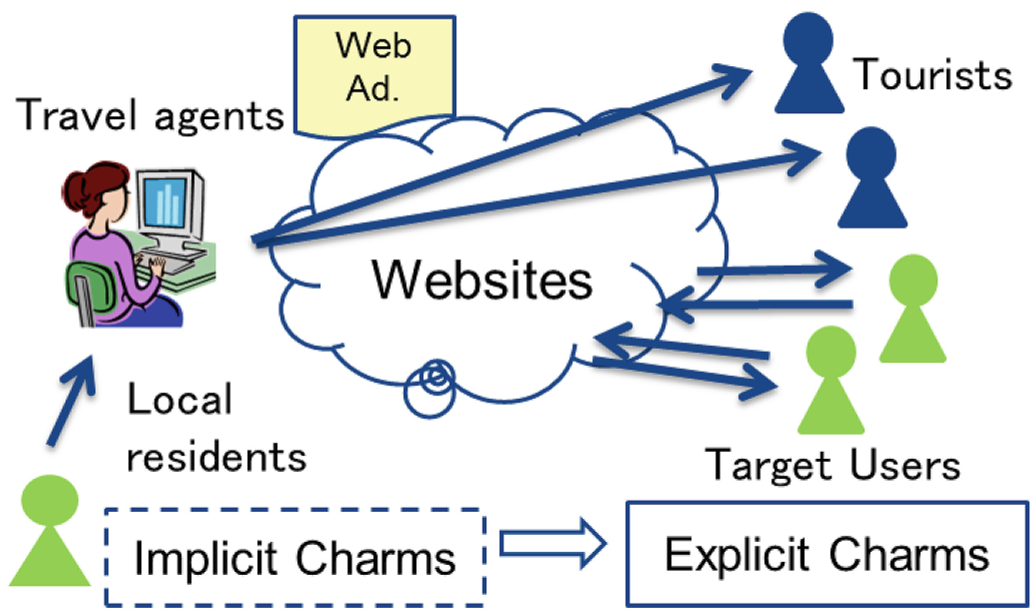 Above: The proposed approach of using Web advertising to bridge implicit charms and target users.
Experiments: Finding the "Who" in Shizukuishi
The team ran a 28-day pilot project for "Shizukuishi Cottage Village," a rural residential sales project. They used three major channels:
- Facebook Advertising (Social Targeting)
- Yahoo! Sponsored Search (Keyword-based Listing)
- Yahoo! Display Ad (Interest Match)
Deconstructing the Results
The study utilized Click-Through Rate (CTR) as the primary metric. Surprisingly, the data revealed a very specific demographic profile that traditional marketing might have overlooked:
- Geographic Surprise: While they aimed for nationwide reach, the majority of visitors were already from the local Iwate Prefecture.
- Demographic Peak: The highest engagement (highest CTR) came from the over-45 age group.
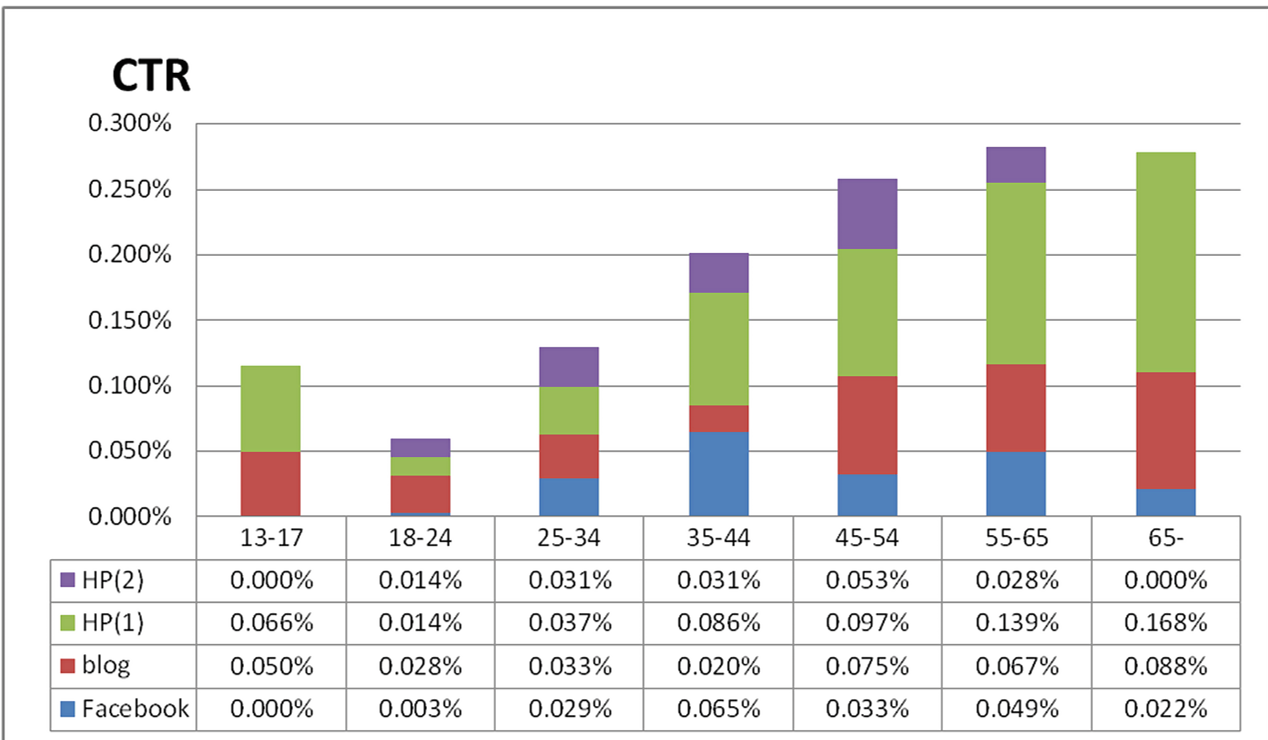 The data clearly shows that the "Local Charm" content resonated most with older demographics, providing a clear path for future budget allocation.
Critical Insights & Conclusion
The true value of this research isn't just in "getting clicks," but in the feedback loop of user identification.
- Implicit to Explicit: The study provides a framework for digitizing cultural heritage that isn't yet "famous."
- Data-Driven Personas: By analyzing CTR across different platforms, local governments can stop wasting budget on broad "metropolitan" ads and focus on "near-local" demographics who are more likely to convert into visitors or residents.
Limitations & Future Work
The study's budget was relatively small (300 yen/day), which limited the scale of the data. Furthermore, while they increased web traffic, the link between a "click" and a "physical visit" remains a challenge to track perfectly. Future research needs to integrate O2O (Online-to-Offline) tracking—perhaps via GPS or coupon redemption—to prove the economic ROI of these digital charms.
Takeaway: To save rural areas, don't just build an app; build a data-refining engine that knows exactly who your "hidden gems" are for.